Massage guns for muscle recovery are sold on a number that barely matters. The box prints strokes per minute in enormous type, and strokes per minute on its own tells you almost nothing about how the tool behaves when you lean into a loaded quad. What matters is how deep the stroke travels and how much pressure the motor tolerates before the percussive action stalls out.
That gap between the marketing and the mechanics is where most buyers get stuck. Someone coming off a long ride, a heavy lifting session, or a week of desk work ends up comparing four guns with near identical sounding specs and no way to tell which one will actually move blood through a muscle belly and which one will just buzz the surface.
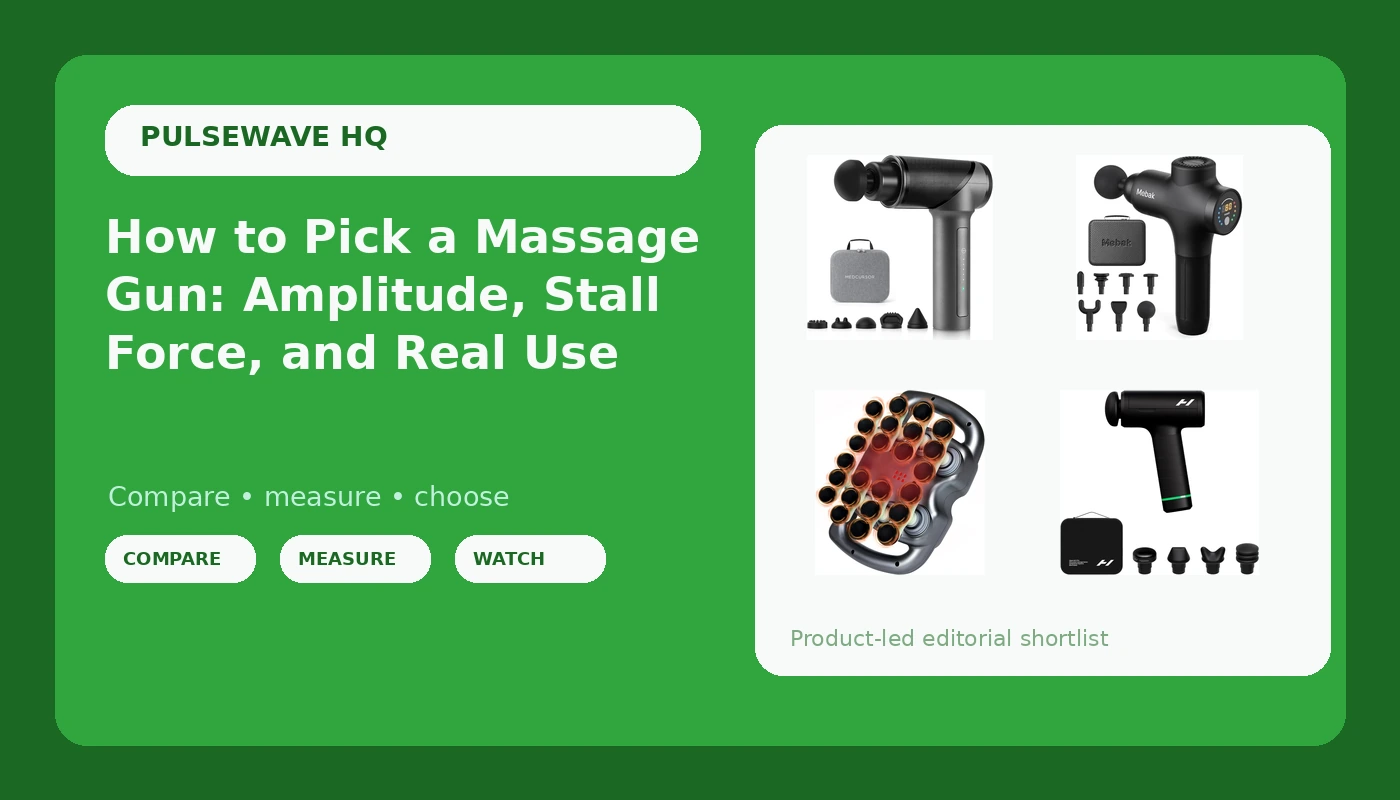
This guide explains the specs that predict real world behavior, then walks through four options at four price points: a heated premium gun with a carry case, a mid range model aimed at athletes, a kit built around 24 attachment heads, and an inexpensive handheld. None of these treat an injury. Percussion therapy is a recovery and warmup tool, and the real goal is picking the one you will keep reaching for.
Related: Massage Gun Amplitude and Stall Force Explained →
Quick answer
Amplitude and stall force decide whether a massage gun does useful work. Amplitude is stroke depth in millimeters, and stall force is how much pressure the motor takes before the stroke quits. A gun with a shallow stroke and a weak motor will buzz the surface of a muscle and give up the moment you press into it. Noise and battery life decide whether you keep using it after the novelty wears off. The four options below cover a heated premium model with a carry case, a mid range gun marketed to athletes, a set organized around 24 attachment heads, and a low cost handheld. Choose based on how much pressure you plan to apply and where you plan to use it, not on the biggest number on the box.
Four useful options
| Model | Best fit | What stands out |
|---|---|---|
| Hyperice Hypervolt 3 Pro Percussion Massage Gun Heated Head Carry Case | Buyers who want a premium gun with a heated attachment and travel storage | Heated head plus an included carry case |
| Mebak 3 Massage Gun Deep Tissue, Muscle Massager for Athletes Pain Relief | Athletes who want a mid range deep tissue gun | Deep tissue percussion positioned for athlete recovery |
| 24 Head Massage Gun Set, Massager Gun Deep Tissue, Back Massager | Buyers who want the widest range of attachment shapes | 24 interchangeable heads in one set |
| Medcursor Massage Gun with High Intensity Brushless Motor and 6 Massage Heads (Gray) | First time buyers and lighter daily use | Brushless motor with six massage heads at an entry price |
Premium option: Hyperice Hypervolt 3 Pro Percussion Massage Gun Heated Head Carry Case
The heated head is worth thinking about separately from the percussion. Warmth before you work on a stiff muscle can make the tissue feel more comfortable to move through, and having that built into the same tool saves you from packing a separate heat source. The carry case matters more than people expect, because a gun that lives loose in a gym bag tends to lose its heads and pick up trail dust.
The trade off is price. Heat and a case are conveniences rather than capabilities that change how the motor performs, so if you only want a gun for post ride quads, the gap between this and the mid range option below is hard to justify. If you travel with your recovery gear, or you want heat and percussion in a single device, the bundle starts to make sense.
Mid range option: Mebak 3 Massage Gun Deep Tissue, Muscle Massager for Athletes Pain Relief
This is the middle of the range, and the middle is often where the sensible answer lives. You are not paying for a heated head or a hard case, and you are not scraping the bottom of the price ladder either. A gun in this bracket is usually built around one job: getting a large muscle group loose before or after training.
That focus is also the limitation. A standalone gun with a small head selection asks you to work with what is in the box, and if you like changing contact shapes for different areas, the next option offers far more of that. What you get in return is simplicity and a lower bill than the premium pick.
Attachment heavy option: 24 Head Massage Gun Set, Massager Gun Deep Tissue, Back Massager
Head shape changes how a gun feels more than most people expect. A rounded ball head spreads pressure across a broad area like a quad or a glute, while a narrower head concentrates it on a smaller patch of tissue. On a curved area such as the calf or the upper back, the right shape is the difference between a stroke that lands cleanly and one that skitters off the side.
What head count cannot do is make a shallow motor push deeper. Attachment variety is a comfort and coverage feature, not a depth feature. Buy this set because you know you will swap heads and you want the options on hand, not because 24 pieces sounds like more power.
Entry level option: Medcursor Massage Gun with High Intensity Brushless Motor and 6 Massage Heads (Gray)
Entry price guns are where the stall force question matters most, because that is the spec budget hardware usually trims first. The practical version of the test is simple: press the gun into a relaxed muscle and see whether the stroke keeps tapping or fades into a dull vibration. On shoulders, calves, and forearms at moderate pressure, a lighter motor is usually fine. On a heavy quad with your full body weight behind it, a light motor may slow noticeably or stop.
If your routine is a few minutes on the shoulders after a desk day, this class of gun covers it at a fraction of the premium price. If you are chasing deep work on big leg muscles, this is not the tool for that job, and the mid range or premium options are the ones to compare instead.
Prices and availability may change. Check the retailer listing for current details before you buy, and treat any spec or feature claim as something to verify on the product page.
Amplitude and stall force: the two specs that matter
Amplitude is stroke length, measured in millimeters, and it describes how far the head travels in and out with each tap. Roughly, 10mm is a light, surface oriented stroke, while 16mm reaches into the deep tissue territory people associate with a serious gun. Amplitude is the reason two guns with identical stroke rates can feel completely different: one thumps, the other tickles.
Stall force is the other half of the story, and it is the spec most listings never print. It describes how much pressure the motor can absorb before the percussive stroke stops. A gun with a strong motor keeps tapping when you lean into a hamstring. A gun with a weak motor turns into a vibrating brick the moment you add body weight.
The two specs work together. Deep amplitude without stall force means a stroke that collapses under pressure. High stall force with shallow amplitude means a gun that keeps running but never reaches past the surface. Neither number is useful alone, and neither can be replaced by a large RPM figure on the front of the box.
Noise, battery, and the specs that decide daily use
Noise is the most underrated spec in this category. A gun that rattles the room is a gun you stop using, no matter how strong the motor is. Brushless motors tend to run quieter and smoother than brushed motors at the same speed, which is one reason the term shows up so often in listings. Whatever the claimed decibel figure, the number that matters is how the gun sounds at the speed you actually use, which is usually the middle of the range, not the top.
Battery life is the second underrated spec, and the honest way to read it is in sessions rather than hours. A gun that gives you five or six twenty minute sessions between charges covers a normal week of training and recovery. A gun that needs a charge after every second session will end up sitting in a drawer.
Two more practical points. First, attachment shape affects coverage as much as motor power does, so a small set of well chosen heads beats a big pile of near duplicates. Second, percussion is for muscle bellies only. Stay off bone, joints, and the spine. That is not fine print, that is anatomy, and it is the fastest way to make a useful tool feel unpleasant.
When you are comparing options, work through the decision in this order:
- Decide where you will use it most: legs after training, shoulders after desk work, or a mix of both.
- Estimate how much pressure you plan to apply, since that determines how much stall force you need.
- Pick a target amplitude based on the muscle size you work on most, roughly 10mm for light use and up to 16mm for large muscle groups.
- Check how loud the gun runs at its middle speed, because that is the setting you will live on.
- Compare the attachment set last, once the motor and the stroke already fit your use.
Practical guidance
- Start on the lowest speed and work up. Most people settle in the middle of the range, and higher speeds are not automatically better for recovery.
- Keep the head moving over the muscle belly rather than parking it in one spot, and spend a minute or two per area.
- Use it before training as a warmup tool and after training as a recovery tool, not as a substitute for sleep, food, and hydration.
- Test the stall behavior in the store or during the return window by pressing the gun into a relaxed thigh and watching whether the stroke holds.
- Skip the app gimmicks when you compare. Anything that gates basic speed control behind a subscription is a reason to look elsewhere.
Which option should you choose?
Choose the Hyperice Hypervolt 3 Pro Percussion Massage Gun Heated Head Carry Case when you want heat and percussion in one tool and you travel with your recovery gear. Choose the Mebak 3 Massage Gun Deep Tissue, Muscle Massager for Athletes Pain Relief when you want a focused deep tissue gun for post training legs without paying for extras. Choose the 24 Head Massage Gun Set, Massager Gun Deep Tissue, Back Massager when attachment variety matters because you work on several different areas and want the right shape for each. Choose the Medcursor Massage Gun with High Intensity Brushless Motor and 6 Massage Heads (Gray) when your use is light, regular, and mostly on smaller muscle groups at moderate pressure.
One caveat on all four: the listings describe features, not performance under load. Amplitude and stall force are the numbers that predict how a gun feels when you press it into a working muscle, and where a brand does not publish them, the return window is your testing period. Percussion is a recovery and warmup tool. If something hurts in a way that persists, that is a conversation for a clinician, not a massage gun.
The bottom line
The right massage gun for muscle recovery is the one whose stroke depth and motor strength match the muscles you actually work on and the pressure you actually apply. Premium options like the Hyperice Hypervolt 3 Pro add heat and a carry case, mid range guns like the Mebak 3 focus on deep tissue work for athletes, the 24 head set leans into attachment variety, and the Medcursor gun keeps the entry price low with a brushless motor and six heads. None of them will fix an injury, and all of them are more useful than the spec sheet suggests when you pick the one that matches your routine.