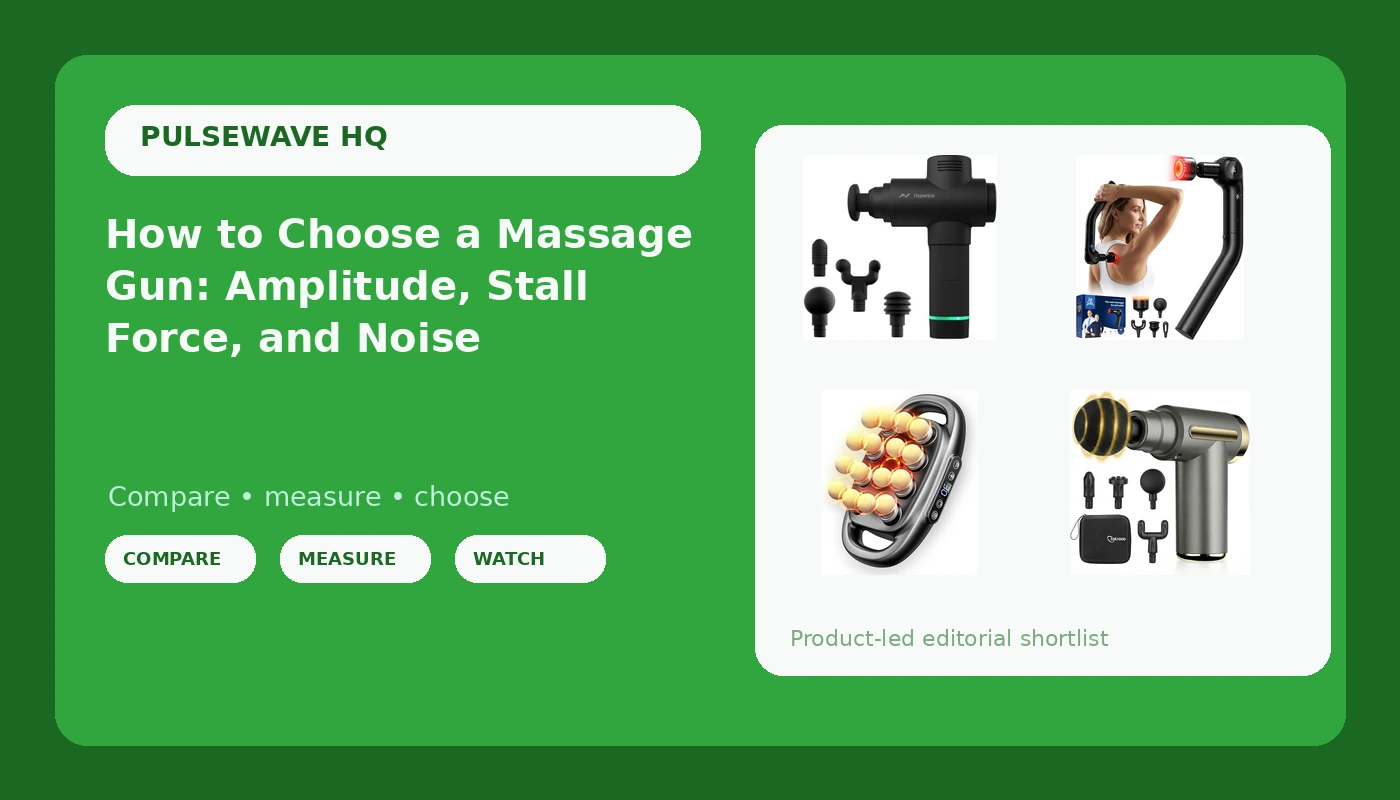
Walk into any gym and you will see three people holding three different massage guns, each convinced theirs is the one that works. The marketing does not help. Boxes shout about RPM, apps, and vaguely "therapy-grade" motors while burying the two numbers that decide whether a device does anything useful for you. If you are shopping for a massage gun for muscle recovery, the questions worth asking are narrower than the category suggests. How far does the head travel with each stroke? How much pressure can the motor absorb before the stroke stalls out? How loud is it at the speed you will actually use? Everything else, the color, the case, the Bluetooth pairing, the head count, is secondary. This guide explains those specs in plain language, then lines up four current options at very different points on the price and feature spectrum so you can match the tool to the job.
Related: How to Use a Massage Gun Without Bruising Yourself →
Quick answer
For most people the deciding specs are amplitude (stroke length in millimeters) and stall force (how much pressure the motor takes before the stroke stops), not RPM. If you want a mainstream deep-tissue tool from a name you already know, the Hyperice Hypervolt 2 is the safest pick here. If you want extras, the Bob and Brad L7 Ultra adds heat, red light, and an extension handle for reaching your own back. If you want the most head shapes for the smallest commitment, the 16 Head Massage Gun is the head-count pick. If you need something that fits in a gym bag or a desk drawer, the Jancane Mini is the compact one.
Four useful options
| Model | Best fit | What stands out |
|---|---|---|
| Hyperice Hypervolt 2 Handheld Percussion Massage Gun Deep Muscle Tissue | Buyers who want a mainstream deep-tissue percussion tool | Recognizable brand and a simple handheld percussion design |
| BOB AND BRAD L7 Ultra Massage Gun with Heat, Red Light & Extension Handle | Buyers who want extras and a handle that reaches the back | Heat, red light, and an extension handle in one kit |
| 16 Head Massage Gun Deep Tissue - 2026 Upgrade Back Muscle Massager | Buyers who want maximum head shapes for the money | 16 interchangeable heads, positioned for back and deep tissue work |
| Jancane Mini Massage Gun with Case, Deep Tissue Muscle Massager with 6 Speeds & 4 Heads, Super Quiet Handheld Percussion Massager for Pain Relief, Athletes, Office Workers & Parents, Portable Gift | Travel, desk, and gift use | Mini form factor with a case, 6 speeds, and 4 heads |
The mainstream deep-tissue pick: Hyperice Hypervolt 2
What you are buying here is a known quantity and a simple deep-tissue percussion tool. The trade-off is feature count: there is no heat, no red light, and no extension handle, so reaching your own upper back means the same shoulder contortions you would face with any standard gun. If those extras matter to you, they exist on the Bob and Brad L7 Ultra below. If what you want is a recognizable handheld percussion gun for large muscle groups and you would rather not spend time researching brands you have never heard of, this is the most established option in this group.
The feature-loaded mid-range pick: BOB AND BRAD L7 Ultra
The extension handle is the feature I would weigh most heavily, because it solves a geometry problem rather than adding a novelty. Reaching your own mid-back with a standard gun is awkward at best and a shoulder strain at worst, and a handle changes that. Heat is a warmup convenience, not a substitute for actually warming up, and you should expect to wait for the head to come up to temperature before you start. More features also mean more parts that can fail, so treat the extra electronics as a bonus rather than the reason to buy.
The head-count value pick: 16 Head Massage Gun
Sixteen heads is a lot of heads, and honesty matters here: most people rotate through three or four shapes and leave the rest in the case. A flat head, a round head, a bullet head for smaller spots, and one firm head for big muscle bellies cover nearly everything. The head count is not a downside, it is just not the spec that determines whether the gun works on your quads. Judge this one on whether the stroke holds up under your own hand pressure, and treat the extra heads as a bonus for the days you want a different shape on your calves or feet.
The compact travel pick: Jancane Mini
Mini guns trade depth for portability, and that trade is worth making only if portability is your actual problem. A compact gun is a reasonable desk companion, a sensible travel item, and a low-risk gift. It is not the tool for loosening a 30-mile ride's worth of quads, because small motors and short strokes run out of travel exactly where big muscle bellies need it most. On the quiet claim: quiet at speed one and quiet at speed five are very different things, so test the setting you would actually use rather than the lowest one.
Prices and availability may change. Product images, names, and retailer links are matched to verified listings. No current price, rating, stock status, or measured result is stated here without current evidence.
Amplitude and stall force, explained without the box copy
Amplitude is stroke length, measured in millimeters: how far the head travels with each percussive stroke. A 10mm stroke is a light surface tap, useful for warmups and smaller areas like forearms and feet. A 14mm to 16mm stroke reaches deeper into large muscle bellies like quads, glutes, and hamstrings, which is where most people actually want the tool to work. RPM, the number printed largest on most boxes, is strokes per minute. Without amplitude behind it, a high RPM figure just means the gun is tapping quickly on the surface.
Stall force is the spec almost nobody publishes. It describes how much pressure the motor can absorb before the stroke stops moving. Every percussion gun has a ceiling, and cheap motors hit it early. You notice it the first time you lean into a tight hamstring and the head stops thumping and starts buzzing. At that point you are holding an expensive vibration device. Since stall force rarely appears in a listing, test it yourself: press the head into your palm at the pressure you would use on your own leg and see whether the stroke keeps going. That single check tells you more than the entire product description.
Matching a gun to your body, your sport, and your noise tolerance
Start with the muscle groups you will actually treat. Cyclists and runners tend to live in their quads, calves, glutes, and hamstrings, which are large and dense and reward more amplitude. Desk workers and people treating forearms, hands, and feet need less depth and more precision, which is where a smaller head and lighter gun win. A massage gun is a recovery and warmup tool. It does not fix an injury, and it does not replace sleep, hydration, or actual training load management.
Noise deserves more weight than it usually gets. A gun you avoid using because it sounds like a blender is a paperweight no matter how much you paid for it. Check noise at the speed you would realistically run, not the quietest setting. Battery claims deserve the same skepticism: a 20-minute session is normal, so a gun that needs charging every few days is a hassle, and lab numbers measured on low speed do not translate to real use.
- Identify the two or three muscle groups you will treat most often and how large they are.
- Decide the minimum amplitude that reaches those groups rather than buying for the biggest number on the shelf.
- Press the head into your palm at working pressure to see whether the stroke stalls before you commit.
- Run the gun at your realistic speed and judge the noise, not the demo setting.
- Check head compatibility, case, and warranty, since these decide whether the gun survives a year in a gym bag.
Practical guidance before you buy
- Keep the head on muscle bellies only. Never on bone, joints, or the spine. That is anatomy, not fine print.
- Treat it as a recovery and warmup tool, not a treatment device. It helps your body do the fixing, it does not do the fixing.
- Use light pressure and let the amplitude do the work. Leaning in hard is what stalls cheap motors and bruises tissue.
- Buy from a listing with a return window so you can test stall force and noise at home, on your own muscles.
- Match the form factor to where the gun will live. A tool that stays in the closet helps nobody, and a mini that travels with you beats a full-size that never leaves the house.
Which option should you choose?
Choose the Hyperice Hypervolt 2 Handheld Percussion Massage Gun Deep Muscle Tissue when you want a mainstream deep-tissue percussion tool from a name you recognize and you do not need extras. Choose the BOB AND BRAD L7 Ultra Massage Gun with Heat, Red Light & Extension Handle when you want heat, red light, and, most importantly, a handle that lets you reach your own back without help. Choose the 16 Head Massage Gun Deep Tissue - 2026 Upgrade Back Muscle Massager when you want the widest range of head shapes and a gun positioned for back and deep tissue work. Choose the Jancane Mini Massage Gun with Case, Deep Tissue Muscle Massager with 6 Speeds & 4 Heads, Super Quiet Handheld Percussion Massager for Pain Relief, Athletes, Office Workers & Parents, Portable Gift when portability is the whole point, whether that means a carry-on, a desk drawer, or a gift for someone who would never buy one for themselves.
One caveat that applies to all four: none of these listings publishes a measured stall force, and amplitude figures are not always stated plainly. Treat any claim about depth, quietness, or power as unverified until you have the gun in your hand and a return window open behind you.
The bottom line
The massage gun category rewards patience more than budget. Amplitude and stall force decide whether a gun does real work on a big muscle belly, RPM is decoration, and noise decides whether the thing ever leaves the case. If you want a familiar name and a simple deep-tissue tool, the Hyperice Hypervolt 2 covers that. If you want more features for less, the Bob and Brad L7 Ultra brings heat, red light, and a back-saving handle. The 16 Head Massage Gun wins on head variety, and the Jancane Mini wins on being the one you will actually pack. Pick the one that matches the muscles you train and the bag you carry, then test it under your own hand before the return window closes.