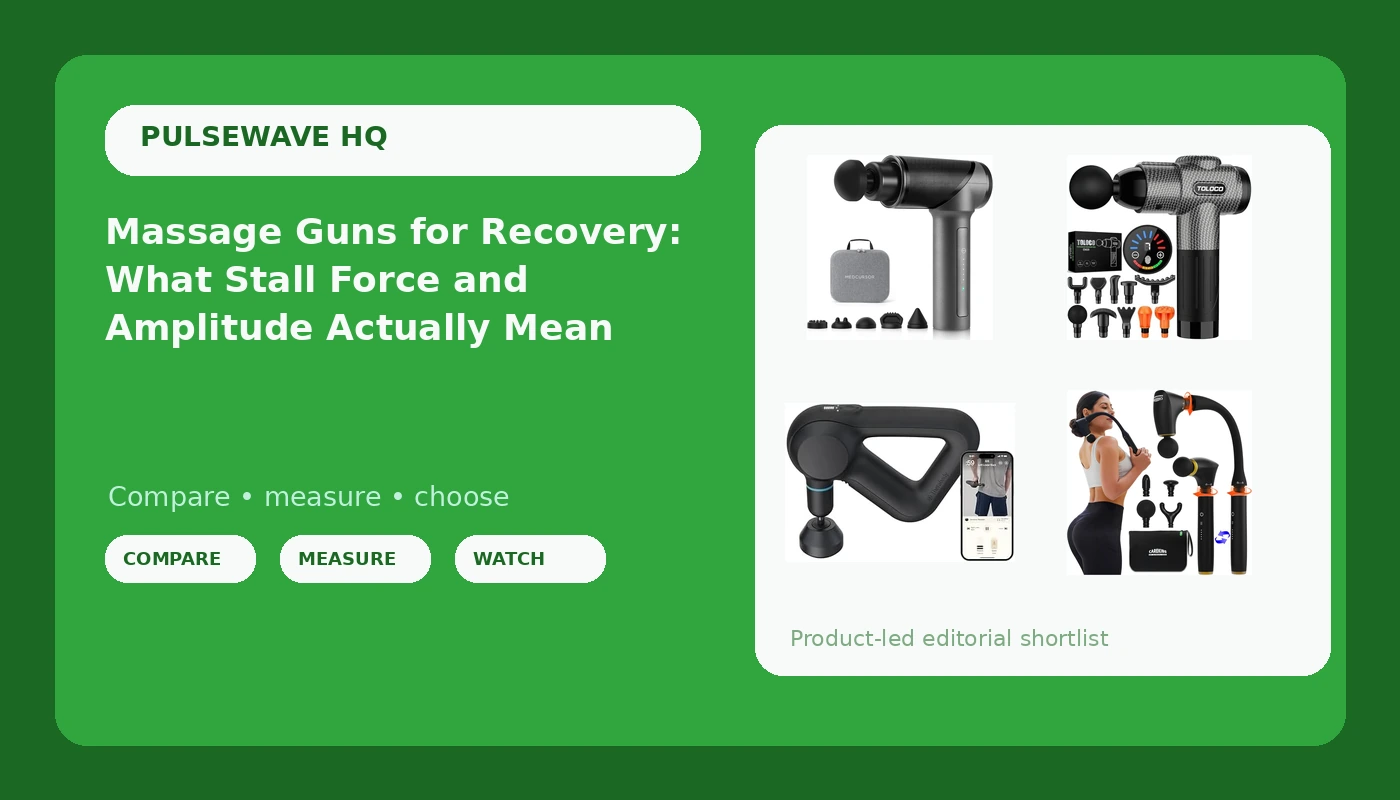
Massage guns for recovery have moved out of the physical therapy clinic and onto the garage shelf, and that is mostly good news. Percussive therapy is a genuinely useful way to warm a muscle belly up before you load it and to get blood moving through it afterward. The bad news is the spec sheet. Every box in this category shouts about RPM, "therapy-grade" motors, and thirty speed settings, while the two numbers that decide whether a gun is worth carrying sit in the fine print or nowhere at all. This is an explainer rather than a ranking. Below you will find what actually separates a recovery tool from a buzzer, how to judge a gun you have never held, and how four current models differ in the ways that matter for a cyclist, a lifter, or someone who just wants looser shoulders after a long desk day.
Related: Massage Gun Recovery Protocol: How Long, How Hard, and Where Not to Press →
Quick answer
Buy for amplitude and stall force, not RPM. Amplitude is the stroke length in millimeters, meaning how deep the percussive thump reaches. Stall force is how much pressure the motor absorbs before the stroke stops moving. Neither number appears on most budget boxes, so the practical shortcut is matching the gun to the muscle you need to reach. A small handheld suits forearms, calves, and neck. A mid-size gun covers quads and lats. An extension handle or detachable head section lets you reach your own mid-back and hamstrings without recruiting a second person. If a listing gives you head count and motor type but no amplitude figure, treat it as a light-use tool and buy accordingly.
4 useful options
| Model | Best fit | What stands out |
|---|---|---|
| TheraGun Therabody Prime 5th Gen Deep Tissue Massage Gun | Buyers who want a single gun from an established percussive-therapy brand | A current-generation model in a well-known product line |
| TOLOCO Massage Gun | Anyone who wants the widest attachment set in this group | Ten interchangeable massage heads and a brushless motor described as silent |
| 2-in-1 Detachable Massage Gun Deep Tissue with Extension Handle | Mid-back, hamstrings, and other spots you cannot reach alone | A detachable head section plus an extension handle |
| Medcursor Massage Gun | A straightforward first gun or light-use handheld | High-intensity brushless motor and six massage heads |
The established brand pick: TheraGun Therabody Prime 5th Gen Deep Tissue Massage Gun
The trade-off with any established-brand gun is that you are paying partly for the name and the ecosystem rather than purely for specs per dollar. If your priority is the largest number of interchangeable heads in one box, the TOLOCO or the Medcursor gives you more attachments for the same job. If your priority is reaching your own upper back without help, the extension-handle model is the more useful shape. What this one offers instead is the least amount of homework: you are buying into a line that has been through five iterations, and you know what you are getting in terms of form factor and support. It is the option for someone who wants one gun, used the same way every time, without a comparison spreadsheet.
The multi-head all-rounder: TOLOCO Massage Gun, Deep Tissue Back Massage for Athletes, Percussion Massager with 10 Massage Heads & Silent Brushless Motor, Carbon
More heads only helps if you actually swap them. The honest version of this trade-off is that most people settle into two or three attachments, a ball for large muscle bellies and something flatter or more pointed for smaller spots, and the rest live in the case. That said, the head count matters more than it sounds when you are working on very different areas in the same session, because a head shaped for a quad is not the head you want on a calf or a forearm. The quiet motor claim is worth taking seriously for a different reason: a gun you avoid using at night because it is loud is a gun that stops earning its shelf space. Whether the noise holds up at the speeds you actually use is something only a product page or your own ears can tell you.
The reach extender: 2-in-1 Detachable Massage Gun Deep Tissue with Extension Handle
Reach is the most underrated spec in this category. The muscles people most want to work after a hard training block, the mid-back, the upper traps, and the hamstrings, are precisely the ones that are awkward to hit on yourself. The usual workarounds are asking someone else, contorting against a wall, or skipping the area entirely. An extension handle solves that problem directly, and that is a real functional difference rather than a marketing one. The trade-off is that a two-piece tool is more to carry and more to keep track of, and an extended handle gives you less fine control than a compact handheld. If your problem areas are all within easy arm's reach, you are paying for a feature you will not use.
The simple handheld: Medcursor Massage Gun, High Intensity Brushless Motor, Handheld Percussion Deep Tissue Massager with 6 Massage Heads (Gray)
The honest framing for a gun like this is that its job is general use, not deep tissue work on the largest muscles in the body. Six heads is plenty for a routine that touches calves, forearms, shoulders, and quads. Where a simpler handheld can fall short is exactly where the spec sheet goes quiet: when you lean into a dense quad or glute, a motor that cannot hold its stroke will stall, and the sensation changes from percussive to a buzzing hand. That is not a reason to avoid the category, it is a reason to set expectations. If your routine is a few minutes of light percussion after a run or a long day at a desk, this form factor does the job. If you are trying to work deep into big muscle groups, prioritize a published amplitude figure.
Prices and availability may change. Product images, names, and retailer links must be matched by verified ASIN. Do not state a current price, rating, stock status, or measured result without current evidence.
Why amplitude and stall force decide everything
RPM is the number brands print big because it is easy to inflate. It measures strokes per minute, and past a certain point more of them does not mean deeper work. Amplitude is the number that changes how a gun feels on a quad. A 16 mm stroke travels almost twice as far as a 10 mm stroke, and that extra travel is what lets the percussive wave reach deeper tissue instead of just buzzing the surface. Deep tissue work lives roughly in the 12 to 16 mm band. Anything under about 10 mm behaves more like a handheld vibration plate.
Stall force is the other half of the equation, and it is the one most listings hide. Stall force is how much pressure the motor absorbs before the stroke stops. It matters because you press a massage gun into a muscle, you do not hover it above one. On a dense muscle group like the quads or the glutes, a low-stall-force gun simply stops reciprocating the moment you lean in, and what you feel is a buzzing motor and a hand that has gone slightly numb. That is the difference between a recovery tool and a paperweight, and no head count makes up for it.
The two specs interact in a way that is easy to miss. A long stroke with a weak motor stalls even faster, because the motor has more distance to cover under load. A short stroke with a strong motor stays alive but never gets deep. The useful zone for real recovery work is a genuine long amplitude paired with a motor that keeps the stroke moving while you apply moderate pressure.
There is a third spec that almost never makes the box: noise. If a gun is loud enough that you avoid using it in the evening, its other specs stop mattering, because the best gun in your house is the one that actually gets used. Battery life follows the same logic. A device that needs a charge after every session is a device that ends up in a drawer.
How to judge a gun you have never held
Because the two numbers that matter are usually missing, the practical approach is to work backward from your own body and your own routine, then treat the remaining specs as tiebreakers.
- Name the muscle you need to work most often. Quads and glutes for cyclists and lifters, calves and forearms for runners, upper back and neck for desk work.
- Decide how deep you need to go. Large, dense muscle groups want the longest stroke you can find. Small muscles and bony areas do not.
- Check whether you can reach it alone. If your target is your mid-back or the far side of a hamstring, an extension handle or a detachable head section removes the contortion.
- Count the heads you will actually use. A ten-head kit is only useful if you know which three or four match your routine. The rest are case filler.
- Set a noise and battery expectation before you buy. If a listing does not describe how loud it is at the speed you will use, assume you will need to try it.
Practical guidance for using one safely
- Muscle bellies only. Never run the head over bone, joints, the spine, or the front of the neck.
- Keep the head moving. Holding a gun in one spot is how people bruise themselves.
- Use it before and after, not during. A couple of minutes before a ride or a lift is a warmup. A few minutes afterward is recovery.
- Let the gun do the work. Press in enough to make solid contact, not enough to stall the motor or dig into tissue.
- Skip it on anything acute. A fresh injury, swelling, or bruising is a reason to talk to a clinician, not to reach for a percussive device.
Which option should you choose?
Choose the TheraGun Therabody Prime 5th Gen Deep Tissue Massage Gun when you want a current-generation device from the brand that popularized percussive therapy, and you would rather buy once from a known product line than compare spec sheets. Choose the TOLOCO Massage Gun when you want the widest attachment set in this group and a brushless motor described as silent, so you can swap heads across different muscle groups in one session. Choose the 2-in-1 Detachable Massage Gun Deep Tissue with Extension Handle when your problem area is one you cannot reach comfortably on your own, such as the mid-back or the back of the thigh. Choose the Medcursor Massage Gun when you want a straightforward handheld with six heads for everyday soreness and stiffness rather than a sport-specific setup.
One caveat applies to all four. None of these product names publishes a measured stall force or amplitude figure, and that is exactly the information a serious buyer wants. Treat head count, motor type, and form factor as the verified differences here. If amplitude matters for your routine, look for it on the product page before you commit. A gun without a published amplitude is not automatically a bad gun, it is a gun you should expect to use lightly until you know more.
The bottom line
The bottom line on massage guns for recovery is that the category is simpler than the marketing suggests. You are buying a motor, a stroke, and a shape. The motor decides whether the stroke survives pressure. The stroke decides how deep the thump reaches. The shape decides whether you can get the head onto the muscle you care about. Everything else, including RPM counts, head counts, and app features, is secondary.
Within this group, the four models split along those lines rather than along a quality ladder. The TheraGun Therabody Prime 5th Gen is the established-brand single-gun option. The TOLOCO is the attachment-heavy kit with a brushless motor described as silent. The 2-in-1 Detachable is the reach extender for your own back and hamstrings. The Medcursor is the simple six-head handheld for everyday use. Pick the shape that fits your body and your routine, then check the amplitude on the product page and check current Amazon price before you decide.