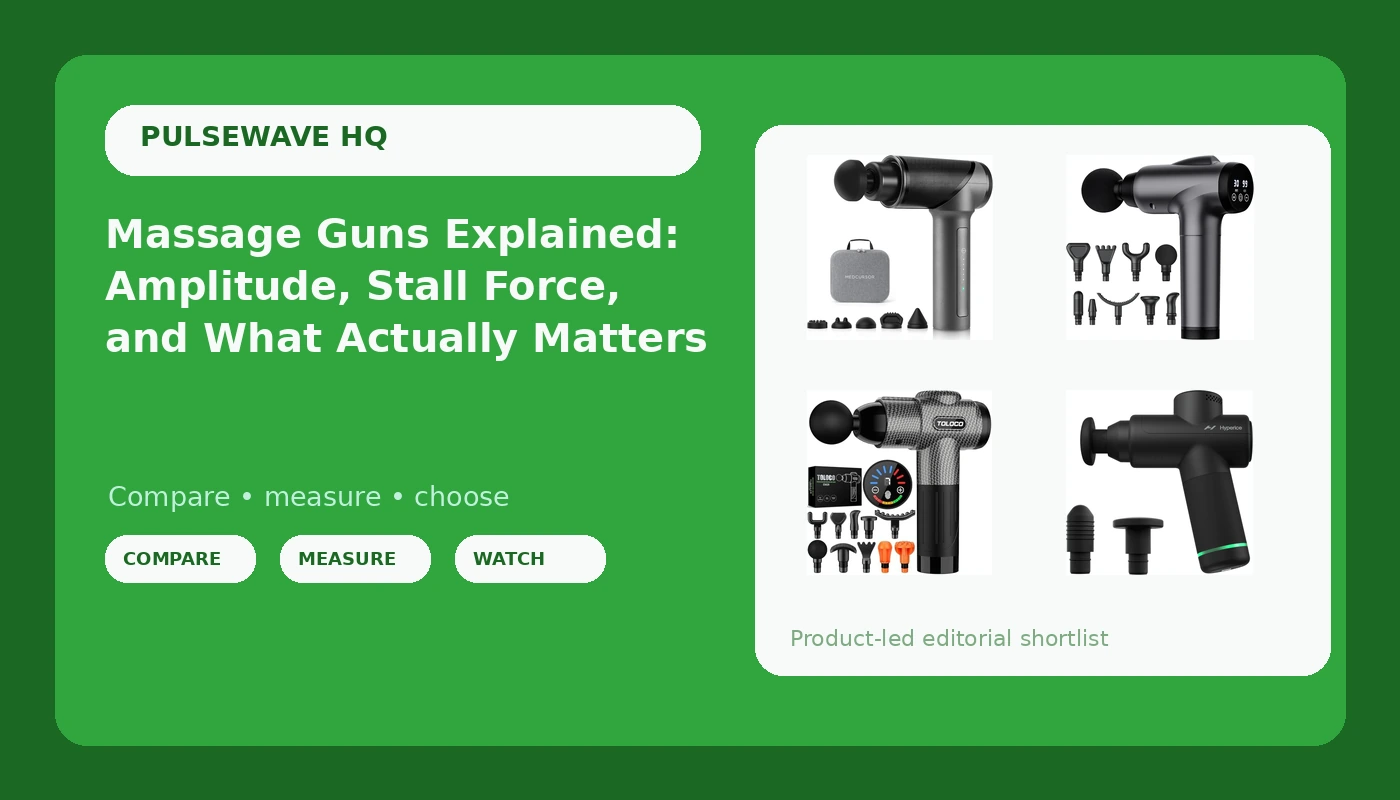
Somewhere along the way, the percussion massager stopped being a physical therapy office tool and became a gym bag staple. Now there are hundreds of them, and the marketing is nearly identical across the whole price range: big RPM numbers, "therapy-grade" claims, and a photo of an athlete mid-grimace. None of that tells you whether a deep tissue massage gun will actually do anything for your quads the morning after a long ride. This explainer covers what these tools are for, which specs decide whether they work, and how four current models fit different riders, lifters, and weekend warriors: a feature-loaded all-rounder, a premium compact, a budget starter, and a mid-priced brushless option.
Related: How to Warm Up Your Legs Before a Big Ride →
Quick answer
A massage gun is a recovery and warmup tool. It drives rapid percussive strokes into a muscle belly to get blood moving, loosen tissue before activity, and take the edge off soreness afterward. It is not a treatment device, and no amount of RPM changes that. When you compare models, look at amplitude (stroke length in millimeters), stall force (how much pressure the motor holds before the stroke quits), and noise at the speeds people actually use. Documented features and intended use separate the four options below, but manufacturers do not publish amplitude or stall force for every model, so verify those numbers before you commit.
4 useful options
| Model | Best fit | What stands out |
|---|---|---|
| TOLOCO Massage Gun | Riders and lifters who want a head for every body part | 10 interchangeable massage heads and a brushless motor the listing describes as silent |
| Hyperice Hypervolt Go 2 | Travel, small hands, and buyers who want an established recovery brand | Compact handheld percussion format for deep muscle tissue |
| OLsky Massage Gun | A first gun and a low-risk experiment | 30 speed settings and 9 attachments at the entry end |
| Medcursor Massage Gun | A middle path between budget and premium | High intensity brushless motor with 6 massage heads for sore muscle and stiffness |
The attachment-heavy all-rounder: TOLOCO Massage Gun
The trade-off with a kit this size is straightforward: more heads means more to keep track of, and most people end up using two of them. A large attachment count does not tell you anything about stroke depth, so the 10 heads are a convenience feature, not a performance spec. If you know you want a flat head for the quads, a ball head for the calves, and something smaller for the forearms, the TOLOCO covers all of it in one box. If you would only ever use the round head, you are paying for accessories. It is also clearly packaged as a gift, which says more about the listing than the hardware.
The premium compact: Hyperice Hypervolt Go 2
Compact guns make a specific trade: you give up some stroke depth and some motor headroom in exchange for something you will actually carry. That is a fair trade for a weekend trip or a race weekend, where the alternative is leaving the gun at home entirely. It is a worse trade if your main complaint is a pair of heavy quads that need a long, deep session, because a small gun has less room for a long stroke and less mass to absorb recoil. The Hyperice name also carries a premium at checkout, and the included attachment count is smaller than the budget options here. Decide whether portability or depth is the priority before you spend.
The budget entry point: OLsky Massage Gun
At the entry end of the market, the compromise is almost always the motor, not the accessory count. Thirty speeds sounds like a lot until you realize most people use two or three of them, and a speed dial cannot make up for a motor that quits when you lean into a hamstring. That is the specific failure mode worth watching for: the gun runs fine against your palm, then stalls the moment you press it into a big muscle. Before you trust any budget gun on a real session, press it into your palm at the speed you plan to use and see whether the stroke holds or turns into a buzz. If it holds, you got a bargain.
The mid-priced brushless option: Medcursor Massage Gun
Six heads is a reasonable middle ground: enough variety to cover a full leg session without a drawer full of attachments you will never touch. Brushless motors are generally quieter and more efficient than brushed ones, which matters more than most buyers expect, because the gun you use is the one that does not annoy everyone in the room. The thing to check on this one, as with the others, is whether the listing publishes an amplitude figure. A "high intensity" claim without a stroke length behind it is marketing. If the number is not there, ask before you buy, or accept that you are buying on faith.
Prices and availability may change. Confirm the current listing details, including included attachments and any published specs, before you buy. Nothing on this page is a current price, rating, stock status, or measured test result.
Amplitude and stall force: the two specs that decide everything
Amplitude is stroke length in millimeters, meaning how far the head travels in and out with each percussion. It is the difference between a tool that reaches deep tissue and a tool that tickles the surface. As a rough map: around 10mm is a light, surface-level stroke that works for warmups and smaller muscle groups; 12 to 13mm is the common middle ground and handles most recreational use; 14 to 16mm is deep tissue territory, the range that makes a difference on big quads, glutes, and calves. A gun with a short stroke can still feel intense, because intensity and depth are not the same thing. It just will not get where you want it on a large muscle.
Stall force is how much pressure the motor can take before the stroke stops cycling. This is the spec that separates a massage gun from a buzzer, and it is the one budget listings almost never print. Here is why it matters: you have to press a gun into a muscle to reach it. If the motor stalls the moment you apply that pressure, you are left with vibration against the skin, which is not percussive therapy. The practical test takes five seconds. Turn the gun on at a mid speed, press it into your palm like you would press it into a calf, and feel whether the thump continues or dies into a rattle.
Neither number is published for every model on this page, and that is the honest limitation of shopping online. Amplitude and stall force are not on the outside of the box the way RPM is. If a listing does not state them, treat the marketing language as unverified and decide based on the return policy.
Why RPM is the number that matters least
RPM, or strokes per minute, is printed large on nearly every box because it is a big number that looks like power. It means almost nothing on its own. A gun rated at 3,200 strokes per minute with a 6mm stroke is delivering a fast, shallow buzz. The same RPM with a 14mm stroke is a completely different tool. Speed is the seasoning, not the meal.
There is also a practical ceiling. Very high speeds on a lightweight gun tend to rattle the hand, and a gun that numbs your forearm is not one you will use for twenty minutes. Most people settle into a middle speed and stay there. When you evaluate a model, ask how loud it is at the speed you would actually run it, not at the top of the dial, because the top of the dial is usually the noisiest setting and the one you will avoid.
How to pick one in five steps
- Define the job. Recovery after long rides and lifting sessions needs more stroke depth than a five-minute warmup before a gym class.
- Find the amplitude. If the listing does not publish stroke length, assume it is short until proven otherwise.
- Press test the stall force. Palm press at a mid speed, and watch for the stroke quitting under load.
- Check the noise at your real working speed. A gun that is too loud to use in a shared room is a paperweight.
- Count the attachments you will actually use, then check the battery and app situation, because subscription-gated features are a deal breaker.
How to use one on a recovery day
- Stick to muscle bellies. Never bone, joints, or the spine. That is anatomy, not a legal disclaimer.
- Keep it moving. Glide slowly along the muscle rather than parking on one spot.
- Short sessions per area. A minute or so per muscle group is plenty for recovery work.
- Use it before and after. A quick pass before activity helps you warm up; a longer pass afterward helps you settle.
- Skip it on anything acute. Sharp pain, swelling, or a fresh injury is a reason to see a professional, not to reach for a percussion gun.
Which option should you choose?
Choose the TOLOCO Massage Gun when you want the widest attachment selection in one purchase and you like the idea of a dedicated head for every area. Choose the Hyperice Hypervolt Go 2 when portability and an established recovery brand matter more than stroke depth, or when the gun needs to fit in a travel bag. Choose the OLsky Massage Gun when you are buying your first gun and want to spend as little as possible to find out whether you will actually use one. Choose the Medcursor Massage Gun when you want a brushless motor and a middle attachment count without jumping to premium pricing.
The caveat that applies to all four: amplitude and stall force are the specs that determine whether a gun works for your body, and they are not published consistently across these listings. Verify them, or buy somewhere with a return window you are comfortable using.
The bottom line
A massage gun is a recovery and warmup tool, not a treatment device, and the right one for you is the one with enough stroke depth and enough motor to hold up under your hand, quiet enough that you will actually turn it on. Attachment counts and RPM figures are the easy things to compare and the least important. Pick the format that matches your life first (compact for travel, full-size for home sessions), then confirm amplitude and stall force before you commit. The best gun in this group is the one whose real specs you can verify and whose noise level you can live with on a Tuesday night.