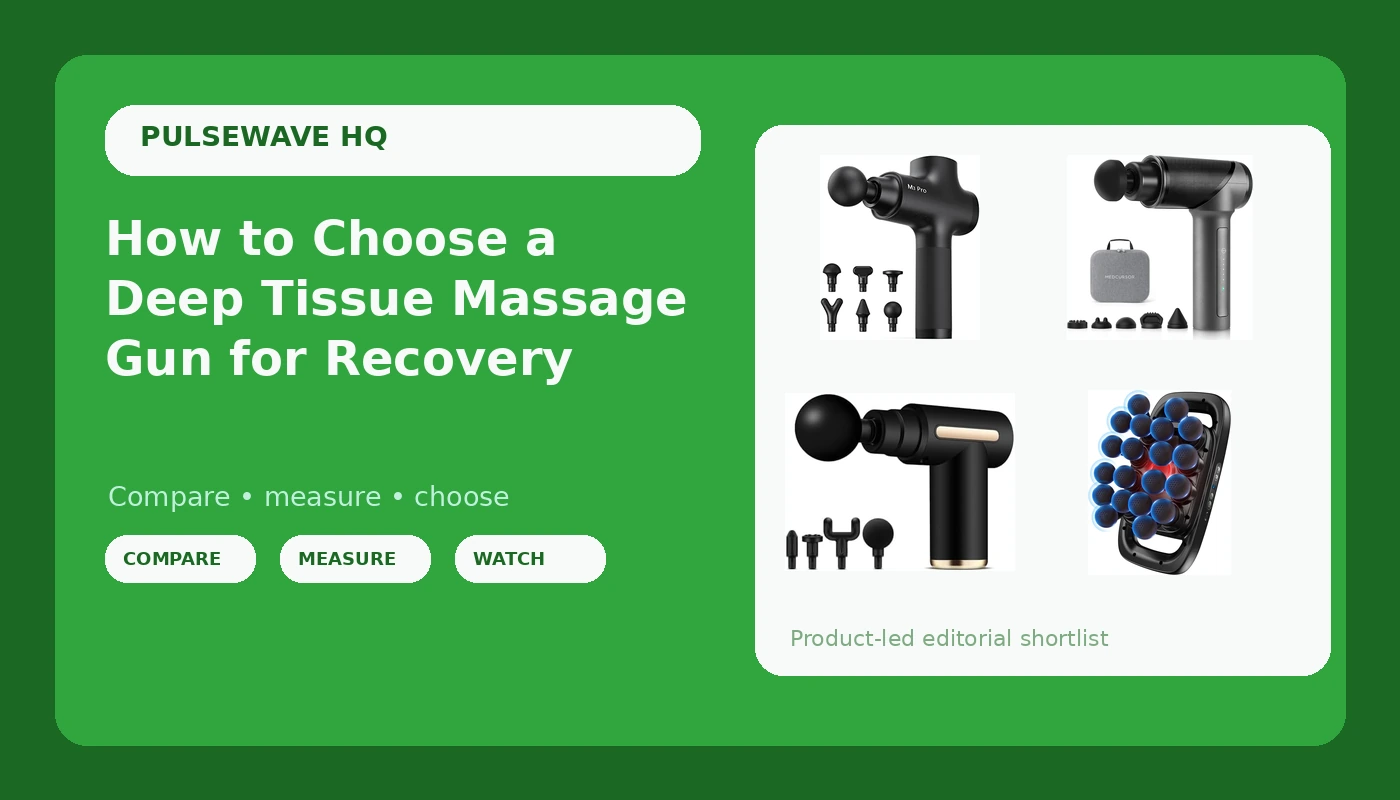
Most people shopping for a deep tissue massage gun end up comparing the numbers printed on the box: strokes per minute, speed levels, and how many attachments come in the case. Those numbers are easy to market and easy to misread. What actually decides whether a gun earns a permanent spot next to your gym bag is how far the head travels on each stroke, how much pressure the motor holds before the stroke stalls out, and whether the thing is quiet enough that you will genuinely use it while watching TV at 9 p.m. This explainer walks through four options available right now, what each one is built for, and how to match a gun to your body, your sport, and your training week.
Related: Massage Gun Amplitude vs RPM: Which Spec Actually Matters →
Quick answer
Match the gun to the job, not to the biggest number on the box. For large muscle groups like quads, glutes, and hamstrings, look for a longer stroke and a motor that keeps moving when you lean into it. For travel, a gym bag, or light daily maintenance, a compact handheld unit does the work without taking up space. The four factors worth weighing are stroke depth, how the motor behaves under pressure, noise at the speed you will actually use, and whether the battery survives a normal week of 15 to 20 minute sessions.
4 useful options
| Model | Best fit | What stands out |
|---|---|---|
| Opove M3 Pro 2 Massage Gun Deep Tissue for Workout Recovery, Black | Post-session work on large muscle groups | Presented specifically as a deep tissue tool for workout recovery |
| Medcursor Massage Gun - High Intensity Brushless Motor, Handheld Percussion Deep Tissue Massager with 6 Massage Heads for Sore Muscle and Stiffness (Gray) | Everyday soreness and stiffness | Brushless motor design paired with six interchangeable massage heads |
| 20-Head Massage Gun Deep Tissue Percussion Massager with 3 Modes | Buyers who want attachment variety | Twenty heads and three operating modes in a single kit |
| Portable Massage Gun Deep Tissue, Percussion Handheld Muscle Massager Tool, Ideal Gifts for Home & Travel (Black) | Travel, gifting, and first-time buyers | Compact handheld format described for home and travel use |
Recovery pick: Opove M3 Pro 2 Massage Gun Deep Tissue for Workout Recovery, Black
The case for a gun like this one is focus. It is presented as a deep tissue recovery tool, and that is the job it should be asked to do: a few minutes on the quads, glutes, or calves after a hard session. The trade-off is that a single-purpose percussion gun gives you fewer attachments to experiment with, so if you like swapping heads to match different muscle shapes, one of the multi-head kits below may suit you better. Verify the stroke length and motor details on the listing before you commit, since those are the two specs that decide whether deep tissue work actually feels deep.
Everyday all-rounder: Medcursor Massage Gun - High Intensity Brushless Motor, Handheld Percussion Deep Tissue Massager with 6 Massage Heads for Sore Muscle and Stiffness (Gray)
A brushless motor is worth understanding as a category, because it is one of the few design details that shows up in how a gun feels. Brushless motors are generally quieter and more efficient than brushed ones, though the exact noise and run time depend on the design, the speed setting, and how hard you press. Six heads is a practical number: a ball head for broad areas, a flatter head for bigger surfaces, and smaller heads for the areas around the shoulder blades or the forearms. If your soreness is mostly the end-of-week, everything-is-tight kind rather than sport-specific recovery, this is the shape of gun that fits that routine.
Attachment variety: 20-Head Massage Gun Deep Tissue Percussion Massager with 3 Modes
Twenty heads is a lot, and the honest read is that most people will use three or four of them. The value is in choice: different shapes suit different muscle groups, and three modes let you change the feel of the percussion without changing the gun. If you like gear that adapts and you do not mind storing a larger kit, this is the option built around that idea. If you want a simple tool you grab and use without thinking, the extras will spend their life in the case. Storage matters more than people expect, because a gun that is annoying to unpack gets used less often.
Travel and gift pick: Portable Massage Gun Deep Tissue, Percussion Handheld Muscle Massager Tool, Ideal Gifts for Home & Travel (Black)
Portability always costs something. A smaller body usually means a shorter stroke and a smaller battery, which is a fine trade for a gun that lives in a duffel bag or gets used on a weekend trip. For a first gun, a gift, or a backup that stays in the car, that trade makes sense. For heavy work on big muscle groups, a gun with a longer stroke is the better long-term pick. The useful question is not which gun is more powerful in the abstract, but which one will be within arm's reach when you actually need it.
Prices and availability may change. Product images, names, and retailer links must be matched by verified ASIN. Do not state a current price, rating, stock status, or measured result without current evidence.
Amplitude and stall force matter more than RPM
Amplitude is the stroke length, measured in millimeters. It is how far the head travels in and out on each cycle, and it is the number that decides whether a gun feels like a deep thump or a surface buzz. A short stroke at high speed produces a fast, shallow vibration that mostly tickles the skin. A longer stroke at a moderate speed drives the percussion into the muscle belly, which is where the temporary relaxation and the blood flow response come from. When people say a gun "feels cheap," they are usually describing a short stroke, not a weak motor.
Stall force is the second number that rarely appears on a box. It is how much resistance the motor can push through before the stroke stops moving. Every gun feels powerful when it is running in the air. The difference shows up the moment you press it into a loaded quad or a tight calf: a weak motor slows, then stops, and you are left holding a vibrating handle against your leg. A gun that stalls on real muscle is not doing much for that muscle, which is why a cheap gun can feel fine in the store and useless after a long ride.
RPM, strokes per minute, is the spec brands print largest. On its own it tells you very little, because a high stroke count with a short amplitude is still a shallow tool. Treat RPM as the least important of the three numbers, and treat stroke length and how the motor holds under pressure as the two worth researching before you buy. If a listing does not mention stroke length at all, that is information too.
Match the gun to your training week, not to the product page
Think about where the gun will live. If it stays on a shelf next to the foam roller and comes out after every hard session, size and weight matter less than stroke depth and how the motor behaves under load. If it rides in a backpack or a jersey pocket, portability and a case that survives being tossed around matter more, and you accept a shorter stroke as the trade. Buying for the wrong location is the most common mismatch, because a great home gun that never leaves the house is not a great travel gun.
Then think about noise. Percussion guns get used in apartments, shared houses, and clinic rooms, often in the evening. A gun loud enough to be annoying gets used less, and a tool you avoid is a tool that does not help you. If you can, listen to a demo or read owner reports about noise at the middle speeds, not just at the lowest setting, since that is where most people actually work.
Finally, consider the attachments. Different heads change how the same motor feels on a given muscle. A round ball head spreads force over a broader area, a fork head fits around either side of a muscle, and a flat head is useful on larger, flatter surfaces. A kit with more heads gives you more ways to adapt, but only if you will actually swap them.
- Identify the muscle groups you actually work. Quads, glutes, calves, and hamstrings tolerate deeper percussion than the neck or forearms.
- Decide where the gun will be used. Home only, gym bag, or travel changes the size, weight, and battery math.
- Look for stroke length before anything else. Longer strokes suit large muscle groups, and shorter strokes suit maintenance and portability.
- Check how the motor behaves under pressure. If no stall information is available, look for owner feedback about whether the gun slows when pressed.
- Factor in noise and battery. A quiet gun with a battery that lasts a week of short sessions will get used more than a loud one that needs charging every other day.
Using a percussion gun well
- Work muscle bellies only. Stay off bone, joints, and the spine. That is anatomy, not fine print.
- Keep sessions short. A couple of minutes per muscle group is usually plenty for a recovery or warmup routine.
- Let the gun do the work. Gliding slowly along the muscle beats jamming the head into one spot.
- Use it before and after training, not instead of sleep and food. Recovery is a system, and the gun is one small part of it.
- Stop if something feels sharp or wrong. A massage gun is a recovery and relaxation tool, not a treatment for an injury.
Which option should you choose?
Choose the Opove M3 Pro 2 Massage Gun Deep Tissue for Workout Recovery, Black when your priority is a dedicated deep tissue tool for post-workout work on large muscle groups. Choose the Medcursor Massage Gun when you want a brushless motor design and a set of six heads for general soreness and stiffness. Choose the 20-Head Massage Gun Deep Tissue Percussion Massager with 3 Modes when attachment variety and multiple modes are what you are after. Choose the Portable Massage Gun Deep Tissue, Percussion Handheld Muscle Massager Tool when the gun needs to travel, or when you are buying a first gun or a gift.
One caveat worth repeating: the descriptions above reflect how each product is presented by its listing, not independent lab measurements. Stroke length, motor behavior under load, noise, and battery life vary between units and can change between production runs. If a deep stroke under sustained pressure is your priority, verify those details on the listing before you buy, and treat any speed number printed on the front of the box as the least useful thing on it.
The bottom line
A massage gun is a recovery and warmup tool, not a treatment device. It does not fix anything, it helps your body recover so it can do the fixing. The right one for you is the one whose stroke depth, motor behavior, and noise level fit how you train and where you will use it. Longer stroke and a motor that holds under pressure for big muscle groups, compact and portable for travel and gifting, head variety for people who like to adapt the tool to the muscle. Start with what you will actually use, keep sessions short, stay on muscle bellies, and let the rest of your recovery routine do its job.