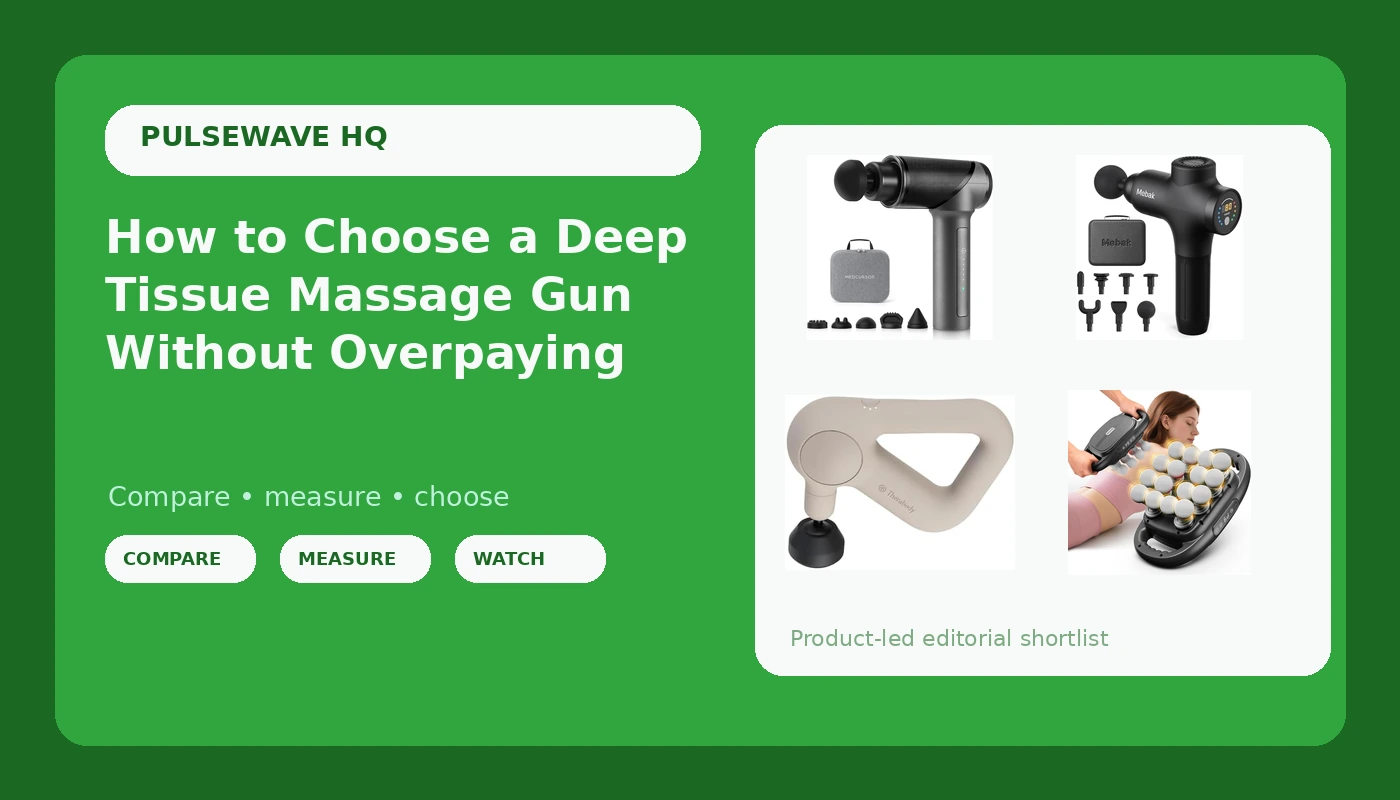
A deep tissue massage gun is one of the few recovery gadgets that genuinely earns its shelf space, and it is also one of the easiest to buy badly. The box shouts about RPM, "therapy grade" power, and app connectivity. Almost none of that tells you whether the tool will keep its stroke when you lean into a loaded quad, or whether the noise will make you stop reaching for it three weeks after it arrives.
I am Tyler, a physical therapy assistant in Denver who has spent eight years working with cyclists, lifters, and weekend warriors coming back from overuse injuries. In the clinic, a deep tissue massage gun is a warmup and flush tool used under a physical therapist's direction. At home, it is part of a wind-down routine after a long ride. This guide explains what percussive therapy actually does, which specs are worth comparing, and how four current options line up against those criteria.
Related: Massage Gun Amplitude and Stall Force, Explained →
Quick answer
For most people, the deciding factors are amplitude (stroke length), stall force (how much pressure the motor holds before the stroke gives out), noise at the speeds you will actually use, and how many heads you will genuinely rotate through. The TheraGun Therabody Relief Massage Gun is the simplest option here, with three speeds and almost no setup decisions. The 16-Head Massage Gun offers the widest range of settings and heads. The Medcursor Massage Gun and the Mebak 3 Massage Gun sit in the middle, one built around a brushless motor and six heads, the other positioned for athletes and deep tissue work. None of them treat an injury, and all of them can help a muscle feel better before or after activity.
Four useful options
| Model | Best fit | What stands out |
|---|---|---|
| Medcursor Massage Gun | Everyday recovery sessions at home | Brushless motor and six interchangeable heads |
| TheraGun Therabody Relief Massage Gun | Simple, low-fuss daily use | Three-speed control in a streamlined format |
| Mebak 3 Massage Gun | Athletes and post-workout routines | Deep tissue percussion format aimed at sport recovery |
| 16-Head Massage Gun | People who want maximum adjustability | Sixteen heads, nine modes, and 99 intensity settings |
The everyday all-rounder: Medcursor Massage Gun
A brushless motor is the quiet part of the spec sheet that matters. Brushed motors rely on contact points that wear and tend to get louder with age, which is why most mid-range guns have moved to a brushless design. Six heads is also a practical number: a ball head for larger muscle bellies, a flat head for broad areas like the quads and lats, and a smaller head or two for spots around the shoulder blades and the arches of the feet. The trade-off is that nothing here adapts for you. There is no pressure sensor and no automatic speed change, so you control depth by how hard you press and how long you stay in one place. That is fine if you already have a routine, and slightly annoying if you are brand new to percussive therapy.
The streamlined daily-use pick: TheraGun Therabody Relief Massage Gun
Three speeds is not a limitation so much as a design decision. Devices with dozens of intensity steps invite you to fiddle with settings instead of using the tool, and most people settle on one or two comfortable speeds within a week anyway. A three-speed layout gets you a low setting for warmups and sensitive areas, a middle setting for general recovery, and a high setting for big muscle groups like the quads and glutes. The trade-offs are real: fewer heads means less specialization for small areas like the forearms and feet, and fewer speed steps means less fine control if you like to dial things in precisely. What you get in return is a tool with almost no learning curve. The Relief model is aimed at daily comfort rather than sport-specific work, which is worth knowing if your goal is a two-minute routine at the end of a desk day rather than a deep session after a long ride.
The athlete-oriented option: Mebak 3 Massage Gun
The Mebak 3 is aimed at athletes and recovery after training, which usually means a percussive format intended to work through larger muscle groups. That positioning matters more than any single line on the listing, because it tells you who the device was built for. If your routine is a few minutes on the quads, hamstrings, and calves after a hard session, this category of gun is designed for exactly that. The trade-off compared with the 16-head option is adjustability: fewer heads and fewer preset modes means less to experiment with, but also fewer parts to keep track of and less to learn. One note on language: the marketing around recovery tools runs broader than the evidence. Treat a gun like this as a comfort and warmup tool, not as a treatment for pain or injury.
The maximum-adjustability pick: 16-Head Massage Gun
Sixteen heads and 99 intensity settings is the most adjustability here, and it is also the most decision-making. The upside is genuine: different heads suit different areas, and a wide intensity range lets you run a light pass over the neck and shoulders and a firmer pass over the glutes without switching devices. The downside is that most people use three or four heads out of sixteen and settle on two or three intensities. If you enjoy experimenting, or you are buying one tool to cover a household with different preferences, that range is an asset. If you want to press one button and get on with your evening, it is clutter. And remember that a larger head count does not make a gun better at reaching a muscle belly. That still comes down to amplitude and stall force.
Prices and availability may change. Product images, names, and retailer links must be matched by verified ASIN. Do not state a current price, rating, stock status, or measured result without current evidence.
What percussive therapy actually does
Percussive therapy is rapid, repeated tapping delivered into a muscle belly. The mechanical effect is straightforward: it moves tissue, gets blood flowing, and can make a stiff area feel looser for a while. Used before activity at a low speed, it can help you feel ready to move. Used after activity, it can be part of a wind-down routine that helps you relax and feel less beat up the next morning.
What it does not do is fix anything. It does not break up scar tissue, it does not flush lactic acid the way the marketing suggests, and it is not a treatment for a tendon problem, a joint issue, or an injury. The research base for percussion devices is modest and mostly supports short-term comfort and range-of-motion changes rather than structural repair. That distinction matters, because it decides how you use the tool: as a few minutes of help for a muscle that is tired, not as a substitute for a diagnosis.
There are also hard boundaries. Muscle bellies only, never bone, joints, or the spine, and never the front of the neck. Skip areas that are bruised, swollen, numb, or tingling. If you are pregnant, take blood thinners, have a history of blood clots, or have a condition you have not had assessed, talk to a clinician before you start.
How to narrow down your options in five steps
The temptation with massage guns is to compare settings counts and pick the biggest number. A better sequence is to start with the job you need done and work backward toward the tool.
- Write down the job. Post-ride quads, desk-day shoulders, a pre-lift warmup, or post-run calves. The area and the goal decide how much amplitude you need.
- Compare amplitude and stall force before you look at RPM. Stroke length tells you how deep the thump goes, and stall force tells you whether the motor holds that stroke when you press. RPM alone is a number printed large on the box.
- Count the heads you will actually use. Three or four covers most bodies: one broad, one ball, one small, one flat. Anything beyond that is optional.
- Decide where the gun will live. If it travels in a gym bag or gets used in a shared living room, size and noise matter as much as power.
- Set your ceiling before you shop. Treat app features as optional extras, since some manufacturers gate basic settings behind a subscription.
Practical guidance for using one well
- Stay on muscle bellies. Never bone, joints, or the spine, and never the front of the neck.
- Work an area for about 30 to 60 seconds, then move on rather than camping on one spot.
- Start on the lowest speed that feels useful and increase only if you need more.
- Use it before activity at a light setting as a warmup, and after activity for a longer, gentler pass.
- Stop if you feel sharp pain, numbness, tingling, or see bruising, and do not use a gun over an injury you have not had looked at.
- Do not lean your body weight into the tool. If the stroke stalls out, you are pressing harder than the motor can support.
Which option should you choose?
Choose the Medcursor Massage Gun when you want a general-purpose home gun with a brushless motor and a sensible set of heads, and you are happy to control depth by feel. Choose the TheraGun Therabody Relief Massage Gun when you want the fewest decisions possible and a three-speed layout for daily comfort use. Choose the Mebak 3 Massage Gun when your routine is built around post-training recovery on large muscle groups and you do not need a pile of accessories. Choose the 16-Head Massage Gun when you want the widest settings range in this group and you enjoy tailoring the tool to each area.
One caveat applies to all four: none of the listings here publish the kind of measured stall force and amplitude data that would let anyone rank them against each other with confidence. What you can compare is the format, the controls, and the head selection, and then match those to how you actually plan to use the thing.
The bottom line
The right deep tissue massage gun is the one whose amplitude and stall force match the muscles you work, whose noise level you can tolerate for a 10 to 15 minute session, and whose controls you will not resent. The TheraGun Therabody Relief keeps things simple, the 16-Head Massage Gun gives you the most to adjust, and the Medcursor and Mebak 3 split the difference between a general home routine and sport-focused recovery. Buy for the job you have, keep it on muscle bellies, and treat it as a recovery and warmup tool rather than a cure.