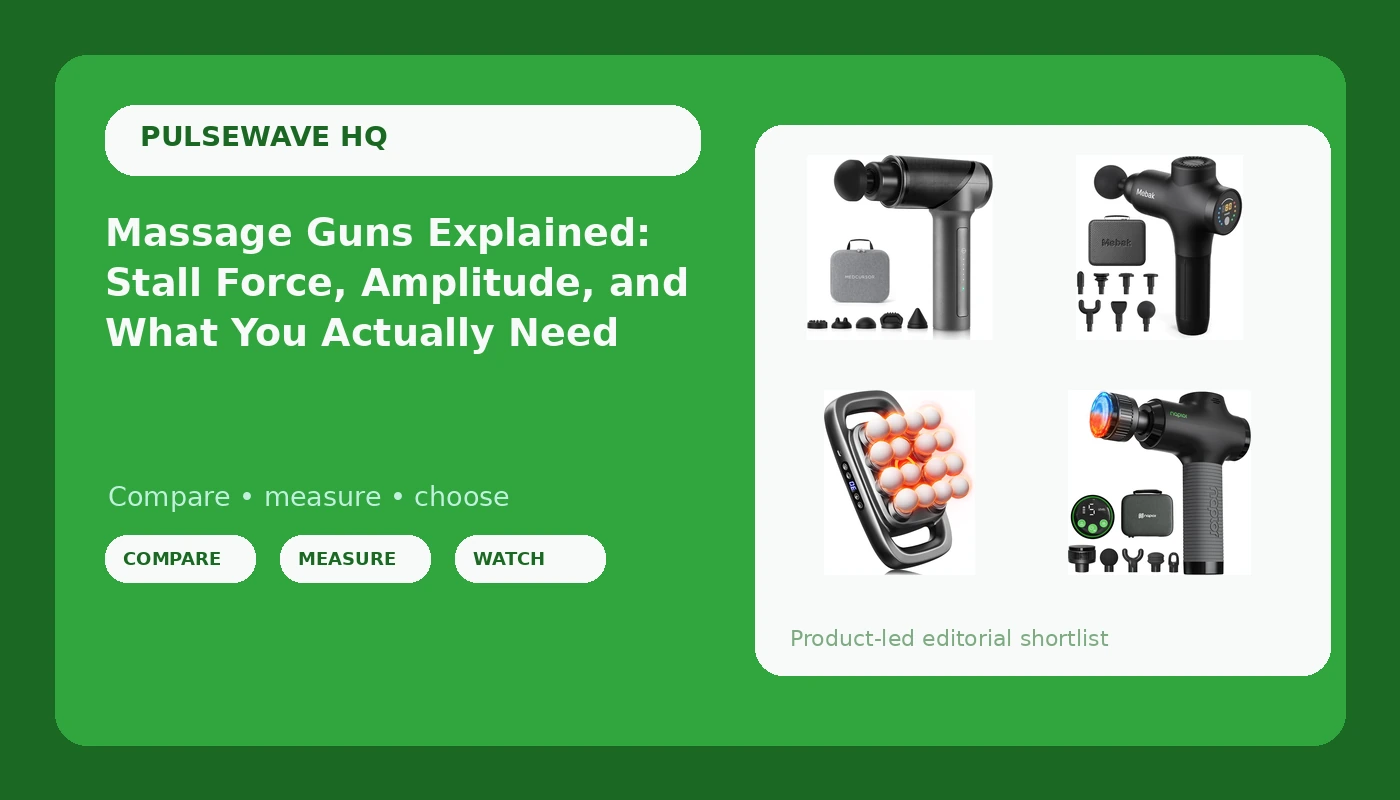
Most people shopping for a deep tissue massage gun start with the number a brand prints biggest on the box: RPM. That is the wrong place to start. Strokes per minute tells you how fast the head taps, not how much of that tap reaches muscle, and it says nothing about whether the motor keeps cycling when you lean your weight into a quad that has been tight since mile 20. Two other specs decide whether a gun is actually useful to you: amplitude, the stroke length in millimeters, and stall force, the pressure the motor absorbs before the piston stops moving. Get those two right for your body and your sport, and everything else, including color and app, becomes a detail.
Related: Massage Gun Recovery Basics: How to Use One Without Overdoing It →
Quick answer
A deep tissue massage gun is a recovery and warmup tool, not a treatment device. It moves blood through a muscle belly before or after effort; it does not repair tissue or resolve an injury. If you want the widest range of attachment shapes in a single purchase, the 16-head set is the most flexible of the four here. If you are spending carefully on a first gun, the Medcursor model is the smallest commitment. If you want temperature alongside percussion, the heat and cold gun is the only one of the four that offers it. If you are comparing deep tissue guns marketed specifically to athletes, the Mebak 3 belongs on your list. None of these four can be called the quietest or the strongest on the strength of a product listing alone. Those are measured claims, and you should look for published numbers before you trust them.
Four useful options
| Model | Best fit | What stands out |
|---|---|---|
| 16-Head Massage Gun Set for Deep Tissue Massage, 3 Modes | Anyone who wants many attachment shapes | Sixteen heads and three modes in one kit |
| Medcursor Massage Gun (Gray) | A careful first purchase | Brushless motor, six heads, handheld format |
| Massage Gun with Heat and Cold | Temperature alongside percussion | Heat and cold functions on a deep tissue gun |
| Mebak 3 Massage Gun Deep Tissue | Athletes comparing deep tissue options | Marketed for athletes and post-training use |
Most attachment options: 16-Head Massage Gun Set for Deep Tissue Massage, 3 Modes
Sixteen heads sounds like a gimmick until you have worked a calf with a fork head and a shoulder with something flatter. The trade-off is housekeeping: more pieces to keep track of, more surfaces to clean, and more drawer space than a single-head gun takes. The listing for this model does not publish amplitude or stall force, so treat the head count as a starting point rather than a verdict. If you plan to press hard into big muscle groups, those two numbers are the ones to ask about before you buy.
Budget-friendly pick: Medcursor Massage Gun - High Intensity Brushless Motor, Handheld Percussion Deep Tissue Massager with 6 Massage Heads for Sore Muscle and Stiffness, Valentines Day Gifts (Gray)
A brushless motor and a six-head kit in a handheld body is the profile most first-time buyers are actually looking for. Brushless motors are generally quieter and more efficient than brushed ones, and six heads is enough variety without turning into a collection. Nothing here promises clinic-grade output, and it does not need to. For light daily use on calves, quads, and shoulders at moderate pressure, this is the category where a first gun makes sense. Check the published stroke length before assuming it will hold up to heavy loading.
Heat and cold: Massage Gun with Heat and Cold, Deep Tissue Percussion Massager Gun
Heat and cold are the interesting variable here. Warmth before activity is a familiar way to loosen tissue, and cold after a long effort is a familiar way to calm things down, so having both in a percussion device is genuinely different from the other guns on this list. What temperature does not do is substitute for amplitude. A gun with a warming head and a short stroke is still a short stroke. Read the specs, and if the listing does not state stroke length, treat the temperature feature as a bonus rather than the reason to buy.
Athlete-focused: Mebak 3 Massage Gun Deep Tissue, Muscle Massager for Athletes Pain Relief
The Mebak 3 is marketed to athletes and to post-training soreness, which is a positioning, not a measurement. That distinction is worth stating plainly, because "pain relief" on a box is marketing language, and a percussive device is not a treatment for an injury. What the athlete framing does tell you is who the manufacturer has in mind: people working on large muscle groups after training. Judge it on the two specs that matter. If you can find published amplitude and stall force, compare them against the other guns here. If you cannot find them, that absence is information too.
Prices and availability may change. Product images, names, and retailer links must be matched by verified ASIN. Do not state a current price, rating, stock status, or measured result without current evidence.
Amplitude and stall force, in plain terms
Amplitude is stroke length: the distance the head travels in and out with each tap, measured in millimeters. A shallow stroke feels like vibration on the surface of the skin. A deeper stroke carries more of the thump into the muscle belly underneath, which is the whole point of percussive therapy. Guns in this category commonly publish stroke lengths in the low teens, and a couple of millimeters of difference is more noticeable on a thick quad than on a forearm.
Stall force is the other half of the equation. Every motor has a point where enough pressure stops the piston from cycling, and that point is what separates a massage gun from a buzzer. A gun with a high stall force keeps moving when you lean in; a gun with a low one quits the moment you press, and now you are holding a vibrating handle against a muscle that is getting nothing. This is why a cheap gun can feel impressive in your hand at the store and useless on a hamstring at mile 40.
Neither number appears on most boxes. That is not an accident. RPM prints bigger, sounds more impressive, and requires no explanation.
What RPM does and does not tell you
Strokes per minute describes frequency. Amplitude describes depth. Frequency without depth is a massage gun that hums against your skin without reaching anything, and a high RPM figure with a shallow stroke is the most common way a product listing oversells itself. Speed settings still matter, because the speed you can tolerate on a sore area is usually not the speed you want on a fresh one, but they are a control, not a capability.
There is also the question of whether you will actually use the thing. A gun that rattles your hand numb at its top speed is a gun you will stop reaching for by week three, no matter what its specs say. Noise and hand vibration are not vanity metrics; they decide whether the device lives on your shelf or in a drawer. The same goes for battery, which is easy to overstate in a lab and harder to deliver across a week of twenty-minute sessions.
Before buying any percussion gun, work through these five steps:
- Find the published amplitude, and if the listing does not state it, ask.
- Find a stall force or pressure rating, not just a motor description.
- Look for noise figures at the speeds people actually use, not just the lowest setting.
- Compare battery runtime against the length of your real sessions, not a single charge cycle.
- Match the included attachments to the areas you actually work on, since a head you never use is not a feature.
Practical guidance for using one
- Muscle bellies only. Never bone, joints, or the spine. That is anatomy, not a legal disclaimer.
- Keep the head moving at roughly an inch per second instead of parking it in one spot.
- Limit each area to a minute or two, then move on. More is not better here.
- Use it before activity as part of a warmup and after activity as part of recovery, not as a substitute for either.
- Skip bruised, swollen, or injured tissue entirely, and talk to a clinician if something hurts rather than working around it.
Which option should you choose?
Choose the 16-Head Massage Gun Set for Deep Tissue Massage, 3 Modes when you want the widest spread of attachment shapes and would rather have options than a single fixed head. Choose the Medcursor Massage Gun when you want a simple handheld brushless gun with a modest head count and you are not planning to load it heavily. Choose the Massage Gun with Heat and Cold when temperature is part of your routine and you want it built into the same tool. Choose the Mebak 3 Massage Gun Deep Tissue when you are specifically comparing deep tissue guns positioned for athletes and post-training soreness.
That said, none of these four listings publishes the two numbers this article keeps returning to. That does not make them bad choices. It means the deciding evidence is missing, and you should either ask the seller for amplitude and stall force or accept that you are buying on attachment count, temperature features, and positioning instead of on measured output.
The bottom line
A massage gun is a recovery and warmup tool. It helps your body do its own repair work by getting blood moving through a muscle belly, and it is not a treatment for an injury. The specs that determine whether a given gun can do that job are amplitude and stall force, and the specs that determine whether you will keep using it are noise, vibration, and battery life. Attachment count, color, and temperature modes are real considerations, but they sit downstream of those four. Pick the gun whose shape and features match how you train, confirm the numbers where you can, and use it on muscle bellies only.