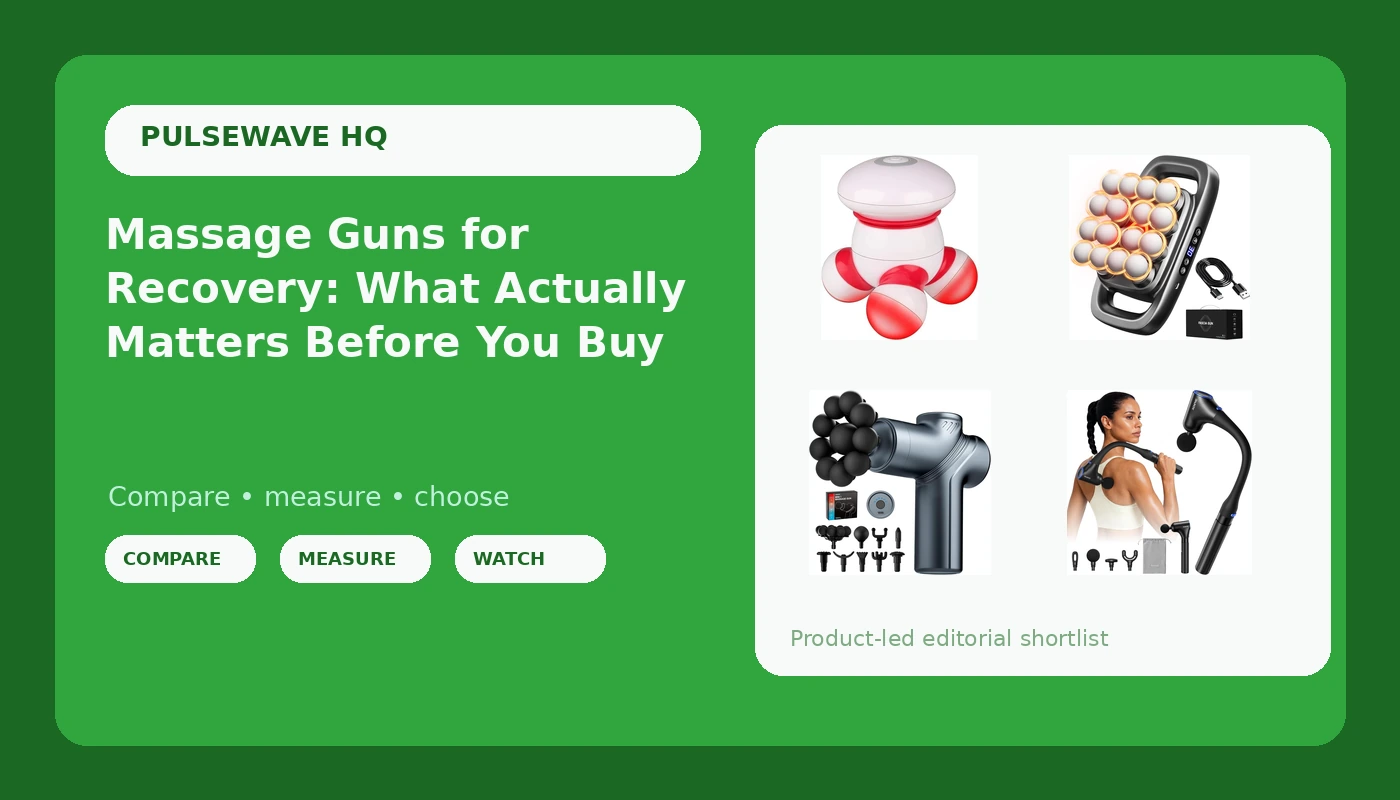
Massage guns are a category where the marketing has badly outrun the engineering. Walk into any gym and you will see someone pressing a pistol-shaped device into a quad while a screen counts up to a number in the thousands. That number is usually strokes per minute, and strokes per minute by itself tells you almost nothing about whether the tool will actually help you loosen up after a long ride or a heavy session. If you are shopping for massage guns for recovery, the useful questions are narrower: how deep does the stroke travel, how much pressure can the motor absorb before it quits, how loud is the thing at the speed you will really use, and will the battery survive a normal week. This guide works through those questions, then looks at four options that sit at very different points on the size, feature, and price spectrum, from a small handheld vibrating massager to a full-size gun with an extension handle.
Related: Massage Gun Amplitude and Stall Force, Explained →
Quick answer
Match the tool to the job. Amplitude, which is stroke length, and stall force, which is how much pressure the motor takes before the stroke stops, matter more than the strokes-per-minute figure printed on the box. A gun with a longer stroke and a motor that holds its rhythm under load suits large muscle groups like quads, glutes, and calves. A small, light device with a shorter stroke suits hands, forearms, neck, and travel. Handle geometry and attachment variety decide whether you can comfortably reach your own upper back. None of these devices treats an injury, and none of them replaces sleep, food, and easy movement on recovery days.
Four useful options
| Model | Best fit | What stands out |
|---|---|---|
| RENPHO Reach Curve Massage Gun with Extension Handle, 4-in-1 Massager | Reaching your own back and shoulders | Extension handle plus a 4-in-1 massager design aimed at coverage |
| 16 Head Massage Gun Deep Tissue, Gift for Husband 2026 Upgrade 48KG Force, 3 Modes & 30 Intensities, Quiet Portable with Dual Safety Protection for Neck Back Legs Waist Pain Relief | Attachment variety and fine intensity steps | Listing advertises 48KG of force, 3 modes, 30 intensity levels, and 16 heads |
| LEERCON Massage Gun Deep Tissue Mini Muscle Back Massager for Pain Relief | Travel and smaller muscle groups | Compact mini format built around portability |
| cotsoco Handheld Massager Mini Portable Vibrating Body Massager with LED Light for Hand Head Neck Back Legs Arms Pain Release, Battery Operated, Easy Hand Grip | Gentle vibration on hands, neck, and arms | Battery operated handheld with an LED light and a one-hand grip |
The reach pick: RENPHO Reach Curve Massage Gun with Extension Handle, 4-in-1 Massager
Reaching your own back is the hardest problem in this category, and it is worth being honest about the trade-off. Adding a handle length between your hand and the head costs you leverage, so you can place the head where you want it but you cannot press as hard as you can with a short-bodied gun held close to your palm. That is a fair trade for upper back and shoulder work, where access is the limiting factor. It is a poor trade for a heavy quad session, where you have all the leverage you need and just want maximum pressure. Keep the head on muscle tissue, and remember that the spine itself and the bony points of the shoulder blades are not targets.
The attachment-heavy pick: 16 Head Massage Gun Deep Tissue, Gift for Husband 2026 Upgrade 48KG Force, 3 Modes & 30 Intensities, Quiet Portable with Dual Safety Protection for Neck Back Legs Waist Pain Relief
Here is the honest caveat on attachments: most people end up using three or four heads and ignoring the rest. The value is not the number, it is whether the set includes the shapes you need. Fine intensity steps are the more quietly useful feature, because the jump between low and medium on many guns is bigger than it should be, and a small step up lets you work a tender area without flinching. Force ratings in kilograms describe how much resistance the motor is built to handle, and they are only meaningful alongside stroke length. A high force number paired with a shallow stroke still feels like a buzzer rather than a percussive tool.
The mini pick: LEERCON Massage Gun Deep Tissue Mini Muscle Back Massager for Pain Relief
Minis make a predictable trade: a smaller motor and a shorter body usually mean less stroke length than a full-size gun, so the thump does not travel as deep into a big muscle. What you get back is portability and control. For a weekend trip, a race-day bag, or a desk drawer at work, that is often the better deal. For a 30-mile ride followed by a Sunday of negotiating with your quads, a mini is going to feel like it is knocking on the door rather than opening it. If you own one of these, use it for maintenance and small areas, and do not expect it to replace a full-size gun on the biggest muscle groups.
The gentle handheld pick: cotsoco Handheld Massager Mini Portable Vibrating Body Massager with LED Light for Hand Head Neck Back Legs Arms Pain Release, Battery Operated, Easy Hand Grip
It is worth separating vibration from percussion, because they do different things. Percussion delivers rapid tapping that gets blood moving through a muscle belly, which is what makes a gun useful before a workout and pleasant after one. Vibration is a lighter, more continuous sensation, and it is far more tolerable on the neck, the hands, and the forearms, where a percussive gun at a useful speed is simply too much. If your goal is loosening a tight upper back after a day at a desk, a handheld vibrator can be the more pleasant tool. If your goal is prepping a quad for a hard effort, it will not get you there.
Prices and availability may change. Product images, names, and retailer links are matched to verified listings. No current price, rating, stock status, or measured result is stated here without current evidence.
Amplitude, stall force, and the number nobody should care about
Amplitude is stroke length, measured in millimeters. It describes how far the head travels on each stroke, which is a rough proxy for how deep the thump reaches into a muscle. Most full-size guns land somewhere in the 10 to 16 millimeter range, and that spread is enormous in practice. A shallow stroke feels like a firm buzz sitting on the surface of the skin. A deeper stroke feels like something is actually moving the muscle underneath it. For large, thick muscle groups, that difference is the whole ballgame.
Stall force is how much pressure the motor can absorb before the stroke stops moving. This is the spec that separates a real tool from a toy, and it is the one you almost never see printed on a box. Press a weak gun into a tight hamstring and the head simply stops reciprocating; you are now holding a vibrating plastic handle. Press a strong gun into the same spot and the stroke keeps going, which is what you want, because a muscle that needs work is usually a muscle you need to press into.
Then there is RPM, strokes per minute, the number printed largest on the packaging. It means almost nothing on its own. High RPM with a shallow stroke is a fast surface buzz. Moderate RPM with a long stroke moves tissue. When a listing leads with a big RPM figure and says nothing about amplitude or stall force, that is a signal about what the marketing team had to work with.
How to read a massage gun listing
Force ratings in kilograms describe motor resistance, not the sensation you will feel. They are a useful clue that a manufacturer paid attention to the motor, and they are not a substitute for stroke length. A listing that advertises 48KG of force without mentioning amplitude has told you half of one story.
Attachment counts are similar. Sixteen heads sounds impressive until you realize you will use a round head, a flat head, and one narrow head and leave the rest in the case. What matters is whether the shapes you need are included.
Quiet is a claim worth taking seriously, because noise is the reason most guns end up in a drawer. A device you are embarrassed to run in a shared living room is a device you stop using, no matter how good its motor is. Since you cannot test noise from a listing, look for any indication of decibel level at a stated speed, and be skeptical of a quiet claim with no number behind it.
Battery claims deserve the same skepticism. A runtime figure measured at the lowest speed on a bench is not the same as a week of 20-minute sessions at a speed you would actually choose.
Watch for app gating too. If basic speed control or a preset requires a subscription, that is a recurring cost attached to a physical tool, and it is worth knowing before you buy.
- Name the muscle groups you actually want to work, and be specific. Quads and glutes point one direction; neck and forearms point another.
- Decide whether you need to reach your own upper back without help. If yes, handle geometry moves to the top of the list.
- Look for amplitude and stall force before you look at anything else. If neither appears anywhere, keep scrolling.
- Think about where you will use it and who will hear it. Noise tolerance is a real constraint, not a luxury.
- Match the format to the job: full size for big muscles, mini for travel and small areas, handheld vibration for gentle work on hands and neck.
Practical guidance for using one well
- Stay on muscle bellies. Never work directly on bone, joints, or the spine itself. That is anatomy, not a legal disclaimer.
- Use it as a warmup before activity and a wind-down after, moving the head slowly rather than parking it in one spot.
- Keep sessions per area short and move on. More time in one place is not better.
- Skip it entirely on an acute injury, a bruise, swelling, or anything a clinician is already managing.
- Charge it after every session. A dead battery at a trailhead is the most common way these tools stop being useful.
Which option should you choose?
Choose the RENPHO Reach Curve Massage Gun with Extension Handle, 4-in-1 Massager when your main frustration is reaching your own back and shoulders and you want a multi-use design. Choose the 16 Head Massage Gun Deep Tissue, Gift for Husband 2026 Upgrade 48KG Force, 3 Modes & 30 Intensities, Quiet Portable with Dual Safety Protection for Neck Back Legs Waist Pain Relief when you want a wide range of contact shapes and fine intensity steps in a single kit. Choose the LEERCON Massage Gun Deep Tissue Mini Muscle Back Massager for Pain Relief when portability matters most and you are working smaller areas. Choose the cotsoco Handheld Massager Mini Portable Vibrating Body Massager with LED Light for Hand Head Neck Back Legs Arms Pain Release, Battery Operated, Easy Hand Grip when you want gentle vibration for hands, neck, and light general use rather than deep percussive work.
The limitation worth repeating: the specifications above come from the product listings, not from independent measurement, and manufacturer force and noise claims vary in how they are tested. Nothing here is a medical recommendation. If you are dealing with an injury, a diagnosed condition, or pain that is not resolving, that conversation belongs with a clinician, not with a product page.
The bottom line
Buy the tool that fits the job you actually have, not the one with the biggest number on the box. If you want to reach your own back, handle geometry beats raw force. If you want options, attachment variety and fine intensity steps are the useful features. If you travel, a mini you carry beats a full-size gun you leave behind. And if what you really want is something gentle for your neck and hands, a handheld vibrator is a legitimate answer rather than a compromise. Whatever you pick, keep it on muscle, keep sessions short, and check the current listing details before you commit, since specs and availability move around.