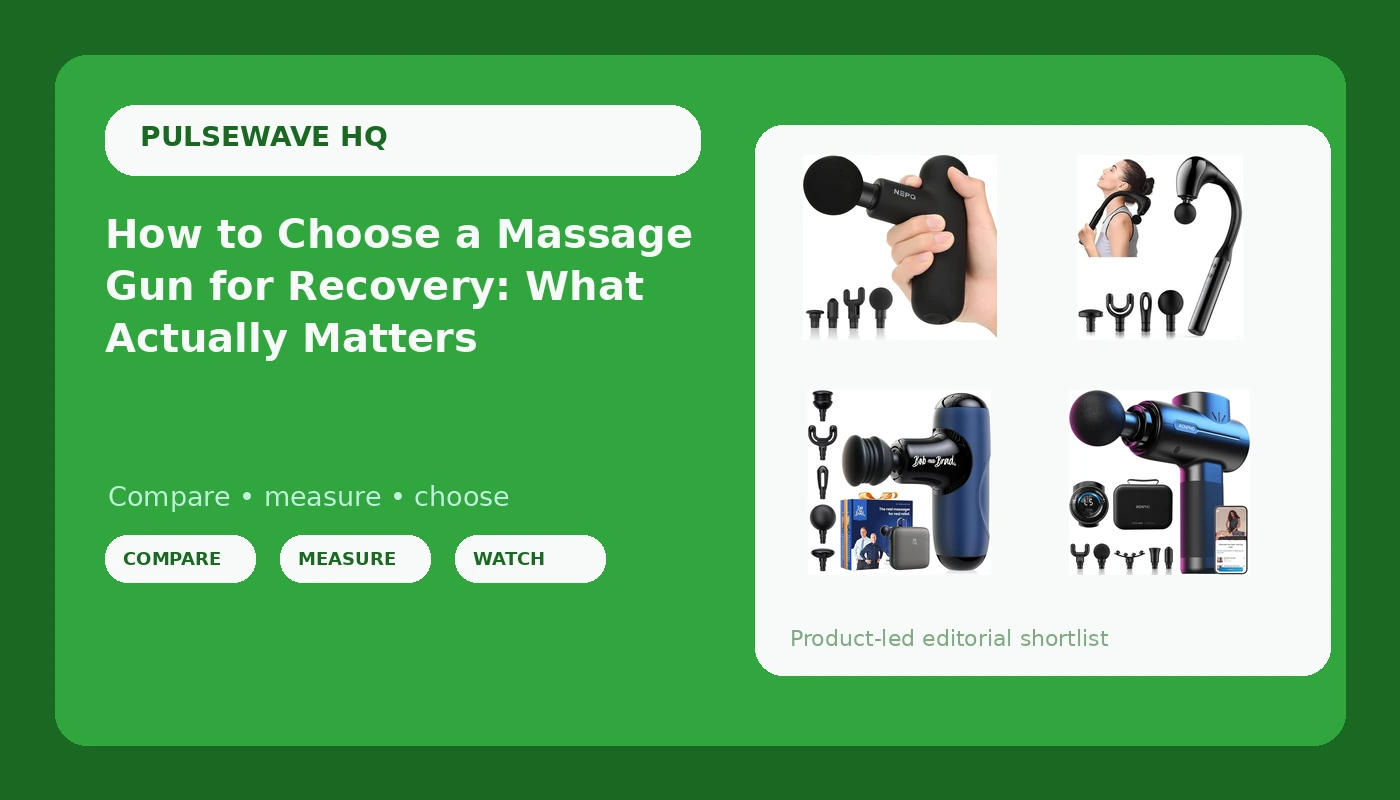
Picking a massage gun for recovery gets confusing fast, because the box in front of you is covered in numbers that do not predict how the tool will feel on a tight quad. Strokes per minute get printed in the largest font on the packaging, amplitude and stall force get buried in a bullet list, and two guns that look nearly identical can sit a hundred dollars apart. This explainer covers the two specs that decide whether a percussion massager helps you loosen up or just buzzes your skin, then walks through four portable options at different sizes and price points so you can match the tool to the tissue you actually need to work on.
Related: Massage Gun Amplitude and Stall Force Explained →
Quick answer
Amplitude, which is stroke length measured in millimeters, and stall force, which is how much pressure the motor takes before the percussion head stops moving, matter more than advertised RPM. A gun with a deeper stroke and a motor that holds under pressure can work a quad or a glute. A gun that stalls the moment you lean into it cannot, no matter what the box claims. Smaller and lighter guns trade some of that depth for portability and easier reach, which is a fair trade if you mostly work on forearms, calves, and shoulders. Decide which muscle groups you actually need to cover, then weigh noise and battery life at the speeds you will genuinely use.
4 useful options
| Model | Best fit | What stands out |
|---|---|---|
| NEPQ Mini Massage Gun, Powerful Fascial Gun Portable Deep Tissue Percussion Muscle Back Head Massager for Pain Relief with 4 Massage Heads High-Intensity Vibration Rechargeable Small Massage Gun | A small-format all-rounder on a budget | Four interchangeable massage heads and a rechargeable, compact body |
| Fronnor Massage Gun Deep Tissue with Extended Handle Revolutionary U-Shaped Back Massager Body Massager for Neck,Shoulder,Leg | Reaching your own neck, shoulders, and upper back | Extended handle plus a U-shaped head built for curved areas |
| BOB AND BRAD Q2 Mini Massage Gun, Pocket-Sized Deep Tissue Massager, FSA Portable Percussion Muscle Massager Gun, Ultra Small & Quiet Travel Massage Gun for Pain Relief, HSA Eligible | Travel, gym bags, and desk drawers | Pocket-sized travel format that is FSA and HSA eligible |
| RENPHO Active+ Massage Gun, App-Controlled Guided Courses, Bluetooth | Anyone who wants a routine instead of freestyling | Bluetooth app control with guided courses |
Budget mini: NEPQ Mini Massage Gun, Powerful Fascial Gun Portable Deep Tissue Percussion Muscle Back Head Massager for Pain Relief with 4 Massage Heads High-Intensity Vibration Rechargeable Small Massage Gun
The trade-off with any mini is depth. A short stroke feels pleasant on a forearm and superficial on a loaded quad, and small motors tend to give up sooner when you press. That is not a flaw, it is physics: less mass and a shorter stroke mean less punch. If your main complaint is a tight upper back after a desk day, a mini is plenty. If you are trying to loosen a heavy lifter's glutes, you want more gun than this.
Extended reach: Fronnor Massage Gun Deep Tissue with Extended Handle Revolutionary U-Shaped Back Massager Body Massager for Neck,Shoulder,Leg
An extended handle is a genuine ergonomic advantage, and it is also a lever. The longer the arm, the more torque your wrist absorbs, so the handle geometry matters as much as the head. When you try one of these, hold it the way you would actually use it on your own trapezius and see whether your wrist stays neutral. A gun that reaches the right spot but cranks your wrist sideways will sit in a drawer within a month.
Travel format: BOB AND BRAD Q2 Mini Massage Gun, Pocket-Sized Deep Tissue Massager, FSA Portable Percussion Muscle Massager Gun, Ultra Small & Quiet Travel Massage Gun for Pain Relief, HSA Eligible
Noise is the spec most buyers ignore and most regret ignoring. A loud gun does not get used in a shared living room, a hotel room, or an open-plan office, and an unused gun is an expensive paperweight. Because "quiet" is a marketing word as much as a measurement, judge it yourself: run it at the middle speed, which is where most people actually work, and listen from a few feet away rather than holding it at arm's length.
Guided routine: RENPHO Active+ Massage Gun, App-Controlled Guided Courses, Bluetooth
App features come with a caveat: check what the app does after the free tier ends before you commit. A gun whose core speeds are locked behind a subscription is a very different purchase than one whose app is a bonus on top of a fully functional device. The hardware should stand on its own.
Prices and availability may change. Product images, names, and retailer links are matched to verified listings. No current price, rating, stock status, or measured result is stated here without current evidence.
Amplitude and stall force, explained without the marketing
Amplitude is stroke length, measured in millimeters. It is the distance the head travels in and out on each cycle, and it determines how deep the percussion reaches into a muscle belly. A 10 millimeter stroke taps the surface layers. A 14 to 16 millimeter stroke reaches deeper tissue, which is what you want on quads, glutes, hamstrings, and calves. When a brand prints a huge RPM number and says nothing about amplitude, that is a tell. Strokes per minute tell you how fast the head taps, not how deep it goes, and a fast shallow tap is a vibrating massager, not a deep tissue tool.
Stall force is the second half of the story. Push a gun into a big muscle and the resistance goes up. A motor with real stall force keeps cycling under that load. A weak motor stops mid-stroke, and what you feel is the head parking against your leg while the motor hums. This is the single most common way cheap guns disappoint people, and it is invisible on a spec sheet, because almost nobody publishes a stall force number. You find out by pressing the gun into your own thigh at a moderate speed and seeing whether the rhythm holds.
The practical rule: amplitude decides where the energy goes, stall force decides whether the energy keeps coming when you lean in. Both matter. Neither is RPM.
Matching the gun to the muscle you actually need to work on
Most people buy for the muscle group they can already reach, then get frustrated by the one they cannot. Before you compare models, write down the two or three areas that actually bother you. If it is neck, shoulders, and upper back, reach and handle geometry outrank raw power, and a gun with an extended handle solves a problem that a stronger gun does not. If it is quads, glutes, and hamstrings after long rides or heavy squat days, you need amplitude and stall force, and a mini will leave you wanting. If it is forearms, calves, and feet, almost anything decent works, so portability and noise become the deciding factors.
Then run the five-step check that separates a usable gun from a return:
- Press it into your thigh at a middle speed and see whether the stroke holds or stalls.
- Run it at the speed you would actually use and listen from a few feet away.
- Check the stroke length in the listing, not the RPM headline.
- Confirm the battery claim matches your real session length, roughly 10 to 20 minutes a day.
- Hold it in the position you would use on your own back and check that your wrist stays neutral.
If it passes all five, the rest is preference.
Practical guidance for buying and using one
- Keep the gun on muscle bellies only. Bone, joints, and the spine are not targets, and that is anatomy, not a legal disclaimer.
- Use it before activity to warm tissue up and after activity to help recovery. It is a recovery and warmup tool, not a treatment for an injury.
- Stay in the middle speed range most of the time. Max speed is for big muscle groups, not for a sore neck.
- Give each area a short pass, a minute or two, rather than camping on one spot for ten minutes.
- Buy for the hardest muscle you need to cover, not the easiest one, because that is where weak guns get exposed.
- If you are buying through a benefits account, confirm eligibility on the listing before checkout.
Which option should you choose?
Choose the NEPQ Mini Massage Gun, Powerful Fascial Gun Portable Deep Tissue Percussion Muscle Back Head Massager for Pain Relief with 4 Massage Heads High-Intensity Vibration Rechargeable Small Massage Gun when you want a compact, rechargeable percussion gun with several head shapes and you mostly work on smaller areas. Choose the Fronnor Massage Gun Deep Tissue with Extended Handle Revolutionary U-Shaped Back Massager Body Massager for Neck,Shoulder,Leg when your problem area is your own neck, shoulders, or upper back and reach is the limiting factor. Choose the BOB AND BRAD Q2 Mini Massage Gun, Pocket-Sized Deep Tissue Massager, FSA Portable Percussion Muscle Massager Gun, Ultra Small & Quiet Travel Massage Gun for Pain Relief, HSA Eligible when the gun needs to travel with you and you want something the listing describes as ultra small and quiet. Choose the RENPHO Active+ Massage Gun, App-Controlled Guided Courses, Bluetooth when you want guided courses and app control to give your recovery sessions some structure.
One caveat applies to all four: the descriptions here come from the listings, and no stroke length, stall force, or noise figure is stated for any of them in this article. Verify amplitude and stall force behavior yourself, in the speeds you will actually use, before you decide.
The bottom line
A massage gun is a recovery and warmup tool, and the specs that predict whether it will help you are amplitude and stall force, not the strokes-per-minute number on the front of the box. Pick the gun that matches the muscle groups you genuinely need to work, then confirm that it holds its stroke under pressure and stays quiet enough that you will actually use it. The four options here cover the realistic use cases: a budget mini with multiple heads, an extended-handle design for your own back, a pocket-sized travel gun, and an app-guided model for people who want a routine. Any of them can work, as long as you match it to the tissue instead of the marketing.