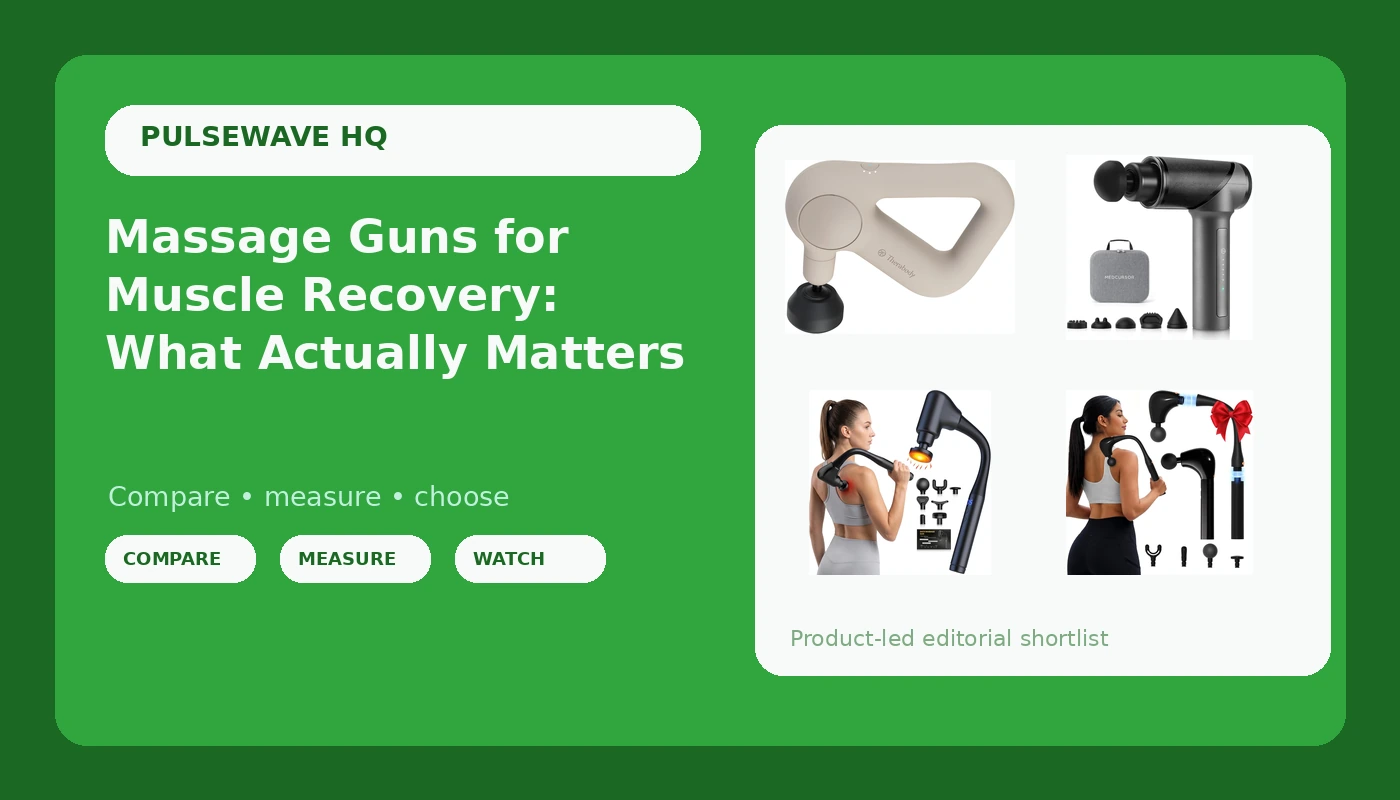
Buying a massage gun for muscle recovery is mostly an exercise in ignoring the box. The numbers printed largest, strokes per minute and a vague promise of "therapy grade" power, tell you very little about how a tool behaves when you press it into a tight quad. What matters is how far the piston travels on each stroke, whether the motor holds that travel under load, and how loud the gun gets at the speed you will actually use it. This explainer walks through the four options covered here, what each one is built around, and how to decide between them without paying for features you will never touch.
Related: How to Use a Massage Gun Without Bruising Yourself →
Quick answer
Match the gun to the job, not to the price tag. If you want a light, simple, well-known tool for general everyday use on the neck, back, legs, and shoulders, the TheraGun Relief by Therabody is the most straightforward option in this group. If you want more head options and a brushless motor for working bigger muscle groups, look at the Medcursor Massage Gun. If heat and reach are what you are missing, the AERLANG Massage Gun with its heat extension handle and the 2-in-1 detachable extension handle gun are the two designs here built around those needs. None of these listings publishes a measured stall force or amplitude, so treat the printed specs as a starting point and read the listing details before you commit.
Four useful options
| Model | Best fit | What stands out |
|---|---|---|
| TheraGun Relief by Therabody - Easy-to-Use, Comfortable & Light Handheld Percussion Massage Gun for Everyday Pain Relief Massage Therapy in Neck, Back, Leg, Shoulder and Body (Sand) | Everyday, simple use | Light, easy-to-use handheld percussion gun from Therabody in a sand colorway |
| Medcursor Massage Gun - High Intensity Brushless Motor, Handheld Percussion Deep Tissue Massager with 6 Massage Heads for Sore Muscle and Stiffness, Gifts for Father/Dad (Black) | Deep tissue work with head options | Brushless motor described as high intensity, plus six massage heads |
| AERLANG Massage Gun with Heat Extension Handle Massager Birthday Gifts | Heat and hard-to-reach areas | Heat function plus an extension handle |
| Massage Gun Deep Tissue 2-in-1 Detachable with Extension Handle | Reach and travel | Detachable 2-in-1 design with an extension handle |
The simple everyday pick: TheraGun Relief by Therabody
The trade-off with a simple gun is adjustability. Fewer controls and a light body usually mean fewer speed steps and less fine-tuning than a spec-heavy tool, which is exactly the point for someone who wants to pick it up and use it on a tight calf without reading a manual. One thing to keep in mind: the listing's therapeutic wording is marketing copy, not a clinical claim. A percussion gun does not treat an injury, it gets blood moving through a muscle belly so your body can do the repairing. Check the listing for amplitude and stall force before you buy, because those are the two numbers that decide whether this is a light-duty tool or something that can handle a loaded quad.
The deep tissue option with head choices: Medcursor Massage Gun
Six heads sounds like a lot until you realize most people rotate through two of them: a ball for big flat areas like quads and glutes, and something narrower for the area beside the shoulder blade. That is fine. The extras cost nothing once they are in the box, and a head you never use is not a flaw. A brushless motor is the more meaningful detail here, because brushless designs generally run cooler and quieter over long sessions than the cheaper brushed motors found in budget guns. Whether this specific motor holds its stroke under pressure is a different question, and it is the one you should try to answer from the listing or the manufacturer's own documentation rather than the marketing photos.
The heat and reach option: AERLANG Massage Gun with Heat Extension Handle
Heat plus percussion is a genuinely appealing combination for a stiff upper back, and an extension handle solves a real problem: you cannot comfortably reach your own mid-back or between your shoulder blades with a short gun, so you either skip those areas or contort yourself. The trade-off is complexity. More functions means more to fail, more battery draw, and more buttons to learn. If you want a gun you can hand to a friend without explaining anything, this is more tool than you need. If your problem area is consistently your back and you want warmth along with the percussion, it is worth a close look.
The detachable 2-in-1 option: Massage Gun Deep Tissue with Extension Handle
The detachable design is the practical part. With the handle on, you can reach your upper back without help. With it off, you have a shorter, more packable tool for legs and arms. The product name provided for this one does not identify a brand, so read the listing carefully and look at what the seller publishes about amplitude, motor type, and warranty before buying. An unbranded gun can be perfectly serviceable, but you have less documentation to fall back on if something goes wrong, which makes the return window and the listing details more important than usual.
Prices and availability may change. Product images, names, and retailer links are matched to verified listings. No current price, rating, stock status, or measured result is stated here without current evidence.
Amplitude and stall force: the two specs that matter
Amplitude is stroke length in millimeters. It is how deep the percussive thump reaches into the tissue. A short stroke, somewhere around 10mm, feels like a fast vibration on the surface. A longer stroke, in the 14mm to 16mm range, gets into the belly of a big muscle like a quad or a glute. Neither is better in the abstract. A light stroke is fine for a neck or a forearm, and it is often more comfortable for people who are new to percussive therapy. If your main complaint is a dense, locked-up hamstring after a long ride, a short stroke will mostly tickle it.
Stall force is how much pressure the motor can absorb before the piston stops moving. This is the spec nobody prints, and it is the one that separates a real tool from a buzzer. A gun with weak stall force works fine when you rest it lightly on your skin and collapses the moment you lean into a knot, which is exactly when you want it to keep working. You can test this yourself in ten seconds in a store, or with a return-friendly online purchase: turn the gun on, press it firmly into your palm, and see whether the stroke keeps thumping or flattens into a dull hum. If it flattens, it will flatten on your calf too.
RPM, the strokes-per-minute figure printed in the largest font on the box, means very little on its own. A high stroke rate with a short amplitude is a vibrating toy. A moderate stroke rate with a long amplitude and a motor that holds under load is a recovery tool. When you compare listings, read RPM last.
Noise, heads, and battery: the practical specs
Noise is the spec that decides whether you actually use the thing. A gun that sounds like a dental drill at the speed you need will sit in a drawer, and a tool in a drawer helps nobody. If you live in an apartment, share a bedroom, or like to use a gun while watching television, prioritize a quieter motor and a lower usable speed range over raw power you will never dial up.
Massage heads are simple. A ball head covers large, flat muscle groups. A flatter head spreads pressure over a broader area along the spine of a muscle. A narrow or bullet-shaped head concentrates force into a smaller spot, which is useful on a trigger point but easy to overdo. You do not need many heads. You need the two or three that match the areas you actually work.
Battery life claims are usually measured in a lab under ideal conditions, so treat them as a ceiling rather than a promise. What matters is whether the gun survives a week of twenty-minute sessions without a charge, and whether it uses a standard charging cable or a proprietary brick you will lose.
If you want a repeatable way to choose between the four options here, work through this:
- Name the job. Is this for post-ride quads, a stiff desk-bound neck, or your lower back after lifting? Write it down.
- Find the amplitude. Look for a millimeter figure in the listing. If the seller will not state one, assume it is short.
- Ask about stall force. If it is not published, read the reviews for complaints about the gun stopping under pressure, and use the return window as your safety net.
- Check the noise at your usual speed. Look for real-user comments about volume at low and mid settings, not just the top speed.
- Confirm the return policy and warranty. This matters most for an unbranded tool, where documentation is thinner.
Using a massage gun safely
- Work muscle bellies only. Never on bone, joints, the spine, the front of the neck, or over an area that is swollen, bruised, or injured.
- Keep it moving. Thirty to sixty seconds per area, then move on. Parking the gun in one spot for five minutes is how people end up sore for a different reason.
- Start at the lowest speed and add pressure gradually. If you have to brace the gun against your body to keep it from stalling, you are past the useful range.
- Use it before activity as a warmup and after activity as part of recovery. It is a tool for getting blood moving, not a treatment for a strain or a tear.
- If something hurts in a sharp or shooting way, stop and get it looked at. A percussion gun is not a diagnostic tool.
Which option should you choose?
Choose the TheraGun Relief by Therabody when you want a light, simple, recognizable handheld gun for everyday use on the neck, back, legs, and shoulders, and you would rather not think about settings. Choose the Medcursor Massage Gun when you want a brushless motor and a full set of heads for working bigger muscle groups, and you are comfortable dialing in the tool yourself. Choose the AERLANG Massage Gun with Heat Extension Handle when heat and reach are the two things your current routine is missing, especially if your back is the area that bothers you most. Choose the Massage Gun Deep Tissue 2-in-1 Detachable with Extension Handle when you want the reach of an extension handle in a tool that can also be used short and compact, and you are willing to do a little extra homework on the listing.
One caveat applies to all four. The information available for these listings does not include a measured stall force or a verified amplitude figure, and those are the two numbers that determine how a gun performs on real muscle. Before you buy, read the full listing, check the manufacturer's documentation where one exists, and lean on the return window. The gun that suits your body and your routine is worth more than the gun with the biggest number on the box.
The bottom line
A massage gun is a recovery and warmup tool, not a treatment device. It does not fix anything, it helps your body recover so it can do the fixing. That reframing makes the decision simpler: you are looking for enough amplitude to reach the muscle you care about, enough stall force to keep working when you press, and a noise level low enough that you will actually pick it up. The TheraGun Relief by Therabody covers the simple everyday case with a familiar brand behind it. The Medcursor Massage Gun adds a brushless motor and six heads for deeper work. The AERLANG gun and the 2-in-1 detachable model both solve the reach problem, one with heat added and one with a design that splits into two configurations. Any of them can do the job. Pick the one that matches where you actually get tight, and check the current Amazon price on the listing before you decide.