Most people use a massage gun wrong. They crank it to the highest speed, run it straight down the shin bone, park it in one spot for 30 seconds, and then wonder why their legs still feel like concrete the next morning. I have watched that happen in a clinic in Denver for eight years, and I have done it to myself after a long ride more times than I will admit.
A massage gun is a recovery and warmup tool. It does not fix anything. It moves blood through a muscle belly, it wakes a muscle up before you ask it to work, and it helps you feel human again the day after a big effort. That is the whole job.
The massage gun for workout recovery routine below is the one I walk patients through and the one I use on my own quads the morning after a 30-mile ride. It takes about ten minutes, and it works with almost any gun that has real amplitude behind it.
Why you should trust me
I am a physical therapy assistant, eight years in a sports rehab clinic in Denver, working with everyone from pro cyclists to weekend warriors coming back from crashes and overuse injuries. I use massage guns on patients under the direction of the head PT, and I use them on myself after enduro rides on the Front Range.
I own more than 20 guns. I keep a spreadsheet on every one: stall force, stroke length, noise at each speed, battery life under real use, and which ones died inside a year. That spreadsheet is why I do not care what the box says. I have watched a cheap gun stall out on a patient's hamstring mid-session and derail a training block. I have watched a heavy gun rattle a rider's hand numb at max speed.
Two rules I do not break. First, no gun gets recommended without a real stall force and a real stroke length behind it. Second, no medical claims. A massage gun helps your body recover so it can do the fixing. It does not treat an injury.
How I picked these guns and what I checked
Before you look at either gun below, know what you are shopping for.
Amplitude, which is stroke length in millimeters, is how deep the percussive thump goes. Ten millimeters is a light surface buzz. Sixteen millimeters is deep tissue territory. If a listing never tells you the stroke length, that is a red flag, not a typo.
Stall force is how much pressure the motor can take before the stroke stalls out. This is the spec that separates a massage gun from a buzzer. A gun with a big RPM number and no stall force will quit the moment you lean into a quad, which is exactly when you need it to keep working.
Noise matters more than power for most people. A gun you will not use because it sounds like a leaf blower in a shared house is a paperweight with a battery.
Battery life has to be measured in real sessions, not in a lab. Twenty minutes a day, five days a week, is the honest test.
I also check the head attachments and whether the controls work one-handed, because at some point you will be holding this thing behind your own calf.
Then I look at what the gun is actually built to do. That is where these two split.
The guns I would start with
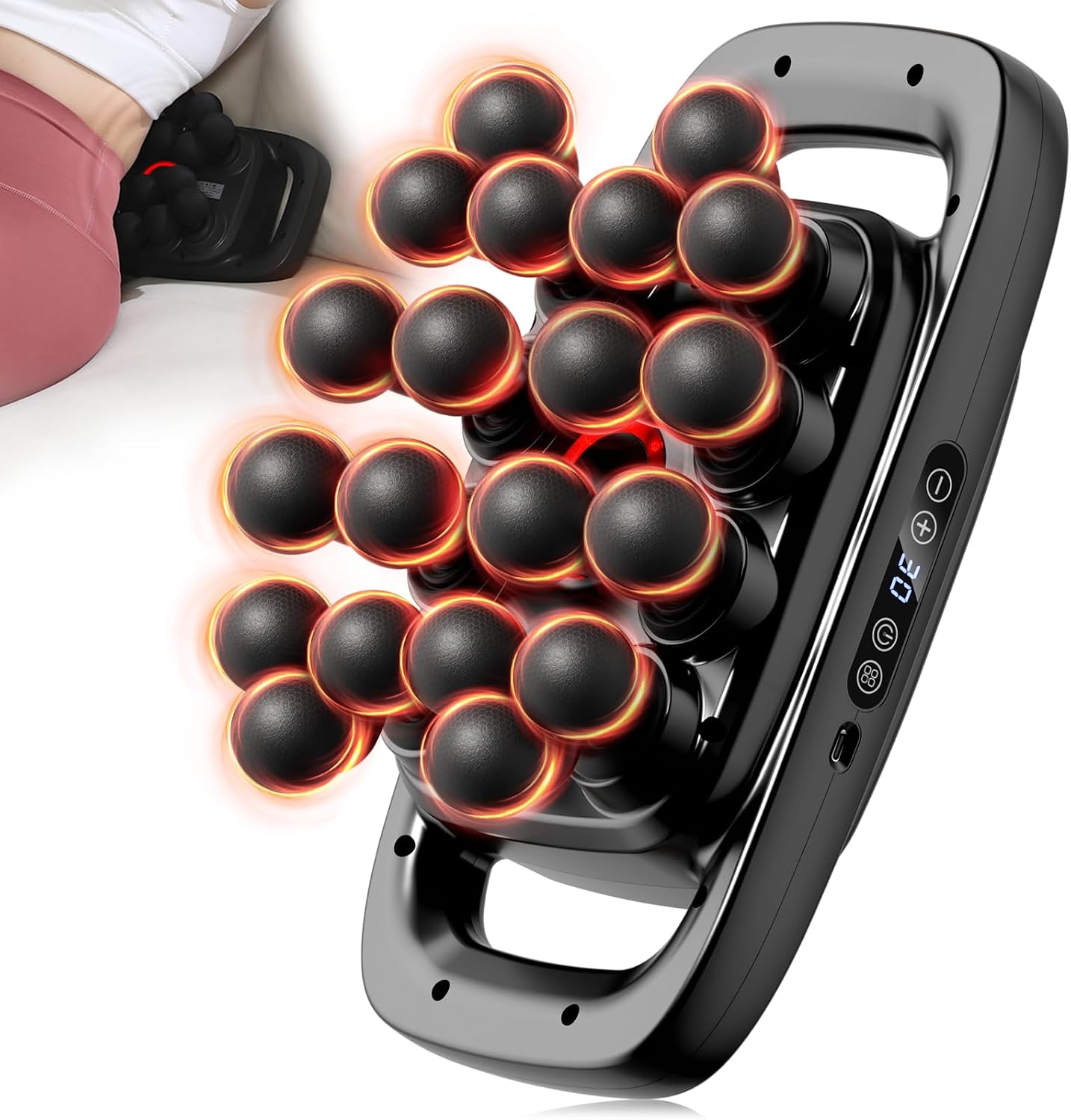
Budget pick: 20-Head Massage Gun Deep Tissue for Back and Legs, 3 Modes, 30 Levels
 Visit on Amazon →
This is the gun I point people toward when they are new to percussive therapy and do not want to spend much to find out whether they will actually stick with it. The kit ships with a set of interchangeable heads, and that matters more than it sounds. A flat head on a quad feels completely different from a small round head on a calf, and having both in the case means you are not improvising with the wrong shape on the wrong muscle.
Three modes and 30 levels give you fine control at the low end, which is where beginners should live. Most people start at max speed because it feels like it is doing more. It is not.
Flaws but not dealbreakers: You will use three heads out of the whole set and the rest will live in the case forever. That is fine. This is also not the gun I would hand a 220-pound lifter who wants heavy pressure on a big quad. Budget guns tend to lose their stroke the harder you press, so this one is best for moderate pressure, warmups, and post-ride flush work on calves, hamstrings, and forearms.
If you are buying your first gun, or you want a second one for a gym bag or a travel bag, start here.
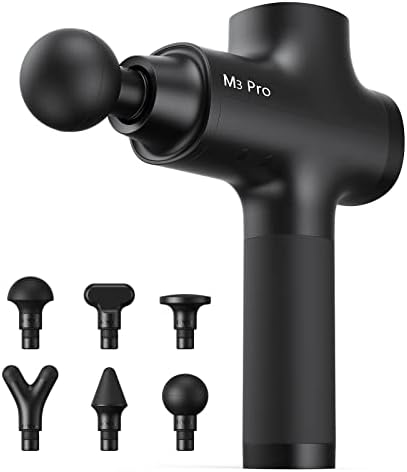
Our pick: Opove M3 Pro 2 Massage Gun Deep Tissue for Workout Recovery, Black
 Visit on Amazon →
The Opove M3 Pro 2 is built around deep tissue work and workout recovery, and that is exactly the job I would buy it for. This is the one I would keep in the truck. It is the gun I would reach for after a long ride when my quads have gone from sore to negotiations, and the one I would hand a patient who is already comfortable with how a gun feels and wants more depth on big muscle groups.
It is a focused tool rather than a buffet. The whole design points at recovery work on large muscles: quads, hamstrings, glutes, calves, lats. If you want a case full of head options, that is the budget pick above. If you want the gun that does the one thing you actually bought it for, this is it.
Flaws but not dealbreakers: It costs more, and it is not a do-everything kit. It is also not a travel gun. It is a stay-at-home or stay-in-the-truck tool for real recovery sessions. If you want something that fits in a jersey pocket, that is a different category and a different article.
Anyone who trains hard, rides hard, or lifts heavy and wants deep tissue work on big muscle groups should look here first.
The actual routine
Now the part you came for. This works with either gun, and with any gun that has real amplitude.
Step one: Warm or cool, depending on the day. Before a ride or a lift, two to three minutes total, light pressure, quicker passes. The goal is to wake the muscle up, not beat it into submission. After a ride or a lift, five to ten minutes, slower passes, more pressure. That is the recovery session.
Step two: Pick the head for the muscle. Flat heads for big, flat muscle bellies like quads and lats. Round heads for smaller, rounder areas like calves and forearms. If you have a set of heads, match the shape of the muscle, not the head that looks the most aggressive.
Step three: Start at the lowest speed and work up. This is the step everyone skips. Start low, glide for 20 or 30 seconds, and only bump the speed if the muscle is still asking for more. Higher speeds do not go deeper. They just make more noise and numb your hand.
Step four: Glide, do not park. Keep the head moving in slow passes along the length of the muscle belly, maybe an inch per second. Holding it in one spot for 30 seconds does not double the benefit. It just irritates the tissue.
Step five: Let the gun do the work. Rest the head on the muscle and let the motor bounce it. You are guiding, not pressing. If you have to lean your whole body weight into it to feel anything, the gun has stalled and you are now holding an expensive vibrator.
Step six: Muscle bellies only. Never on bone. Never on joints. Never on the spine. Never on the front of the neck. That is not a legal disclaimer, it is anatomy. Percussion is for soft tissue. Put it on a kneecap and you will find out why.
Step seven: Watch the clock. Thirty to sixty seconds per muscle belly is plenty, and a whole session should stay under fifteen minutes. More is not better. If you are still sore the next day, the answer is sleep and food, not a longer session.
Step eight: Skip it when it does not apply. Do not run a gun over a fresh bruise, a swollen joint, an acute injury, or a spot that is numb or tingling. Do not use it as a substitute for a warmup that actually raises your heart rate. And if something hurts in a way that is not muscle soreness, see a professional instead of buying a bigger gun.
The competition and why it lost
Not every gun makes sense for this routine, and I have handled enough of them to know the categories.
Mini guns lose here because they are travel tools. They are great in a jersey pocket on a weekend trip, and they are not built for a full ten-minute session on a 200-pound rider's quads.
High-RPM marketing guns lose because RPM is the number brands print big on the box and it means almost nothing without amplitude behind it. A gun that advertises a huge strokes-per-minute figure and never mentions stroke length is telling you which spec it is hiding.
App-gated guns lose because they put basic speed control behind a subscription. If you cannot use the gun without a phone, it is a service, not a tool.
The cheap no-name guns lose for a different reason. They are fine until you press down. Then the stroke stalls, the motor whines, and you are standing there holding a buzzing handle that is no longer doing percussive anything. I have watched that happen on a patient's hamstring mid-session. It is not a subtle failure.
That is the whole reason this guide has two guns in it instead of ten.
What this all costs
Both listings change price often, so check current Amazon price on each before you buy. What matters more than the sticker is the cost per session, and that math is simple.
A gun you use five days a week for ten minutes is a tool you touch hundreds of times a year. A gun you bought because it was cheap and then stopped using because it stalls or sounds like a blender costs more per session than the expensive one, because you paid for it and got nothing back.
The budget pick exists for people who want to find out whether they will actually build the habit. The Opove exists for people who already know they will. Either way, the routine above is the part that does the work.
That is the job. The gun does not fix your legs. It just gets them ready to be fixed by the boring stuff: sleep, food, and time.