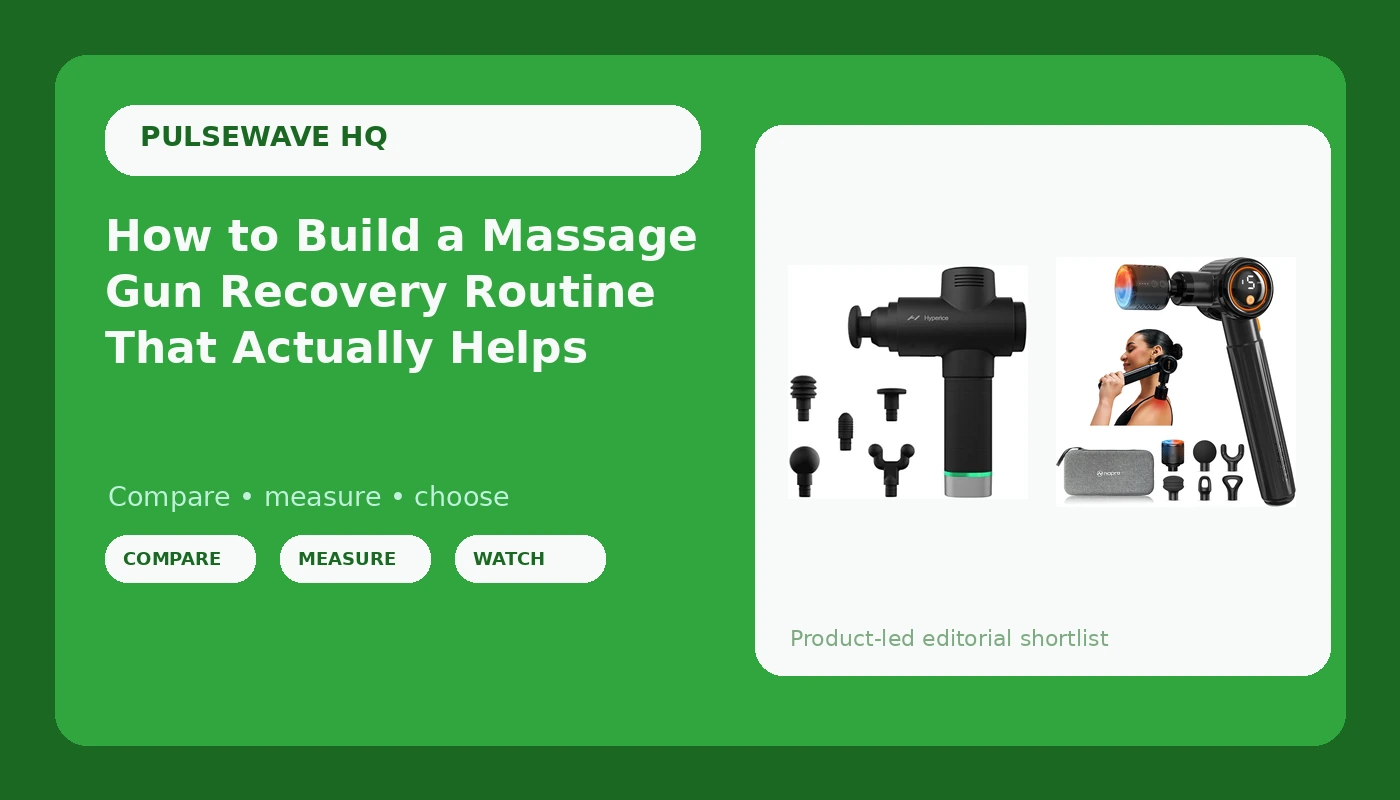
Most people buy a massage gun, run it over their quads for ninety seconds at full speed, and call it recovery. Then they wonder why their legs still feel like concrete the next morning. A massage gun recovery routine is not really about the gun. It is about matching the tool to the muscle, the timing to the training, and the pressure to what the tissue can actually take that day.
I am Tyler, a physical therapy assistant in Denver. I have spent eight years in a sports rehab clinic working with everyone from pro cyclists to weekend warriors who crashed on a Wednesday and want to ride again by Sunday. I got into enduro mountain biking six years ago, which is how I learned that a thirty mile Saturday means a Sunday spent negotiating with my own quads.
I have owned more than twenty guns and kept a spreadsheet on every one: stall force, stroke length, noise at each speed, battery life under real use, and which ones died inside a year. What follows is the routine I actually run, the two guns I would hand a patient, and the mistakes that turn a recovery tool into a bruise.
Why you should trust me
I use percussion tools in the clinic under a PT's direction, and I use them on myself after long rides. That means I see both sides of it: the patient with a hamstring that just will not settle down, and the rider who cannot get out of the car without wincing.
The thing that changed how I shop was watching a sixty dollar gun stall out on a patient's hamstring mid session. The motor stopped, the head went dead against the muscle, and the whole session reset. I have also watched a four hundred dollar gun rattle a rider's hand numb at max speed, which is its own kind of useless.
Since then I do not trust box specs. I trust what a gun does when you lean into it, how loud it is at the speed people actually use, and whether the battery survives a week of twenty minute sessions. That is the filter everything in this article passed.
What a massage gun actually does, and what it does not
A percussion gun delivers rapid tapping into a muscle belly. That tapping gets blood moving, which is useful before a ride to wake tissue up and useful after a ride when everything is tight and hot.
It does not fix anything. It does not treat an injury, it does not break up scar tissue, and it does not replace sleep, protein, or a real cool down. Think of it as a tool that helps your body get into a better position to do its own repairing. That framing matters, because it changes how hard you press and how long you stay on one spot.
Two specs decide whether a gun can do that job at all. Stall force is how much pressure the motor takes before the stroke quits. Amplitude is stroke length in millimeters, meaning how deep the thump goes. RPM is the number brands print big on the box, and it means almost nothing without amplitude behind it. A gun that stalls the second you press down is a vibrating paperweight, no matter what the RPM figure says.
How I picked the two guns in this guide
I am not ranking nine guns here. I am giving you the two I would actually hand someone: one all rounder that covers almost every use case, and one budget option that brings features you normally pay a lot more for.
The filter was simple. Does it hold its stroke when you lean in? Is it quiet enough that you will use it on the couch instead of hiding in the garage? Can you reach your own back and neck without contorting yourself? And would I be comfortable handing it to a patient who is already sore and nervous?
That last question eliminates most of the market.
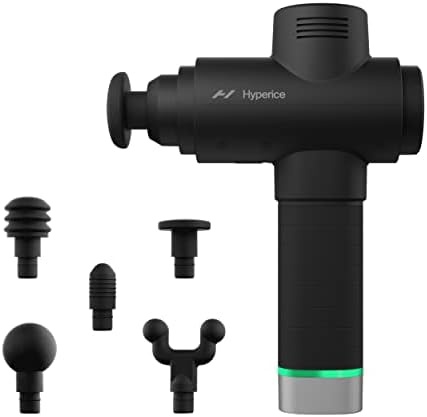
Best all-rounder: Hyperice Hypervolt 2 Pro Handheld Percussion Massage Gun Deep Muscle Tissue
 Visit on Amazon →
This is the gun I reach for first and the one I recommend when someone asks me to just pick. It is genuinely quiet at the speeds people use for recovery work, which sounds like a small thing until you have owned a gun you were embarrassed to turn on in the same room as another human.
The feature that earns it the top spot is the pressure feedback. Beginners press too hard. Everyone does. A gun that tells you when you are leaning in past useful pressure keeps people from bruising themselves on day one, and it teaches you what the right amount of contact feels like. In the clinic, that is the difference between a patient using the tool correctly and a patient showing up with a mark on their calf.
Build quality is what you would expect at this tier. It holds up, it does not rattle your hand numb, and the stroke stays consistent when you work into a big quad or a tight glute rather than skating across the surface.
Flaws but not dealbreakers: It costs real money, and for someone who only wants to loosen up after a jog, it is more gun than the job requires. If your training is light and your budget is tight, the pick below does the same work for a lot less.
Riders, lifters, and anyone with big muscle groups who wants one tool that covers warmups and recovery should start here.
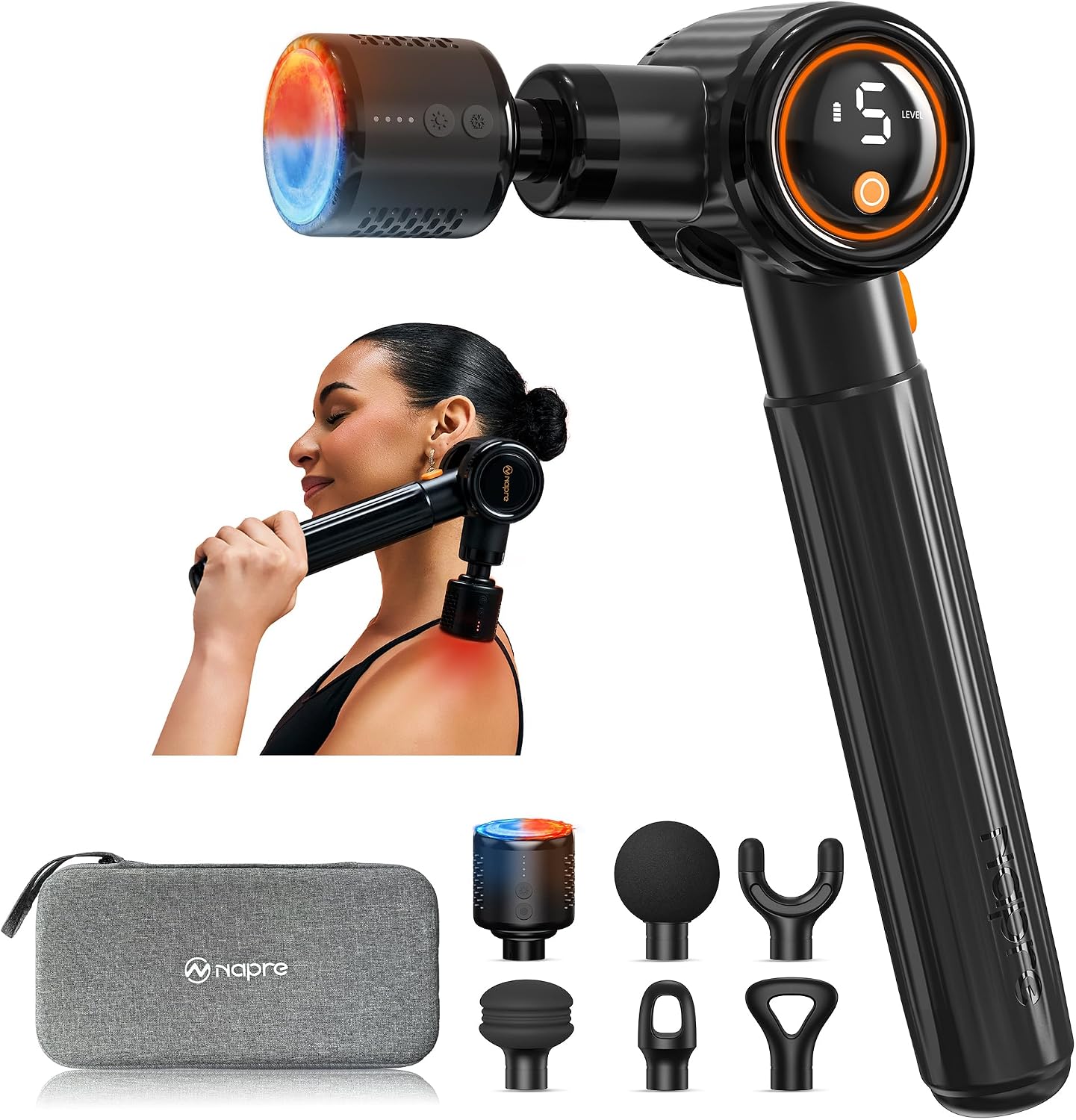
Best budget pick: NAPRE Massage Gun with Heat and Cold, Extension Handle and 3 Adjustable Angles
 Visit on Amazon →
Here is the one that surprised me. The extension handle and the three adjustable angles are the reason this gun exists, and they solve the single biggest problem with handheld percussion: you cannot reach your own upper back and neck properly with a short gun. You end up holding it at a bad angle, your arm burns out before your trap does, and you quit early.
Add heat and cold and you have a tool that handles both ends of a session. Heat before you work, when the tissue is cold and cranky on a winter morning. Cold after, when something is hot and angry and you want to calm it down. That combination in one unit is unusual at this price point.
Six heads and a case round it out. The case matters more than people admit, because a gun that lives loose in a gear bag is a gun with a cracked housing in six months. Mine travels in the case or it does not travel.
Flaws but not dealbreakers: It is a budget gun, so do not expect it to feel like a clinic tool in your hand. The tradeoff for the reach and the heat and cold modes is a housing that feels less premium than the Hyperice. That is a fair trade at this price, and it is the reason I recommend it as a second gun or a first gun for someone testing whether they will actually stick with a routine.
Anyone who trains hard but does not want to spend premium money, and especially anyone whose tight spots live in their back, neck, and shoulders, should look here first.
The actual recovery routine, step by step
This works with either gun. The gun is the easy part. The order is what makes it work.
Step one: Decide what you are doing. A pre-ride or pre-lift pass is short, light, and fast. A post-ride pass is slower and more deliberate. Do not treat them the same. Five minutes of light work before you head out wakes tissue up. Twenty minutes of hard work after you get back is where most people overdo it.
Step two: Pick the head on purpose. Round ball heads for big flat areas like quads, glutes, and lats. Flat heads for broad surfaces where you want even contact. Pointed or bullet heads for getting around a specific spot, and only at low speed, because a pointed head concentrates all the force into a small area. If you are new to this, stay on the round head for a month.
Step three: Start at the lowest speed that does something. Not the highest speed that does not hurt. Most guns have three to five speeds, and the second one is where recovery work lives. Max speed is for the last thirty seconds of a big muscle group, not the whole session.
Step four: Let the gun do the work. Rest the head on the muscle and let it tap. Do not press down like you are trying to reach bone. If you can see the muscle denting under the head, you are pressing too hard, and the motor is probably stalling anyway. This is the single most common mistake I see.
Step five: Move slowly along the muscle belly. About an inch per second. Cover the length of the muscle, then come back. Do not park on one spot and hold. Muscle bellies only, never bone, joints, or the spine. That is not a legal disclaimer, that is anatomy. The spine and the bony points around your knee and shoulder do not want percussion.
Step six: Ninety seconds per muscle group. That is it. Quads, hamstrings, calves, glutes, lats. Move through them and stop. More time is not more recovery.
Step seven: Move after. Stand up, walk, do a few easy range of motion reps. The gun got blood moving; now let the joint actually travel. Percussion without movement is half a routine.
Where people go wrong
The biggest one is treating a massage gun like a treatment device. It is not. If something hurts in a way that is sharp, shooting, or getting worse instead of better, the gun is not the answer and neither is more pressure. That is a conversation with a clinician.
The second mistake is max speed, max pressure, forever. That is how you end up sore from your recovery tool. The third is skipping it entirely on the days it would help most, which for me is the morning after a long ride when the light is good and the trail is calling. I am as guilty of that as anyone.
And the fourth is buying on RPM. If a listing does not tell you anything about how the stroke holds up under pressure, that tells you something on its own.
What this all costs
Both of these guns sit well under what the top tier charges, and neither one requires a subscription to unlock features you already paid for, which is a pet peeve of mine and a real cost over time.
The math is straightforward. A gun you use four times a week for two years is a few cents a day. A gun that sits in the closet because it is too loud, too short to reach your back, or too aggressive for your body costs you the full purchase price and delivers nothing. That is why the reach and the noise level matter as much as the power.
Pick the one that fits how you actually train, run the seven steps, and give it three weeks before you judge it. Recovery is a skill, not a product. The gun is just the thing in your hand while you practice it.