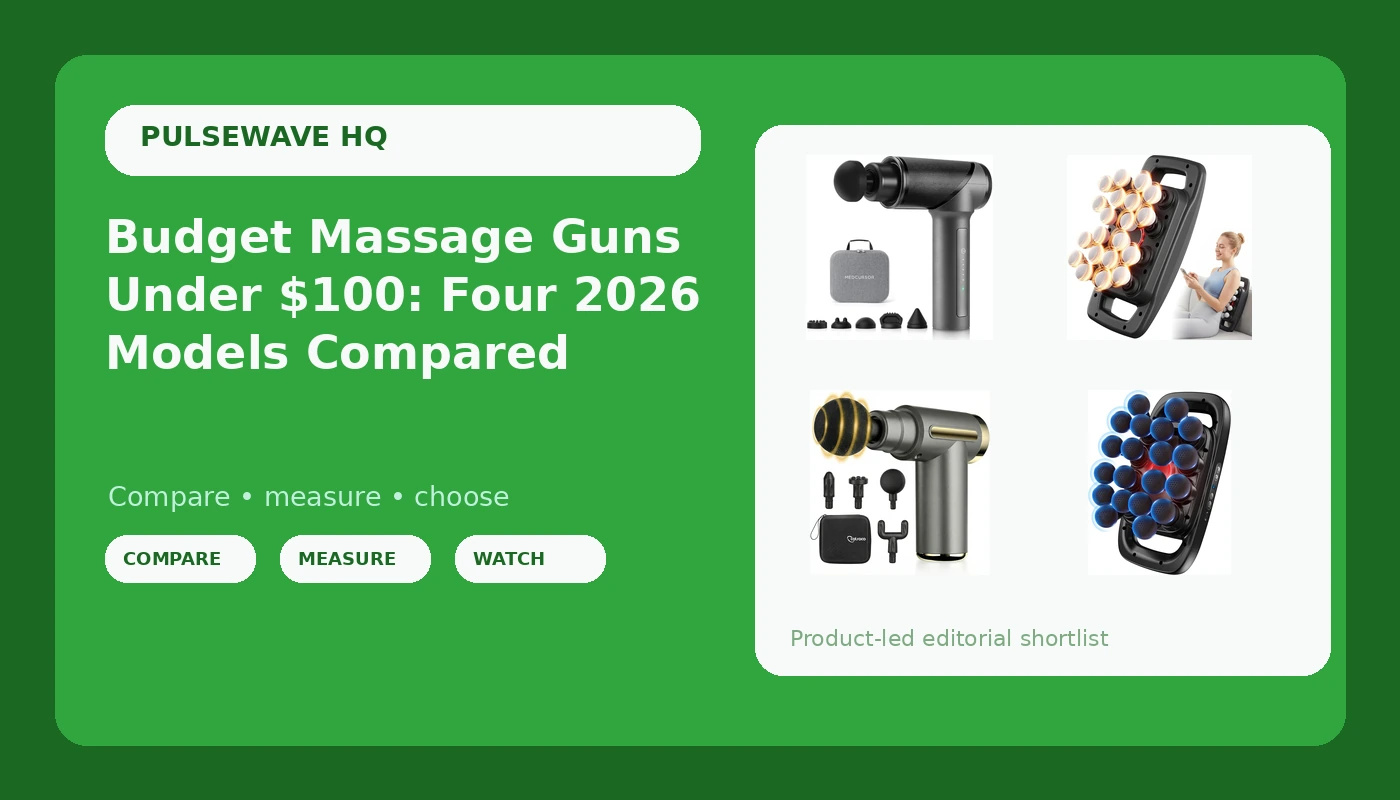
I keep a spreadsheet for every massage gun that comes through the sports rehab clinic in Denver where I work as a physical therapy assistant. Twenty-plus guns over eight years, with columns for stall force, stroke length, noise at each speed, and battery life under real use. That spreadsheet is why I get twitchy around budget massage guns that lead with head count, and it's also why I still test every cheap model that lands on my bench instead of waving it off. Cheap guns have gotten genuinely better. The question is which kind of better you're actually buying.
Related: Massage Gun Amplitude And Stall Force Explained
The four guns in this comparison share one thing: none of them is a flagship-priced unit, and three of them ship with more attachment heads than I own for my own recovery kit. Head count is the easiest spec to print on a box and the least useful thing to measure. What I care about is whether the motor holds its stroke when I lean bodyweight into a quad, how loud the thing gets at the speed a person would actually use, and whether the battery survives a week of twenty-minute sessions without a mid-week charge.
The best of this group for most people is the cotsoco 20-Head Massage Gun Set, because the nine-mode and nine-intensity ladder gives you real speed control instead of three preset buttons. The Medcursor is the one I'd hand to a patient who wants one button and no decisions. The Jancane Mini is the travel gun that lives in a gear bag. The 20-Head 3-Mode model is the one I'd want to see a stall force number for before recommending it to anyone carrying real muscle mass.
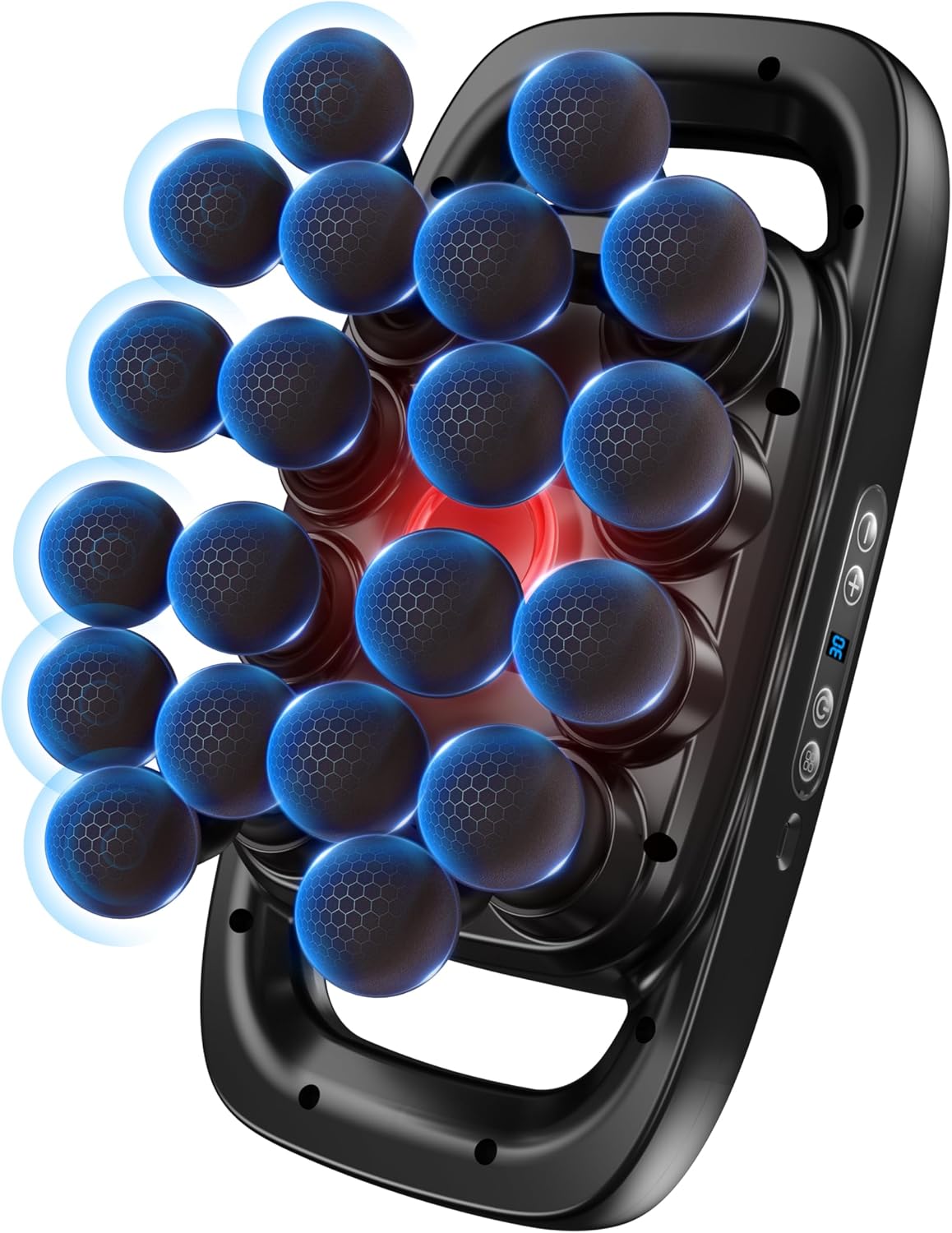
20-Head Massage Gun Deep Tissue Percussion Massager with 3 Modes
Largest attachment set here, and three modes keep the controls dead simple
Three modes is thin adjustability for the money, and the name sells heads instead of amplitude
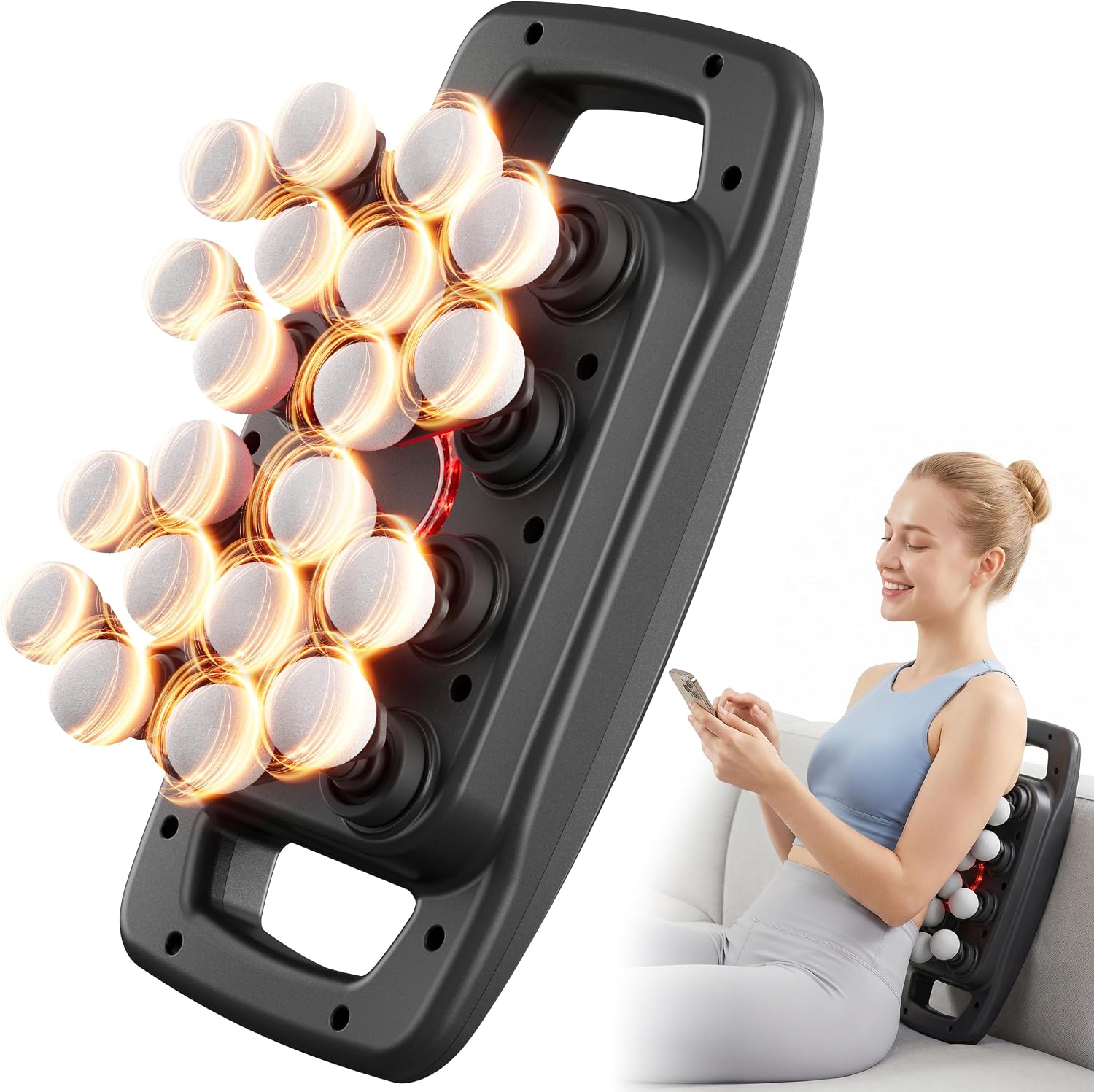
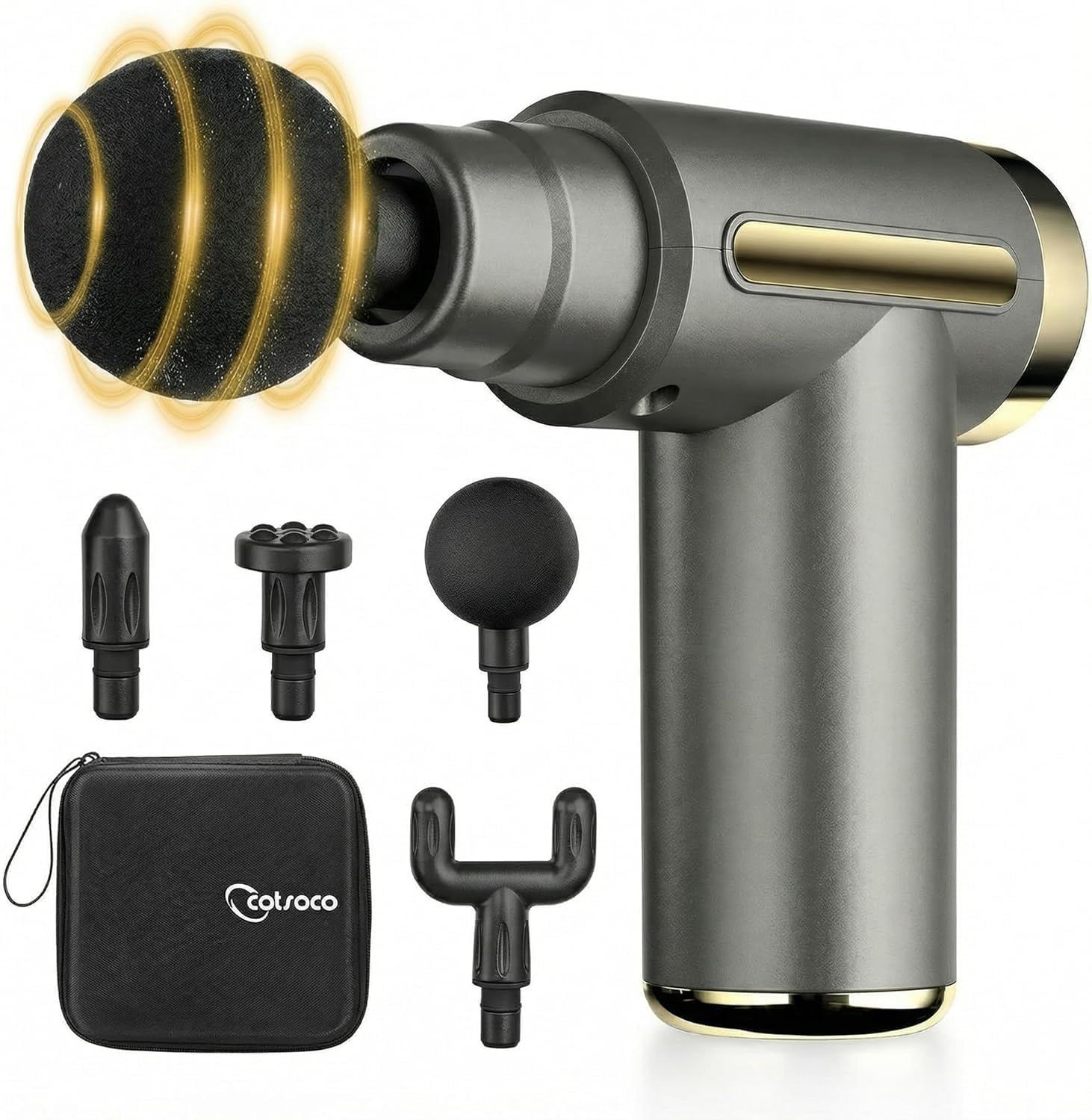
cotsoco 20-Head Massage Gun Set, Deep Tissue Percussion Massager with 9 Modes and 9 Intensities
Nine modes and nine intensities give the finest speed control of the four
More settings than most people will ever use, and the accessory pile gets messy fast
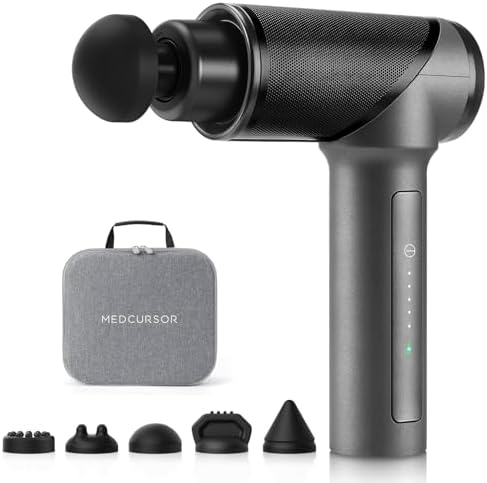
Medcursor Massage Gun - High Intensity Brushless Motor, Handheld Percussion Deep Tissue Massager with 6 Massage Heads
Brushless motor, six heads, and a design that does one job without menus
Fewer heads and no intensity ladder, so there is less to tune as you learn what your legs like
Jancane Mini Massage Gun with Case, Deep Tissue Muscle Massager with 6 Speeds & 4 Heads
Smallest and quietest of the group, and the included case makes it genuinely packable
Mini format means less motor to lean into on big muscle groups like quads and glutes
Prices and availability were captured from Amazon Creators API and may change.
What actually matters on a budget gun
Two specs decide whether a cheap gun is a tool or a toy: stall force and amplitude. Stall force is how much pressure the motor takes before the stroke stops moving. Amplitude is stroke length in millimeters, meaning how deep the percussive thump actually reaches into a muscle belly. Everything else on the box is decoration.
RPM is the number brands print in the biggest font, and it means almost nothing on its own. A gun that cycles fast with a shallow stroke feels like a vibrating phone taped to your leg. A gun with a deeper stroke at a lower speed feels like a hand working through tissue. I have watched a cheap gun stall out on a patient's hamstring mid-session, and I have watched a rider's hand go numb from a gun that rattled at max speed. Both problems trace back to the motor, not the mode count.
Noise belongs in the same conversation, because a gun you won't turn on is a paperweight regardless of what it can do. The speed people actually use is rarely the top speed. It's the middle of the range, where the stroke is still deep and the motor isn't screaming. That's the number worth caring about, and it's the number almost nobody publishes.
None of these four listings leads with a measured stall force or an amplitude figure. What they lead with is head count, mode count, and intensity count. That's not a dealbreaker at this price, but it does mean you should buy on adjustability and format, then judge the motor yourself in the first week while a return window is still open.
The four guns in this comparison
20-Head Massage Gun Deep Tissue Percussion Massager with 3 Modes
This one wins the accessory arms race outright. Twenty heads means you can dedicate a fork tip to your feet, a flat head to your back, and a bullet head to a knot in your upper traps without swapping mid-session. If you have ever tried to work a plantar fascia with a round ball head, you understand why that matters.
The trade-off is control. Three modes is a coarse ladder. On a gun with a deep stroke, three speeds is usually enough, because you settle into one or two settings and stay there. On a gun with a shallow stroke, three speeds feels like a limitation, because you keep hunting for a setting that reaches deeper and it isn't there. I would want to press this one into a loaded quad before I trusted it with a patient. For home recovery use on shoulders, calves, and feet, the head selection does a lot of the work for you.
cotsoco 20-Head Massage Gun Set, Deep Tissue Percussion Massager with 9 Modes and 9 Intensities
This is the pick of the group, and the reason is boring: adjustability. Nine modes and nine intensities gives you a fine enough ladder to find a setting that works on a stiff calf on Monday and a sore lower back on Thursday, without jumping from "barely buzzing" to "hand going numb." That range is what separates a gun you use twice and a gun that lives next to the couch.
The head count matches the 20-head gun above, which means the same accessory advantage. The honest criticism is that most people will use three heads and two speeds and never touch the rest. That's fine. Options you ignore cost you nothing as long as they don't cost you motor quality, and at this price point the settings menu is where your money went.
One note from experience with guns shaped like this: check the noise at the middle of the range, not the bottom. A gun that's quiet on speed one and rattles on speed five tells you the motor is working harder than the housing wants it to. Give it a week of real sessions and you'll know.
Medcursor Massage Gun - High Intensity Brushless Motor, Handheld Percussion Deep Tissue Massager with 6 Massage Heads
A brushless motor is the spec I actually want to see on a budget gun, because brushless designs generally run cooler and hold up better over hundreds of sessions than the brushed motors you find in the cheapest units. Six heads is a sensible number, not a pile. Flat, round, bullet, fork, and a couple of spares covers everything from a quad to a foot arch.
The catch is the missing intensity ladder. This gun gives you one set of speeds and six heads, and that's the whole toolbox. For a patient who wants to turn it on, work a shoulder, and turn it off, that simplicity is a feature. For someone who wants to dial in a specific feel for a specific muscle, it's a ceiling. If you've never owned a massage gun, this is the least complicated way to find out whether percussive recovery fits your routine at all. Black finish, no fuss.
Jancane Mini Massage Gun with Case, Deep Tissue Muscle Massager with 6 Speeds & 4 Heads
Mini guns get dismissed, and that dismissal is usually wrong. The best travel gun is the one that's actually in your bag at the trailhead, not the one sitting in a drawer at home because it weighs as much as a laptop. The case is the detail that makes this a real travel pick: four heads, six speeds, and a hard shell that survives being thrown in the back of a truck next to a helmet.
What you give up is motor mass. A mini has less housing to absorb the stroke, and it has less power to hold that stroke when you press down on a glute or a quad. That's physics, not a flaw. Use it on calves, forearms, shoulders, and feet, and use it before a ride to wake up cold legs. For deep work on the biggest muscle groups, you want a full-size gun.
The other thing this format gets right is noise. Small motors at moderate speeds tend to be quieter than big ones, and quiet is the spec that decides whether you use a gun on the couch during a movie or leave it in the closet. For office workers and anyone in an apartment, that matters more than another mode.
The trade-offs nobody puts on the box
Here's the pattern across all four: your money is going into either accessories or motor, and the listings never tell you which. Twenty heads and nine modes is a lot of features per dollar. That doesn't automatically mean the motor is weak, but it does mean the accessory budget was real, and something had to fund it.
The second trade-off is format. A full-size gun reaches deep and holds its stroke, and you will not pack it for a weekend trip. A mini goes everywhere and won't dig into a loaded quad. If you ride or lift hard, those are two different jobs, and pretending one gun does both is how people end up with a $200 device in a drawer.
The third is adjustability versus simplicity. A nine-by-nine settings menu is genuinely useful when you're learning what your legs respond to. It's genuinely annoying when you just want to turn the thing on. Know which person you are before you buy.
And the one I keep coming back to: no gun in this price range is a treatment device. Percussive therapy moves blood through a muscle belly and helps you feel looser before and after work. It does not fix an injury, and it should never go on bone, joints, or the spine. Muscle bellies only. That's anatomy, not a disclaimer.
Who should buy which
Buy the cotsoco set if you want the most control and the biggest accessory kit, and you're fine spending a few minutes learning the settings. It's the most flexible gun here.
Buy the Medcursor if you want a brushless motor and no menus. One button, six heads, work the muscle, put it down.
Buy the Jancane Mini if your recovery happens away from home, at a trailhead, in a gym bag, or on a work trip. The case is the reason it earns a spot.
Buy the 20-Head 3-Mode gun if you already know which three heads you use and you want the rest of the pile in the box. Just press it into a real muscle in the first week, while you can still return it.
What I'm testing next
I've got two more sub-$100 guns on the bench for the rest of the Colorado riding season, and the logbook question is the same one I ask about every unit: does the stroke hold when I lean into a hamstring at the end of a twenty-minute session, or does it fade? That's the measurement that predicts whether a gun survives three months or three weeks. I'll publish the numbers when the season closes.
The bottom line
Head count sells guns. Motor quality keeps them. In this group, the cotsoco set gives you the most room to find a setting that works, the Medcursor gives you the simplest path to a brushless motor, the Jancane Mini gives you the only gun here you'll actually carry, and the 20-Head 3-Mode model gives you the biggest box of attachments. Pick the one that matches where and how you recover, then judge the motor yourself in week one. That's the only review that counts.