I have been a physical therapy assistant in Denver for eight years, and I have spent six of those years chasing enduro lines on Colorado trails. That combination means I see percussion guns from both sides: in the clinic, where a patient hands me a gun they bought online and asks if it is any good, and on my own living room floor the morning after a 30-mile ride when my quads have opinions about the climb I chose. The best massage guns for recovery are not the ones with the biggest number printed on the box. They are the ones with enough stroke to reach a muscle belly, enough motor to keep moving when you lean in, and a noise level you can tolerate at 9 p.m. on a weeknight.
Related: Massage Gun Amplitude And Stall Force Explained
The short answer: the Bob and Brad C2 is the safest pick for most households, because it pairs a simple five-speed, five-head design with FSA and HSA eligibility. The 24-head gun is for people who want a different attachment for every muscle group. The Sharper Image Powerboost Max is the recognizable retail-brand option. The compact portable gun is the one that lives in a gym bag or a carry-on. The long answer is about how you will actually use the thing, which is what the rest of this comparison covers.
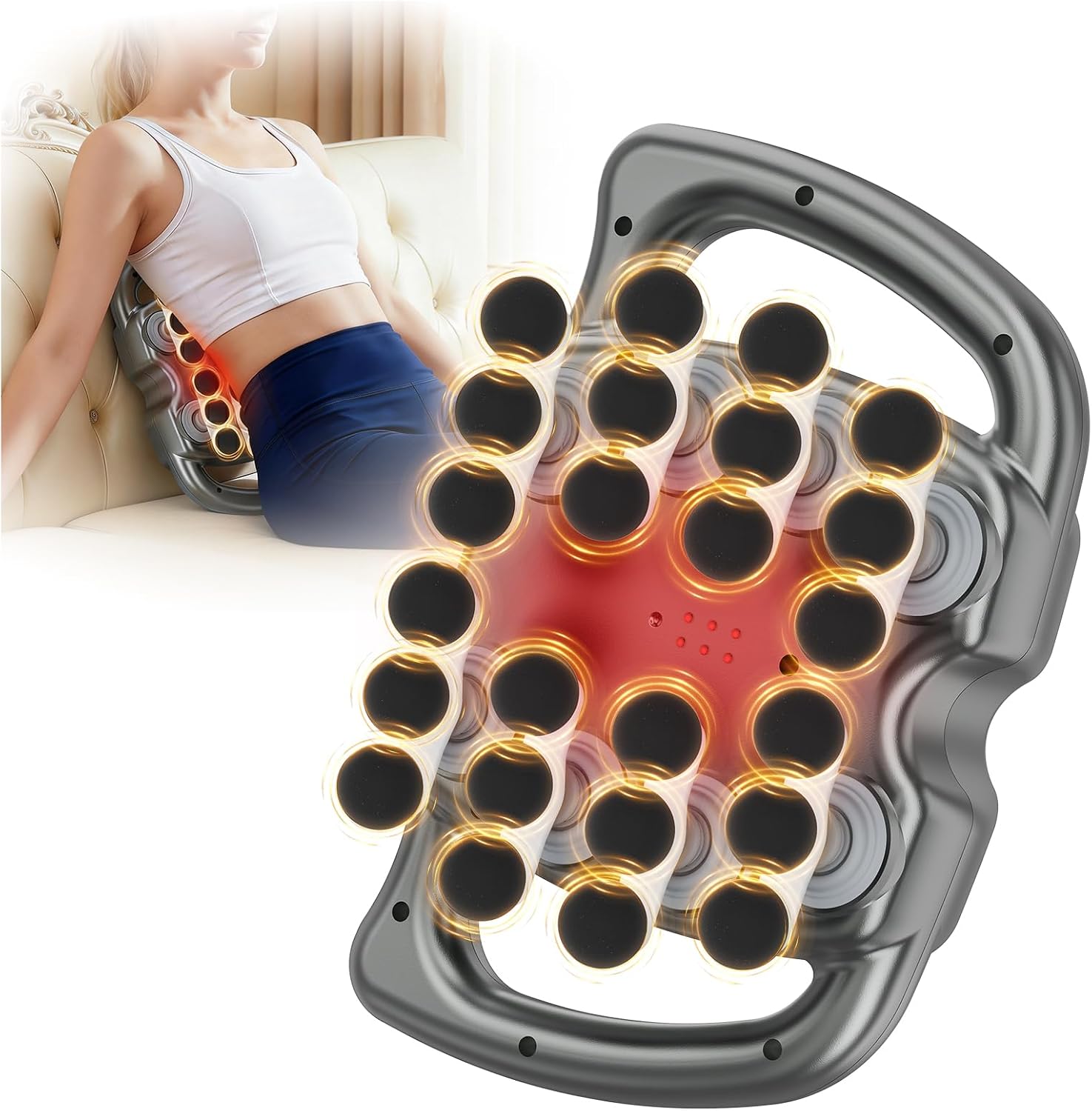
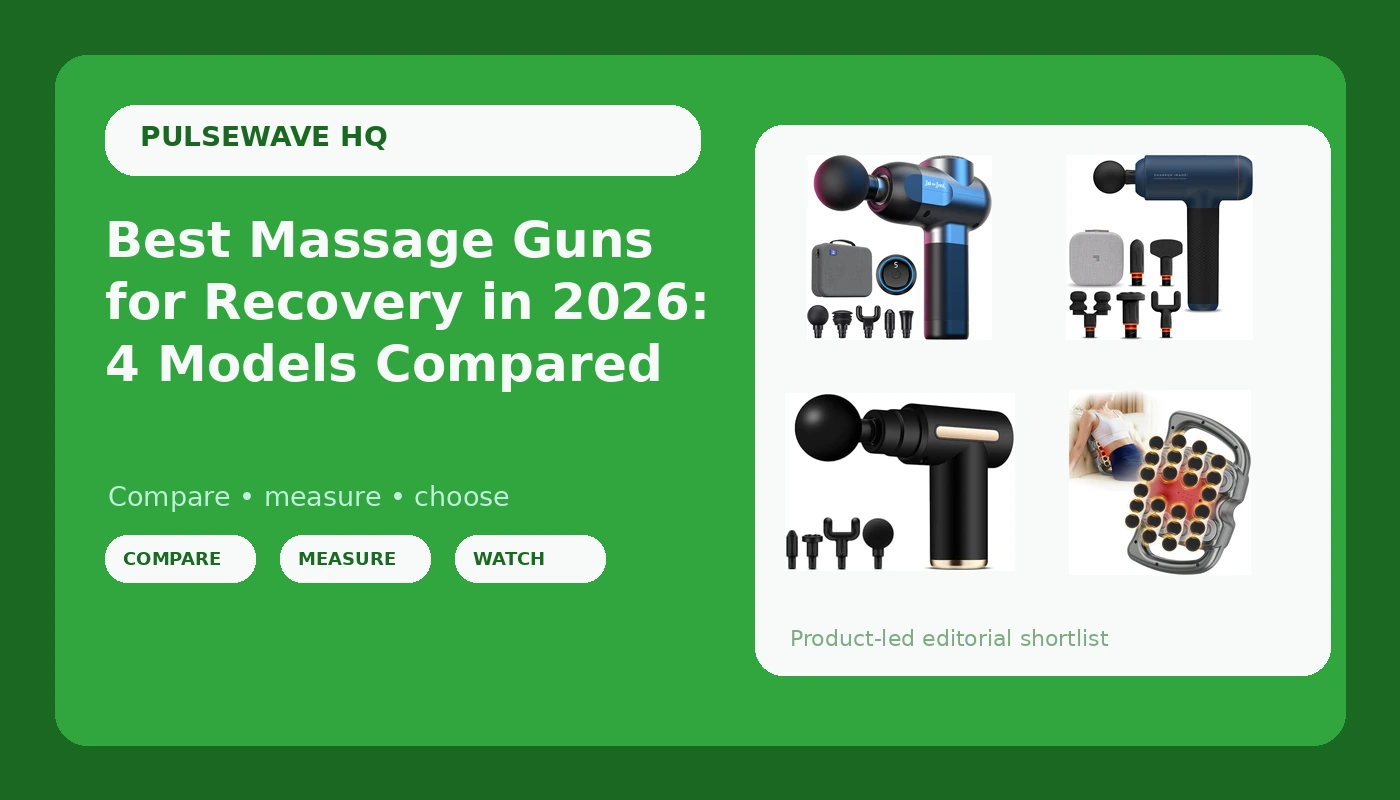
24-Head Massage Gun, 9 Modes x 99 Speeds
24 interchangeable heads cover almost every muscle group, and 9 modes across 99 speed steps gives you fine control at the low end
No published stall force or amplitude, and 24 heads is a lot of small parts to keep track of
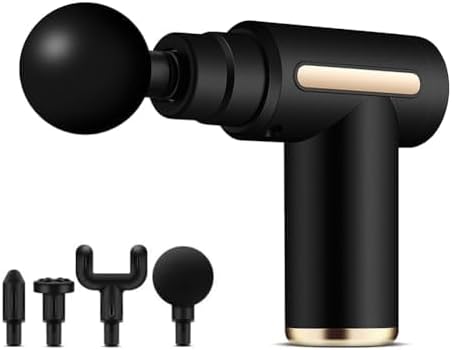
Portable Massage Gun Deep Tissue (Black)
Small, light, and the easiest of the four to keep with you, which matters more than spec sheets for travel and gifts
The least powerful design here, so treat it as a light-use and warmup tool rather than a deep tissue workhorse
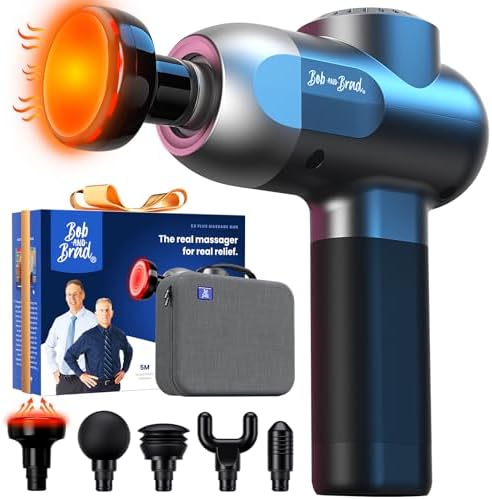
BOB AND BRAD C2 Massage Gun
Five speeds and five heads is a sensible starting kit, and it is FSA eligible and HSA approved, which few guns in this price band are
Five speeds is a coarse range if you like to fine-tune pressure, and the head count is modest next to the 24-head model
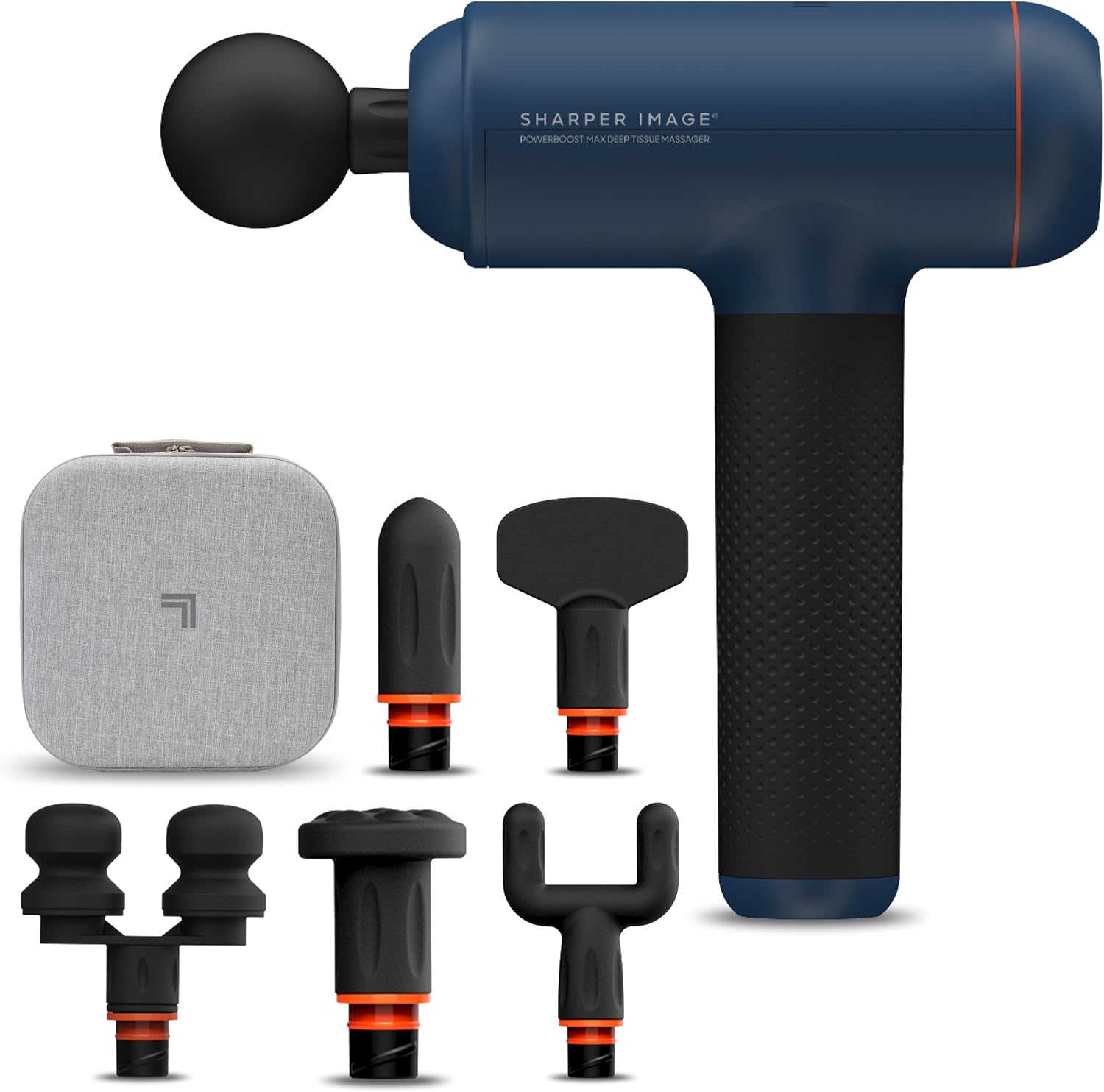
Sharper Image Powerboost Max Deep Tissue Massage Gun 2025 Version (Blue)
A brand you can find in a store, a current 2025 version, and a straightforward deep tissue format
The priciest of the four with the least published detail about stroke and motor behavior
Prices and availability were captured from Amazon Creators API and may change.
Amplitude and stall force decide everything, and none of these list both
Here is the thing I wish more buyers understood before they click buy. RPM, the strokes-per-minute figure, is the number brands print largest and the number that means the least on its own. A gun can spin at a huge RPM and still feel like a phone vibrating in a sock if the stroke length behind it is short. Amplitude, the stroke length in millimeters, is what determines whether the percussive thump reaches the muscle belly or just skims the surface.
Stall force is the other half. That is how much pressure the motor can absorb before the stroke stops moving. In the clinic I have watched a cheap gun stall out mid-hamstring on a patient, and the worst part is not the wasted minute. It is that the gun teaches you the wrong pressure. You push harder to get a response, the motor quits, and you end up mashing tissue instead of letting the tool do the work.
I will be straight with you: none of these four listings publish a stall force number, and only some describe the stroke. That is not a dealbreaker at these prices, but it does mean you should buy from a place with an easy return window and judge the gun on your own leg, not on the box. If a brand is confident in its motor, it prints the number. When it does not, you learn the truth in the first ten minutes anyway.
The 24-head gun: most versatility, most moving parts
The 24-head multi-attachment model is the most interesting product in this group on paper. Twenty-four heads means you can match the tip to the tissue instead of making one round ball do everything. A flat head for quads and glutes, a fork for the erector muscles along the spine, a bullet tip for a stubborn spot in a calf. Nine modes across 99 speed steps also gives you more low-end control than the other three, and low-end control is where beginners actually live. Most people never need the top of the speed range, but almost everyone benefits from being able to start slow.
The listing leads with a quiet, multi-head design, and leading with noise is the right instinct. I have said this for years: a gun that is too loud to turn on is a paperweight with a battery. If you live in an apartment, share a wall, or do your recovery while someone else is watching television, quiet is not a luxury feature. It is the feature.
The trade-off is parts management. Twenty-four heads means twenty-four things to lose, and if you are honest with yourself, you will use three of them. That does not make the gun a bad buy. It makes it a good buy for a household where two or three people will use it on different body parts, and a slightly wasteful buy for one person who just wants their quads loosened.
The Bob and Brad C2: the practical household pick
The C2 is the one I would hand to a friend who is not a gear person. Five speeds and five heads is a sensible kit: enough attachments to cover the muscle groups people actually work on, and few enough that nothing gets lost in a drawer. Bob and Brad built their audience on physical therapy content rather than fitness marketing, and the design reflects that. It reads like a tool made by people who understand that recovery work is boring, repetitive, and best done with a simple interface.
The genuinely practical advantage is FSA eligibility and HSA approval. If you have a flexible spending account balance you need to spend before the year rolls over, this is one of the few guns in this group you can pay for with pre-tax dollars. That is not a marketing line. That is a real discount on a real purchase, and it is worth checking your plan rules before you buy anything else on this list.
The criticism is the speed range. Five speeds is coarse. If you like to nudge intensity up in small increments, or you want a very gentle setting for a neck and shoulders session and a firmer one for a quad, you will feel the gaps between the steps. The 24-head gun solves that with its 99 steps. The C2 solves it by being simple enough that you stop thinking about settings and just use it. Both approaches work. Only one of them fits how you personally behave with a new gadget.
The Sharper Image Powerboost Max: brand recognition costs more
The Powerboost Max is the retail-brand entry, and it is the 2025 version in blue. If you have ever walked through a mall and seen a Sharper Image display, you know the appeal: a name you recognize, a product you can look at before you buy, and a support path that does not depend on a marketplace seller answering emails.
It is also the most expensive gun in this comparison, and it publishes the least detail about the two specs I care about most. That is not an accusation. It is a pattern I have seen across this whole category: the stronger the brand, the less it feels obliged to prove the motor. Deep tissue is the claim, and I have no reason to doubt it does the job for typical home use. I just cannot tell you from the listing whether the stroke is deep enough for a heavy lifter's glutes or whether it will hold pressure when you lean in.
Buy it if brand familiarity and a recognizable retail presence are worth a premium to you. Skip it if you are optimizing purely for features per dollar, because the other three all give you more published detail for less.
The compact portable gun: the one that actually travels
The portable deep tissue model is the smallest and lightest of the four, and it is the one marketed as a gift for home and travel. That framing is smarter than it sounds. The best recovery tool is the one that is with you, and a full-size gun stays home when you are packing a carry-on or a gym bag for a lunchtime session.
Here is the honest limitation: a compact body usually means a smaller motor, and a smaller motor usually means less stall force. This is not a gun I would buy to work on heavy quads after a long ride. It is a gun I would buy to keep in a desk drawer, take on a weekend trip, or hand to someone who wants a gentle warmup before a run. Used that way, it is genuinely useful and the price makes it an easy gift.
If you already own a full-size gun and want a second one for the car or the office, this is the sensible addition. If it will be your only gun and your main goal is deep work on big muscle groups, spend the extra and pick one of the larger options.
Noise and battery: the two specs that decide whether you keep using it
I have owned more than twenty guns over the years, and the ones that got used were never the most powerful. They were the quiet ones with a battery that survived a normal week.
On noise, the multi-head gun is the only listing here that leads with it, which tells you the manufacturer knows it is a selling point. For the other three, assume you are rolling the dice until you turn it on. The test that matters is not the spec sheet. It is whether you can hold a conversation while the gun runs at the speed you actually use. If you have to shout, you will use it less, and less use is the same as no use.
On battery, ignore the lab number. Lab battery claims are measured at a constant speed in a climate-controlled room, and nobody uses a massage gun that way. What matters is whether it survives a week of 20-minute sessions on one charge, because that is the real rhythm: a few minutes per muscle group, several evenings in a row. Any of these four should manage that if you charge it when you are not using it. If you go a month between sessions, charge it before you need it, because lithium cells that sit empty are lithium cells that disappoint you.
Who should buy which
- You want one gun for a whole household: the Bob and Brad C2. Five heads, five speeds, FSA and HSA eligible, and a design that does not require a manual.
- You want maximum attachment variety and fine speed control: the 24-head gun. Best for people who work on several muscle groups and like to dial intensity precisely.
- You want a recognizable brand and a current model year: the Sharper Image Powerboost Max 2025. You pay a premium for the name and the retail path.
- You want something for the gym bag, the office, or a gift: the compact portable gun. Light, cheap, and easy to keep with you.
The trade-offs I would not paper over
More heads is not automatically better. If you use two attachments and lose the other twenty-two, you paid for clutter. Fewer speeds is not automatically worse either. A five-speed dial that you actually turn beats a 99-step range you never explore. And price is a poor predictor of quality in this category. The most expensive gun here is not the one with the most published information, and the cheapest one is not trying to be a deep tissue tool. It is trying to be a travel tool, and it succeeds at that.
The one rule I would hold to: buy where returns are easy, test the gun on your own quad on day one, and lean into it. If the stroke stalls the moment you add pressure, send it back. If it keeps thumping, you found your gun, and the number on the box never mattered.
The bottom line
For most people, the C2 is the pick, mostly because the FSA and HSA angle makes it cheaper than it looks and the design is impossible to overthink. If you want the widest attachment set and the finest speed control, the 24-head model is the more interesting tool. If brand familiarity is worth the money to you, the Powerboost Max is the safe retail choice. And if you need a gun that leaves the house, the compact portable model is the one that will.
Whatever you choose, use it on muscle bellies. Not bone, not joints, not the spine. That is not a disclaimer. That is anatomy.