A massage gun comparison is only worth reading if it answers the question you actually have: which of these will you still be reaching for in three months, and which one ends up at the bottom of a gear bin? I am Tyler, a physical therapy assistant at a sports rehab clinic in Denver. I have spent eight years working with everyone from pro cyclists to weekend warriors coming back from crashes, and six years on an enduro bike learning exactly what my own quads feel like the morning after a long ride. This massage gun comparison covers four percussion models and sorts them by the job each one is built for, not by the number printed largest on the box.
Here is the frame I use for every gun I pick up. Stall force and amplitude are the specs that matter. Stall force is how much pressure the motor takes before the stroke quits moving, and amplitude is stroke length in millimeters, meaning how deep the percussive thump actually reaches. RPM is the number brands print big, and on its own it means almost nothing. Noise at the speed people really use matters more than peak power, because a gun you avoid turning on is an expensive paperweight.
I have not put a full riding season on any of these four units, so I am not going to quote stall force or amplitude figures the listings do not provide. What I can do is read each description the way I read them for patients, tell you where the marketing is doing the talking, and match each gun to a real use case.
The TOLOCO Massage Gun is the strongest overall pick of this group for most people, because ten interchangeable heads and a brushless motor cover more of a normal home routine than a single fixed shape does. The Medcursor Massage Gun is the better travel and gym bag choice, the Mebak 3 is the one positioned squarely at athletes, and the portable handheld model is a light-duty vibration device rather than a true percussion tool.
TOLOCO Massage Gun
Ten heads and a brushless motor make it the most versatile kit here for a household or a full-body routine
Ten heads is not the same as depth, and "silent" is a marketing word for a device that still makes noise
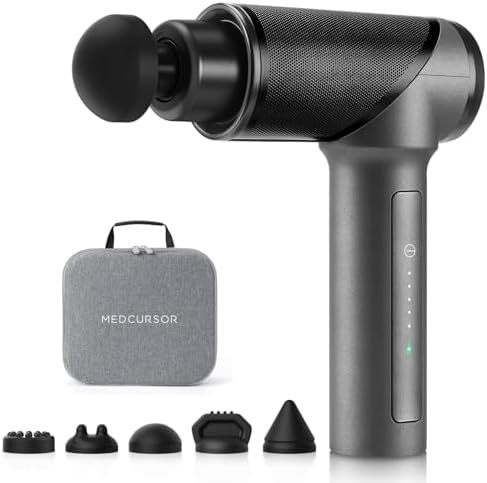
Medcursor Massage Gun (Gray)
Six heads and a compact handheld percussion body that travels well and looks at home in a gym bag
"High intensity" describes motor speed, not stroke depth, so it will not out-thump a deeper-amplitude gun
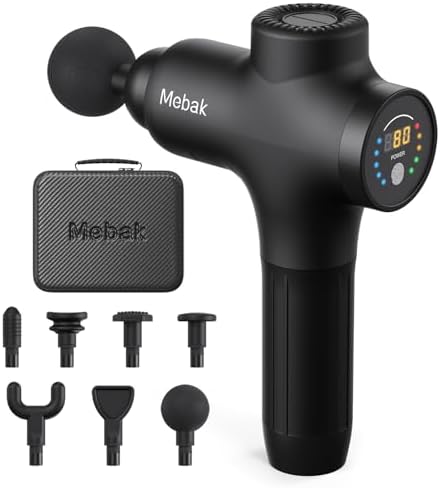
Mebak 3 Massage Gun
Built and marketed around athletes, with a deep tissue focus and a straightforward single-purpose design
Fewer accessories than the TOLOCO, and the listing leans on pain relief language I would not repeat
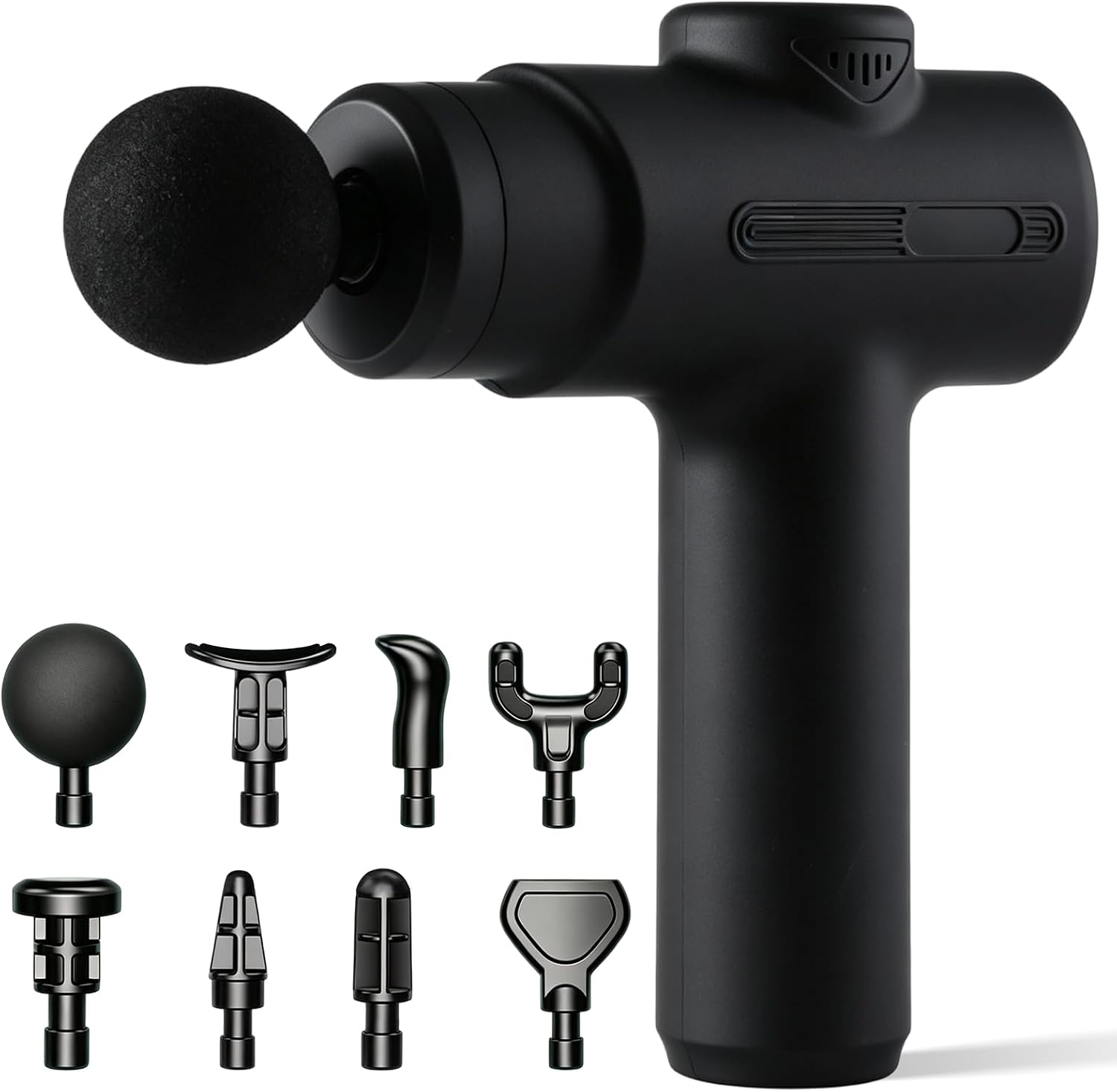
Massage Gun Deep Tissue Handheld Neck Massager (Black)
Small, light, and easy to keep within reach for shoulders and neck after a desk day
Six vibration levels describe a vibration unit, not a percussive gun, so it is a warm-up toy rather than a recovery tool
Prices and availability were captured from Amazon Creators API and may change.
How I sort massage guns before anything else
The first thing I check is whether a listing mentions stall force or amplitude at all. Most do not, which tells you something. A gun that stalls the moment you lean into a hamstring is not doing percussive therapy, it is buzzing the surface of the skin while your hand does all the work. Amplitude is the second filter: something in the 10mm range is light work, and deeper stroke lengths are where actual deep tissue territory starts.
RPM is the last thing I look at. A gun can advertise a huge strokes-per-minute figure and still feel like a phone on vibrate if the stroke is short and the motor folds under pressure. That is why I care about motor type. Brushless motors generally run cooler, quieter, and longer than cheap brushed motors, and three of these four lean on brushless design as a selling point.
The other half of the decision is not a spec at all. It is whether you will use the thing. A gun that is loud enough to wake a sleeping partner, or heavy enough that your forearm fatigues before your quad does, gets abandoned. So I weigh noise and weight as heavily as power, because the best gun is the one that is still in the rotation in week six.
TOLOCO Massage Gun: the ten-head home kit
The TOLOCO Massage Gun comes with ten massage heads and a silent brushless motor, and it is the most complete package in this comparison. Ten heads is not a gimmick in the way people assume. Head shape is what lets you work a broad area like a quad or a lat without digging a hard point into the wrong spot, and then switch to a smaller, more targeted shape for forearms, calves, or the tissue around a shoulder blade.
I will push back on one word in that description: silent. No percussion gun is silent. Brushless motors are quieter and more efficient than brushed ones, and they do not rattle your hand numb the way cheap motors do at the top speeds, but every one of these devices makes noise. What matters is whether it is quiet enough that you use it while watching television instead of apologizing to the room.
The carbon finish and the ten-head kit point to a gun designed for a household or someone who wants one tool to cover a full body routine. If you want a single gun on a shelf that handles post-ride legs and a stiff upper back, this is the one I would point you to first.
Medcursor Massage Gun: the compact percussive pick
The Medcursor Massage Gun is a handheld percussion deep tissue massager with six massage heads and a high intensity brushless motor, finished in gray. It is the middle child of this group, and the middle child is often the sensible choice. Six heads covers the useful shapes without turning your drawer into a parts bin, and the form factor reads as compact enough to live in a gym bag.
The phrase high intensity is where I slow down. Intensity in marketing usually means motor speed, and motor speed without stroke length is just faster buzzing. A gun like this can absolutely get blood moving through a muscle belly before a workout or help you unwind after one, but do not expect it to reach the same depth as a gun with a genuinely long stroke. That is not a knock on the Medcursor specifically, it is a limit of the category at this size.
Where it wins is portability and simplicity. If your routine happens in a locker room, at a climbing gym, or in a hotel room, a gun you can throw in a bag and forget about until you need it beats a more capable gun sitting at home. The gray finish also means it does not look like a toy in a shared space.
Mebak 3 Massage Gun: the athlete-first option
The Mebak 3 Massage Gun is the most narrowly aimed product here: deep tissue, built for athletes, with a design that does not pretend to be a general household gadget. If your version of recovery is twenty minutes on the floor after a hard session, a tool that does one job well is easier to live with than a kit you have to think about.
The listing leans on pain relief language, and I want to be clear about where I stand on that. A massage gun is a recovery and warmup tool. It does not treat an injury, it does not fix a strain, and it is not a substitute for actual rehab work. What percussive therapy does well is get blood moving through a muscle belly, help you feel looser before you train, and give you a structured way to wind down after. That is a real benefit. It is just not the same claim as pain relief, and I would rather you buy this gun for the recovery routine than for the promise on the box.
Fewer accessories than the TOLOCO is the trade-off. If you want one shape and one job, that simplicity is a feature. If you want options for every body part, it is a limitation.
The portable handheld model: read the description closely
The fourth product is described as a deep tissue handheld neck massager with six adjustable vibration levels, portable, for athletes at home or in the gym. Notice the wording: vibration levels, not stroke settings. That distinction matters more than any other line in this comparison.
A vibration unit shakes the surface. A percussive gun drives a stroke into the muscle belly. Those are different tools with different ceilings. Six vibration levels on a small handheld body is a reasonable thing to own if what you want is something light for your neck and shoulders after a desk day, or a small device to keep in a drawer at work. It is not what I would hand someone who just finished a thirty mile ride and needs their quads talked down off the ledge.
I would rather tell you that plainly than let the name on the listing do the selling. If your budget is tight and your needs are light, this is a sensible entry point. If you are chasing real recovery after hard training, spend your money on one of the percussion guns above instead of buying this one and being disappointed twice.
What you give up as you move down this list
The pattern across these four is consistent. As you move toward lighter, smaller, and cheaper, you give up depth first, then head options, then motor quality. You rarely give up convenience, which is why the smaller units keep selling.
Head count is the most visible difference, but it is the least important. A gun with ten heads and a shallow stroke is less useful than a gun with three heads and a deep one. What head count really buys you is comfort: the right shape lets you work a large muscle without pressing a hard edge into a spot that does not want it.
Motor quality is the difference you feel in your hand. Brushless motors run smoother, stay cooler, and hold their speed better under load. Cheaper motors whine, heat up, and rattle at the top of their range. If you have ever used a gun that made your fingers tingle after five minutes, you have met a motor that was built to a price.
Noise, battery, and the paperweight test
Quiet matters more than power for most people. The strongest gun in the world does nothing for you if you will not turn it on because it drowns out a podcast. When you read a listing, treat any noise claim as relative rather than absolute, and look for brushless motor language as a rough proxy for a quieter, smoother device.
Battery is the other spec that separates a tool from a toy. Lab runtime numbers are usually measured at the lowest speed with no load, which is not how anyone uses a massage gun. Think about your real pattern: a few twenty minute sessions a week, maybe more during a heavy training block. A gun that needs charging after every other session will annoy you. A gun that holds a charge for a week of normal use disappears into your routine in the best way.
The last test is the one I use with patients. Would I hand this to someone recovering from a crash and trust them to use it sensibly? That means a device that is easy to control, comfortable to hold, and not so aggressive that a beginner bruises themselves in the first session.
Which one fits your routine
For a full home setup where one gun has to cover legs, back, and shoulders, the TOLOCO Massage Gun and its ten heads are the most flexible answer in this group. For a gun that lives in a gym bag and comes out in a locker room, the Medcursor Massage Gun is the better travel companion. If you train hard, want one tool with one purpose, and already understand that recovery is a routine rather than a rescue, the Mebak 3 Massage Gun fits that mindset. And if your needs are genuinely light, shoulders and neck after desk work, the small portable handheld model will do the job without asking much of your budget or your drawer space.
One rule applies to all four, and it is not a disclaimer, it is anatomy. Muscle bellies only. Never bone, never joints, never the spine. Keep the head moving, keep the pressure tolerable, and stop if something feels sharp rather than sore.
What I am testing next
I am running 2026 guns through a full Colorado riding season with a logbook tracking stall force, stroke length, noise at each speed, and battery life under real use. When I have numbers I trust for this category, I will publish them here rather than repeat what a box claims. Until then, buy for the routine you actually keep, not the one you plan to start.