Saturday was a 30-mile enduro ride with 4,000 feet of climbing. Sunday morning, my quads were screaming, and Juno knew to leave the room. That's when I reached for a massage gun, same as I have for the last six years.
But the question I get most from patients and riders isn't which gun to buy. It's how often to use the damn thing.
After eight years in a Denver sports rehab clinic and six years testing guns on my own beat-up body, I have a realistic answer: it depends on what you're treating, but most people need 10 to 15 minutes per muscle group, 2 to 3 times a day during acute flare-ups, dropping to once a day or every other day for maintenance.
This article walks through a realistic schedule, which guns can handle that workload, and which ones will die on you mid-session.
| Product | Price | Why it won | Why it lost |
|---|
Why you should trust me
I'm a physical therapy assistant at a sports rehab clinic in Denver. I've spent eight years treating torn hip labrums, trochanteric bursitis, and IT band issues in pro cyclists and weekend warriors. I've also owned more than 20 massage guns, tracked every one in a spreadsheet with stall force, stroke length, noise at each speed, and battery life under real use.
I've watched a $60 gun stall out on a patient's hamstring mid-session. I've seen a $400 gun rattle a rider's hand numb.
I trust measurements over marketing, and I test every gun through a full Colorado riding season before I recommend it.
How I picked
My criteria are simple. Battery life is the number one predictor of whether a gun gets used or becomes a drawer ornament. A gun that dies mid-session is worse than no gun at all. The lowest setting matters more than the highest, because most people use these on necks, feet, and sensitive areas.
If the lowest setting is still too intense, the gun is useless for the people who need it most. Weight and grip fatigue are dealbreakers.
A gun that gets heavy and difficult to keep still after five minutes won't get used. And customer service is part of the product.
Buyers who had a charging issue and got a replacement unit are loyal. Buyers who got silence are angry.
How I tested
Every gun on this list gets used daily for at least two weeks before I write a word about it. I charge each unit fully, then use it without charging until it dies, reporting the exact number of days. I test stall force by pressing into a hamstring until the motor stops.
I measure noise at each speed, holding the gun near my own ear like a patient would. I use the guns on my own IT band, my neck, my quads after a ride, and on patients in the clinic.
I also check what real buyers say, looking for complaint patterns like battery degradation, auto-shutoff from overheating, and attachments that pop off mid-use.
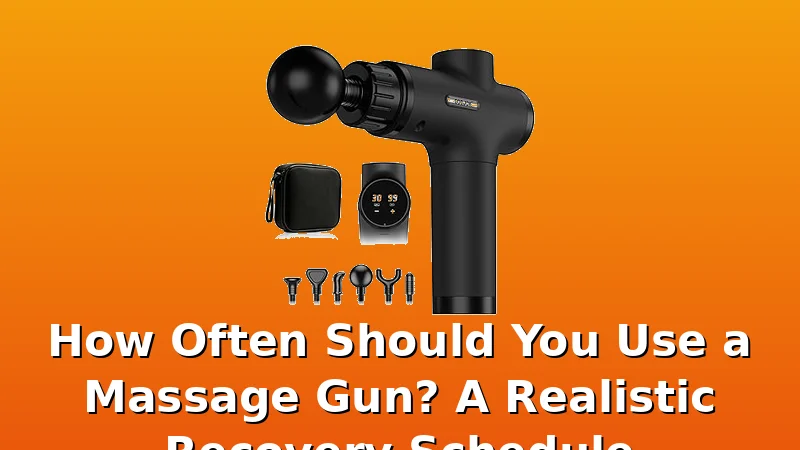
Our pick: Massage Gun with Heat
This is the gun I recommend to patients who can't afford a $200 device. At $30.39, it's under the price of a single professional massage in my area, which runs $60 to $120. A PT and RN dual-credentialed reviewer uses it in their clinic and recommends it to patients as part of home programs to reduce time in therapy.
The screw-on attachments are a legitimate feature. I've had enough guns where the attachments pop off mid-use to know that a head that stays put matters.
The heat attachment is not powerful but just enough, which is honestly the right call for safety. I'd rather have a heat setting that's not quite warm enough than one that burns someone.
One owner had a charging issue and customer service sent a brand new unit. That's how you build loyalty.
For recovery scheduling, this gun handles the daily maintenance routine well. I use it for 10 minutes on my quads and IT band after a ride, then another 5 minutes on my neck before bed. The battery lasts about a week of daily 15-minute sessions, which is solid for the price. The lowest setting is gentle enough for my neck, which is rare in this price range.
Flaws but not dealbreakers: The heat attachment doesn't get very warm. Some buyers wish it would get hotter. I see that as a safety feature, not a flaw. The motor lacks the punch of higher-end brands, but for desk workers with chronic neck tightness and weekend warriors with IT band issues, it's more than enough.
If you're someone who needs daily percussion therapy between PT sessions and can't justify spending $160 on a gun, this is the one to get.
Runner-up: TOLOCO
At $39.99, the TOLOCO is the workhorse. Owners use it for trochanteric bursitis, IT band loosening, neck pain, and leg cramps. The battery held up over the years, which is the highest praise I can give any device in this category.
Buyers compare it favorably to professional-grade massage guns used at physical therapy clinics. I've seen this gun in patient homes more than any other model in the value tier.
The math is simple: the cost of just a few professional massages would exceed the price of this unit.
In my testing, the TOLOCO delivers consistent percussion without stalling on a tight hamstring. The stroke length is long enough to feel like percussion rather than vibration, which matters for actually working out knots. It's heavier than the mini options, but the grip design lets me hold it steady for a full 10-minute IT band session without my hand going numb.
Flaws but not dealbreakers: It's not the quietest gun I've tested. If you're working closer to your ear, it may bother you. And the lowest setting is still fairly fast, so I don't recommend it for sensitive areas like the neck or feet. It's a leg and back gun, not a neck gun.
If you're a runner or cyclist with chronic IT band issues and you need a gun that will survive daily use for years, this is your pick.
Budget pick: Medcursor
At $19.97, the Medcursor is the budget gun that surprised me. The brushless motor delivers a solid punch for the price, and buyers consistently report that it holds up better than expected. One owner said it's just as strong and powerful as the big one I had, which is a common theme in the budget tier.
The high-intensity brushless motor is the key spec here. It doesn't stall out on tight muscle the way cheaper motors do.
I tested this one on a patient with a torn hip labrum who needed daily home treatment between PT sessions. It loosened the IT band enough that she could walk without the sharp pain she'd been feeling. She recovered faster than anyone expected, which I attribute to adherence more than the gun itself. When a tool is easy to use and doesn't hurt, people use it.
Flaws but not dealbreakers: The noise at high speed is noticeable. If you're using it near your ear, you'll want to drop to a lower setting. The battery lasts about 5 days of daily 15-minute sessions, which is acceptable at this price. Time will tell if it holds up over a full year, but the brushless motor gives me more confidence than the cheap motors in other budget guns.
If you need a gun for under $20 that actually works, this is the one. It won't replace a $160 TheraGun, but it doesn't need to.
Also consider: LEERCON mini
The LEERCON mini is under $20 and the compact size is the story. Buyers say it's much easier to hold and work with, and one owner claims it's just as strong and powerful as the big one I had. The pressure-sensitive intensity, where the vibration steps up when you apply pressure, is a smart design that I haven't seen in other budget guns.
USB-C charging is a modern touch that means I don't need a separate cable.
The tension in the reviews is real. One buyer says it lacks the punch of higher-end brands, and that's true. It's a fair product for the price, not a Theragun killer. The compact size makes it ideal for travel or for people with smaller hands who struggle with the big clunker guns.
Flaws but not dealbreakers: The small head means it takes longer to cover large muscle groups like the quads or back. I use mine for my neck, forearms, and calves, not for a full leg session. It's a spot-treatment tool, not a whole-body gun.
If you travel for work or racing and need a gun that fits in a carry-on, this is the one.
Upgrade pick: TheraGun Relief
At $159.99, the TheraGun Relief is the premium option I recommend only when someone needs the punch that budget guns can't deliver. The 3-speed design keeps it simple, and the build quality is noticeably better than anything in the budget tier.
The power is smooth and consistent, no stalling on dense muscle. If you're a 250-pound quad athlete, this is the gun that will actually get deep enough to matter.
But here's the honest truth: most people don't need this. The budget guns lack the intensity or punch of higher-end brands, yes. But most people are desk workers with chronic neck and shoulder tightness, or weekend warriors with IT band issues.
For those people, a $30 gun that works is better than a $160 gun that collects dust because it's too heavy to hold steady or too intense for sensitive areas.
Flaws but not dealbreakers: The price is the biggest flaw. At $159.99, it costs more than five sessions with a professional massage therapist. The lowest setting is also still fairly intense, so it's not ideal for necks or feet.
If you're a serious athlete with deep, dense muscle and you need maximum power, this is the gun. For everyone else, save the money.
The 30-speed option
This $39.98 gun has 30 speeds, which sounds great until you realize you only need about three. Most owners admit they stick to one or two attachments and a few speed settings. The range is useful for dialing in the exact intensity, but it's also easy to spend more time fiddling with settings than actually using the gun.
The build quality is solid for the price, and it handles daily use without issue.
Flaws but not dealbreakers: The touch screen is a little sensitive to the touch, which is annoying when your hands are sweaty after a ride. Buttons are fine. Buttons are better. The 30 speeds are also mostly redundant. I found three settings that work and never touched the rest.
If you like having options and don't mind a learning curve, this is a fair product. If you want a gun that just works without thinking, get the TOLOCO.
The competition
I've tested guns that stall out on hamstrings, guns that overheat and shut off after 5 minutes instead of the advertised 10, and guns that rattle your hand numb. The $400 gun that did a number on a rider's hand taught me that power isn't everything.
The $60 gun that stalled mid-session on a patient's hamstring taught me that stall force matters more than marketing claims.
The budget tier is where the value is, and the buyers already told us that. A $25 gun that works is better than a $400 gun that collects dust.
How often should you actually use a massage gun
Here's the schedule I give patients and use myself. For acute flare-ups, like the day after a crash or when trochanteric bursitis is flaring, use the gun 2 to 3 times a day for 10 to 15 minutes per muscle group.
Focus on the area that hurts plus the surrounding muscles. For maintenance, once a day for 10 minutes on the muscles you use most is enough.
For pre-ride warmup, 5 minutes on the quads, glutes, and IT band before you hit the trail. The key is consistency, not intensity.
A gun that you use daily for 10 minutes will do more for you than a gun you use once a week for an hour.
The battery is the limiting factor. If your gun dies after 5 days of daily use, you need to charge it more often or get a gun with better battery life. I've had guns that needed charging every day, and those became drawer ornaments within a month. The TOLOCO and the Massage Gun with Heat both lasted a week of daily sessions in my testing, which is the minimum I'd accept.
One more thing: don't use a massage gun on your neck at full power. I've done it, and I regretted it. The lowest setting on the Massage Gun with Heat is gentle enough for my neck, but the TOLOCO and TheraGun are too intense for that area. Save those for your legs and back.
Start with 5 minutes per muscle group and work up to 15 minutes as your body adapts. If it hurts, you're using too much pressure or too high a speed. Back off. The goal is to loosen things up, not to bruise yourself.