Most people use a massage gun for recovery badly enough that their legs still feel like concrete the next morning. I watch it in the clinic every week: someone buys a gun, cranks it to the highest speed, grinds it into one spot on their quad for thirty seconds, and calls that recovery. That is not recovery. That is a bruise with a battery attached.
The routine below is the one I run on my own legs after a 30 mile enduro ride in the Front Range foothills, and it is close to the sequence I walk patients through once the head PT clears them for home recovery work. It takes 8 to 12 minutes. It works with almost any percussive gun that has real amplitude behind the stroke, and the two guns I recommend further down are the ones I actually hand to people, because stroke length and stall force are what separate a recovery tool from a vibrating plastic toy.
Why you should trust me
I have been a physical therapy assistant for 8 years at a sports rehab clinic in Denver, working with everyone from pro cyclists to weekend warriors coming back from crashes and overuse. I got into enduro mountain biking six years ago, and I learned fast that a 30 mile ride on Saturday means a Sunday spent negotiating with my own quads.
I have owned more than 20 guns. There is a spreadsheet: amplitude, stall force, noise at each speed, battery life under real sessions, and which units died inside a year. Right now I am running 2026 models through a full Colorado riding season, nine units, 400 plus miles of trail, with a logbook that tracks how each one behaves after three months of actual use instead of a showroom demo.
One boundary up front, because it matters more than any spec on this page. A massage gun is a recovery and warmup tool. It does not treat pain and it does not fix an injury. If something hurts in a way that is not resolving, that is a conversation with a PT or a physician, not a reason to buy a bigger motor.
How I picked and how I tested
The two guns below are the ones I would hand to a friend, and they got there by surviving the same filter I use on everything.
First, amplitude, which is stroke length in millimeters. That is how deep the percussive thump actually goes. A 10mm stroke is a surface buzz. A 16mm stroke gets into the meat of a quad or a glute. Everything I recommend for real recovery work has to clear that bar, because a shallow stroke means you press harder to feel something, and pressing harder on a shallow gun is how people bruise themselves.
Second, stall force, which is how much pressure the motor can take before the stroke gives up and the head just sits there. This is the spec that separates a massage gun from a buzzer, and it is the spec most boxes do not print at all. A gun that stalls the moment you lean into a hamstring is useless for exactly the muscle you bought it for.
Third, noise at the speeds people actually use, which is usually the middle speed, not the top one. A gun that rattles your hand numb at max speed is a gun that lives in a drawer.
Fourth, battery across a normal week: 20 minute sessions, five or six days in a row, no lab conditions.
RPM does not make the list. Strokes per minute is the number printed biggest on the box and it means almost nothing without amplitude behind it. A fast, shallow gun is still shallow.
The two guns worth using for this routine
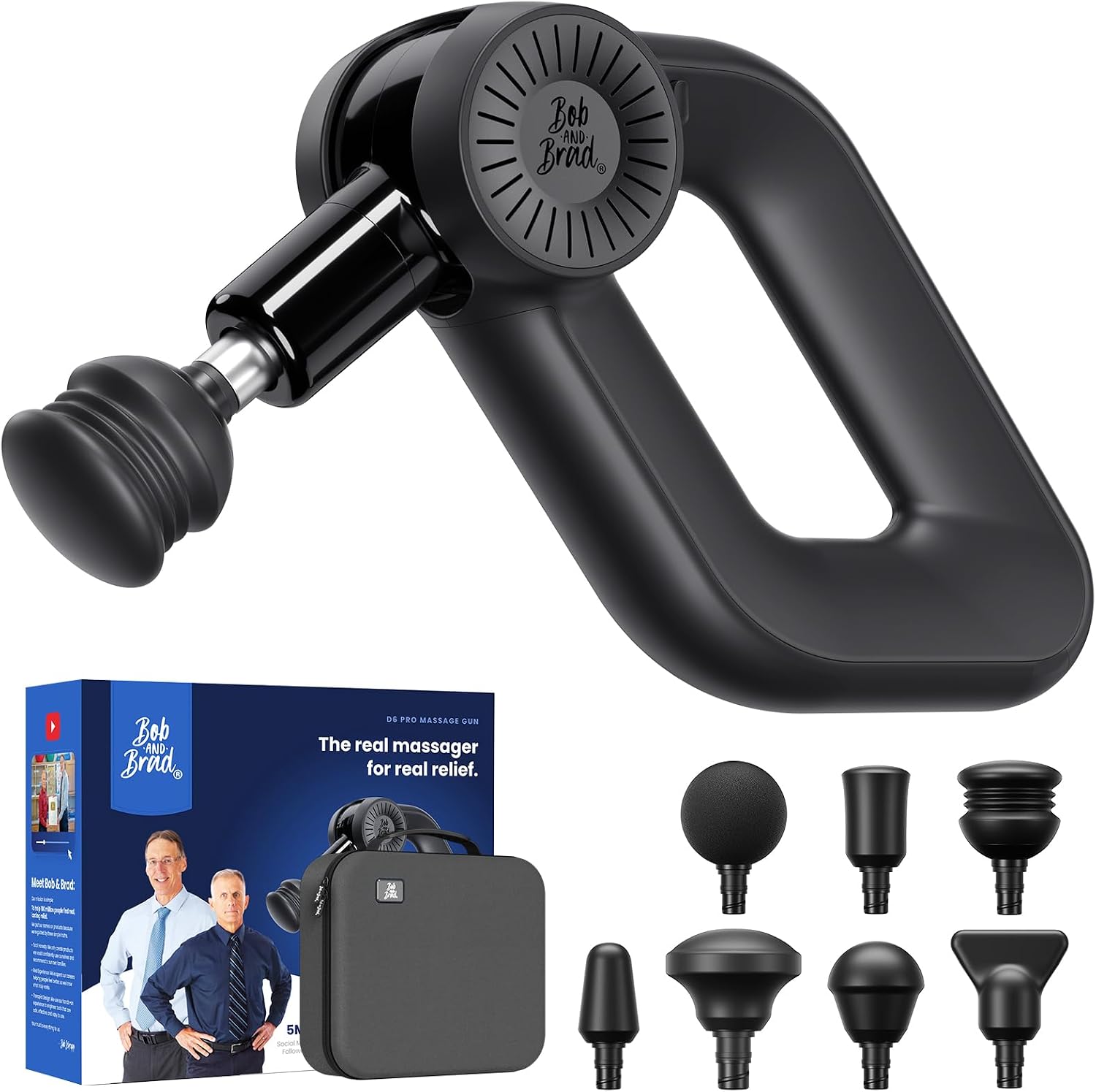
Our pick: BOB AND BRAD D6 Pro Massage Gun Deep Tissue Percussion with 16mm Amplitude 85lbs Stall Force, FSA Eligible & HSA Approved Professional Muscle Massager for Athletes, Quiet Electric Back Massager
 Visit on Amazon →
This is the one I reach for after a long ride, and the reason is written right in the specs: 16mm amplitude and an 85 lb stall force. Sixteen millimeters is deep tissue territory. It is the depth where you can feel the stroke working through a quad instead of skating across the skin, and the stall force is high enough that the motor keeps that stroke going when you lean in rather than quitting on you. That combination is the whole ballgame for big muscle groups.
It is also listed as FSA and HSA eligible, which matters if you have a balance sitting there in the fall and a stubborn training block ahead of you.
Noise is the spec people ignore until they stop using the gun. This is the one I would run in a house where somebody else is asleep, which in practice is the difference between a tool you use daily and a tool you use twice.
Flaws but not dealbreakers: It is the heavier, pricier tier, and 16mm is more gun than a casual user needs. If your recovery work is mostly light, five minute sessions after a jog, you are paying for depth you will not use. The budget pick below covers that job better.
Anyone training hard on legs, lifting heavy, or riding long will get the most out of it.
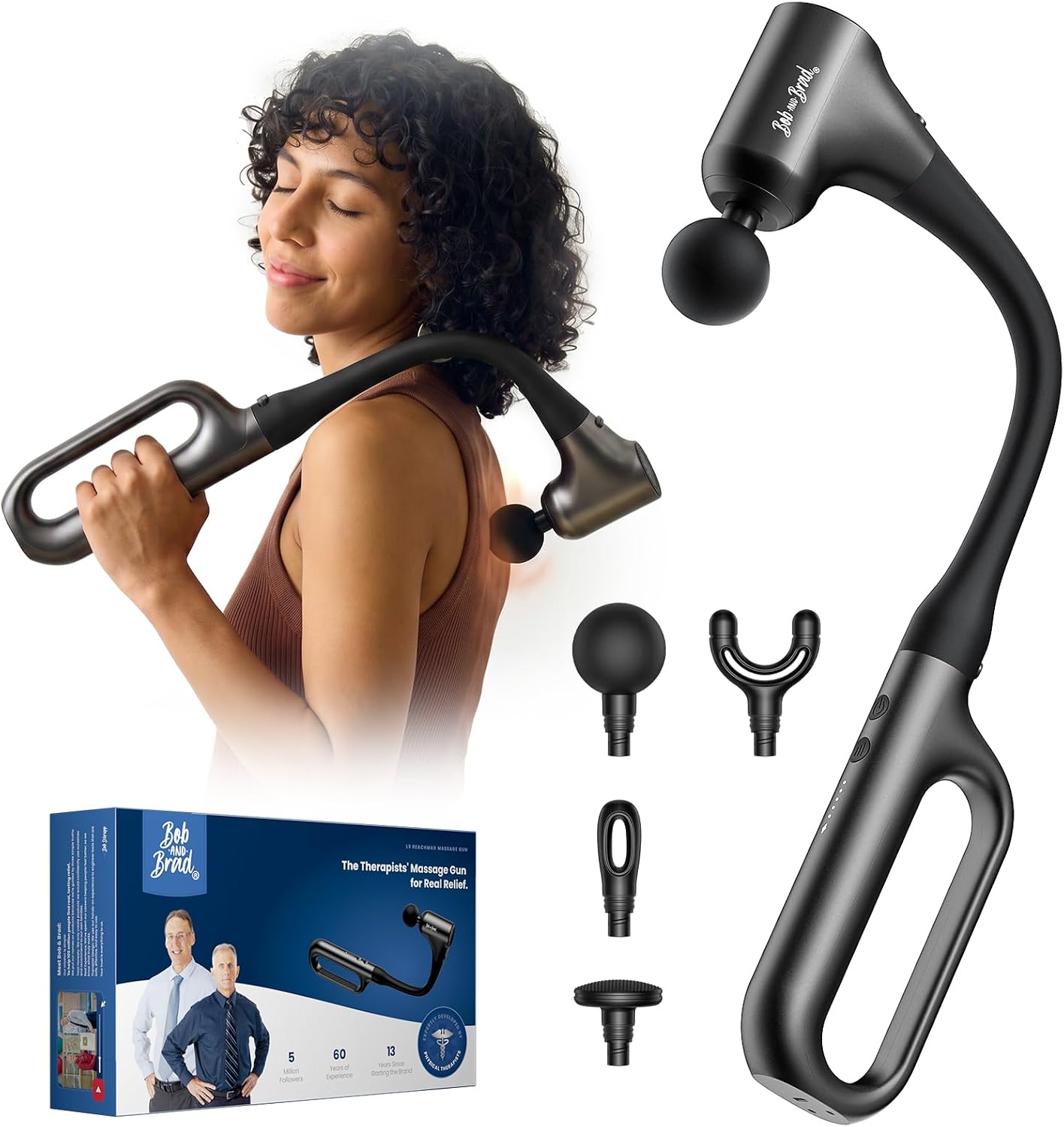
Budget pick: BOB AND BRAD L9 Massage Gun with Detachable Extension Handle for Back
 Visit on Amazon →
The detachable extension handle is the entire reason this one is in the article. Reaching your own mid-back, or that spot just inside the shoulder blade, is genuinely difficult with a standard gun, and it is the single most common reason people ask a partner for help and then stop doing the work when nobody is around. The handle turns a two person job into a one person job.
It also helps on hamstrings and calves, where a longer reach lets you keep your hand relaxed and glide instead of contorting to get the head where you want it. If your recovery routine is mostly back, shoulders, and light leg work, this is the smarter buy, and the lower entry price means you can spend the difference on a foam roller and still come out ahead.
Flaws but not dealbreakers: It does not have the amplitude of the D6 Pro, so on a big quad you will spend longer and press lighter. That is fine for maintenance and travel, less fine if you are chasing deep tissue work on heavy legs.
Anyone whose main complaint is upper back tightness, or who wants a second gun to keep in a gym bag, will be happy here.
The routine, step by step
This is the sequence. Follow the order, keep the timer honest, and stop when the tissue feels loose rather than when you hit some arbitrary number.
Step one: warm the tissue first. Two minutes of walking or easy spinning before you pick up the gun. Cold muscle does not respond well to percussion, and hammering a cold quad is how you end up sore in a way that has nothing to do with your ride.
Step two: muscle bellies only. This is not a disclaimer, it is anatomy. The gun goes on the meat of the muscle, never on bone, never on joints, never on the spine. That means the belly of the quad, not the kneecap. The belly of the calf, not the Achilles. The muscle beside the spine, not the vertebrae.
Step three: start slow and glide. Low or middle speed, and move the head about an inch per second. A massage gun is not a drill. Parking it in one spot and leaning is the fastest way to leave a mark. Pressure should feel like a firm hand pressing on the muscle, not a fist grinding into it.
Step four: 60 to 90 seconds per muscle, two passes. Quads, then hamstrings, then calves, then glutes. That is four to six minutes on legs and it is plenty. More time is not more recovery.
Step five: back and shoulders last, with the extension handle. Run the head along the muscle beside the spine, working up and down rather than across, then hit the traps and the lats. Never on the spine itself. This is where the L9's handle earns its keep, because you can keep the angle consistent instead of fighting your own shoulder to reach.
Step six: timing matters. After a ride, use it within an hour or before bed. Before a ride or a lift, use low speed for 30 to 60 seconds per muscle as a warmup, then go train. Percussive therapy gets blood moving, which is exactly what you want before and after effort, and not what you want in the middle of a hard interval.
Step seven: stop at numbness or tingling. Tingling means you are on a nerve, not a muscle. Move off it. Numbness means you have been in one place too long. Both are signals, not side effects to push through.
Step eight: clean the head and charge it. A gun with a dead battery at 6 a.m. on race day is a paperweight. Wipe the head down after every session and put it back on the charger.
The mistakes that cause bruising, stalls, and wasted money
A few things I see constantly, and none of them are about brand.
- Buying on RPM. The box screams strokes per minute because it is the easy number. Amplitude and stall force are the numbers that decide whether the tool works.
- Pressing so hard the motor stalls. If the stroke quits when you lean in, back off and let the gun do the work. Stalling the motor on purpose does not make it deeper, it just makes it a bad vibration.
- Using it on an injury. A fresh strain, a swollen joint, a hot spot in the calf: those get assessed, not percussed. Recovery tool, not treatment device.
- Ignoring noise. If you will not use it because the house is asleep, you bought a decoration.
- Treating one 30 second blast as a session. Consistency beats intensity here every time.
- Going after the spine or a joint because it feels tight. It is tight because of the muscle around it, and the muscle is where the gun goes.
What this all costs
There are two honest tiers here. The budget tier gets you a working gun with a smart handle and enough punch for back, shoulders, and maintenance work. The pro tier buys amplitude and stall force, which is what you need if your legs are the thing that hurts after every long effort.
The per-session math is not the interesting part. If you use a gun four or five times a week for a couple of years, the entry price stops mattering and the only question left is whether the stroke holds when you lean into a hamstring. That is why I care about stall force more than the number printed on the front of the box.
The free part is the routine itself, and it is the part that decides whether the tool helps. Ten minutes, eight steps, muscle bellies only.
That is the job. Your legs did the work. Give them the ten minutes.