Most people use a massage gun wrong in the same three ways: they crank the speed to max, they park the head on one spot until the tissue goes numb, and they use it once after a hard effort and never touch it again. A massage gun recovery routine fixes all three, and the whole thing takes about 12 minutes.
I'm Tyler, a physical therapy assistant at a sports rehab clinic in Denver. I work with everyone from pro cyclists to weekend warriors coming back from crashes and overuse injuries, and I ride enduro mountain bikes on my own weekends, which means I spend a lot of Sundays negotiating with my own quads.
The routine below is what I actually do, on myself and with patients under the head PT's direction. Two guns, eight steps, and the caveats that keep you from bruising yourself.
Why you should trust me
I've been a PTA for eight years, and I've owned more than 20 massage guns. I keep a spreadsheet on every one: measured stall force, stroke length in millimeters, noise at each speed, and battery life under real sessions rather than lab conditions.
I've watched a cheap gun stall out mid-hamstring on a patient and a flagship model rattle a rider's hand numb, so I trust measurements over the numbers printed big on the box. This season I'm running nine 2026 units through a full Colorado riding season, and nothing gets recommended to anyone until it survives that.
How I picked and how I tested
For this routine, I looked at two shapes rather than two price points, because the job changes depending on which muscle you're chasing.
Every gun I consider gets the same treatment. I press it into a real quad until the stroke stalls, note the speed where the noise becomes annoying rather than background, and run it through a week of 20-minute sessions to see whether the battery holds. Then I ask the only question that matters: would I hand this to a patient recovering from a crash?
Two things decided the picks below. First, can you reach your own back and shoulders without contorting? Second, is there a usable low-speed setting, because that is where most recovery work actually happens.
What matters before you start
Four specs, in order of how much they change your results.
Amplitude. Stroke length in millimeters. Around 10mm is a light buzz that mostly moves skin. The 14 to 16mm range reaches deep tissue. If the box never lists amplitude, that tells you something.
Stall force. How much pressure the motor takes before the stroke quits. This is the spec that separates a massage gun from a buzzer. A gun that stalls the second you lean into a glute is useless for recovery work, no matter how many speeds it advertises.
Noise. If it's too loud to use while you watch TV, it becomes a paperweight. Ask what it sounds like at the speed people actually use, not at speed one.
Attachments. A ball head for big muscle bellies, a flat head for broad areas, smaller heads for forearms and the arch of the foot.
The two guns I'd start with
Both of these sit in the budget-to-mid range, and both are shaped for different jobs. One is compact and curved, the other is a full-size handheld with a pile of speeds and heads.
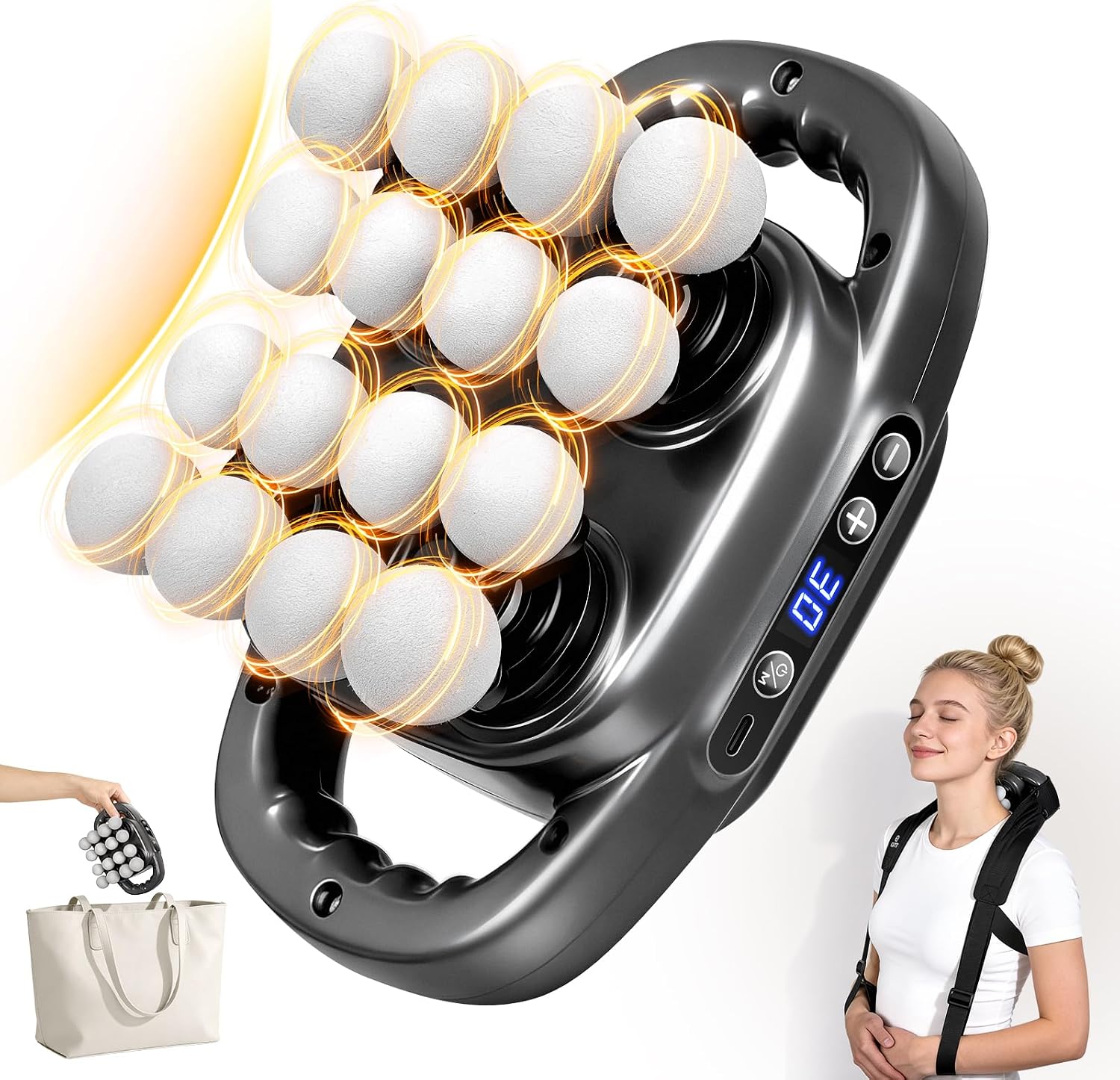
Compact pick: UOTT Mini Curved 16-Head Massage Gun Deep Tissue, Ergonomic Back Massager
 Visit on Amazon →
The curved body is the reason this one earns a spot in the routine. A straight-barrel gun is awkward on your own upper back and lats, because you end up reaching over your head at a bad angle and losing control of the head. The curved shape lets your hand sit lower while the head lands on the muscle beside the spine, which is where the tension lives after a long day in a jersey. It comes with 16 head options, so you can match the attachment to the area instead of making one head do everything. Check current Amazon price.
Caveat: minis trade amplitude for size. A compact gun is great for the back, shoulders, forearms, and travel, but don't expect it to feel like a full-size unit on a big quad. Use it as the second gun or the travel gun, and let it do the reaching your full-size gun can't.
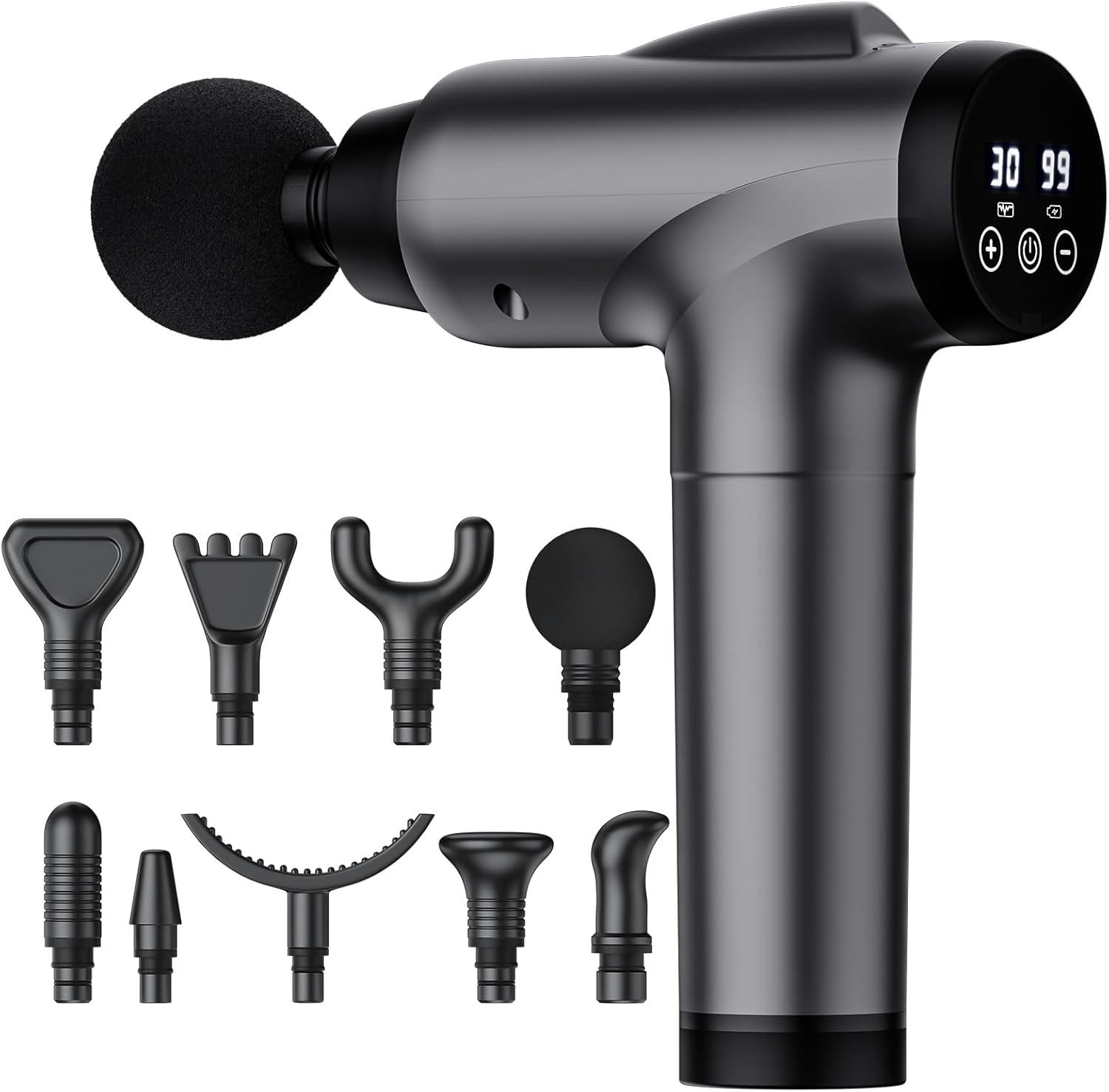
All-rounder pick: OLsky Massage Gun Deep Tissue 30 Speeds 9 Attachments Handheld (Grey)
 Visit on Amazon →
This is the gun I'd hand someone who wants one device for the whole body. It's a full-size handheld with 30 speed settings and 9 attachments, and the grip is comfortable enough for a two-minute pass on each quad without your hand cramping halfway through.
The low end of the speed range is what matters here. The day after a long ride you want slow, wide strokes, not a jackhammer, and a wide speed range makes it easier to find the setting where you feel the thump in the muscle rather than the skin. The nine attachments cover almost every muscle group, and the ball and flat heads will handle most of what you do. Check current Amazon price.
Caveat: 30 speeds is more granularity than anyone needs. You'll find three or four settings you like and never touch the rest. That's fine, just don't buy it for the number.
The routine, step by step
Step one: Decide the goal before you turn it on. Before a ride or a lift, the gun is a warmup tool: low speed, 30 to 60 seconds per muscle belly, just enough to wake the tissue up. After activity, it's a recovery tool: slower passes, about two minutes per muscle belly. Don't blend the two into one long session.
Step two: Pick the head first. Ball head for quads, glutes, hamstrings, calves, and lats. Flat head for broad areas like the mid-back. Small heads for forearms and the arch of the foot. Swapping heads takes five seconds; using the wrong one for ten minutes is how people end up sore in a brand new place.
Step three: Start at the lowest speed. Always. Find the setting where you feel the thump in the muscle and not in the skin, then stay there. Most people never need to go past the middle of the range.
Step four: Let the gun do the work. Rest it on the muscle and let the stroke travel. If you have to lean your body weight into it to feel anything, you're past what the motor can hold and past what the tissue wants.
Step five: Keep it moving. Glide slowly along the length of the muscle belly, roughly an inch per second. Parking the head in one spot is how you get a bruise instead of recovery.
Step six: Muscle bellies only. Never on bone, joints, or the spine. Not on the front of the neck. Not over a bruise, a swollen joint, or an area that's numb. That's not a disclaimer, that's anatomy.
Step seven: Cap the session. Ten to fifteen minutes total. More time is not more recovery.
Step eight: Move afterward. Five minutes of easy spinning, a walk around the block, or a few slow stretches. The gun gets blood moving; movement is what finishes the job.
How I'd split these two guns across a training week
If you own both, give them separate jobs. Long ride on Saturday: the full-size handheld goes on the quads and glutes Saturday evening and again Sunday morning, two minutes per muscle belly at low speed. Weekday desk stiffness and upper back: the compact curved gun, because the shape reaches the muscles beside the shoulder blades without you contorting to get there. Travel or race weekend: the mini goes in the bag and the full-size stays home.
If you're only buying one, pick by complaint. Legs are your problem, go full-size. Back and shoulders are your problem, go compact.
What not to expect
A massage gun is a recovery and warmup tool. It doesn't fix an injury, it doesn't break up scar tissue, and it doesn't replace sleep, food, or an assessment from a professional. If something hurts for more than a few days, or a joint is swollen, that's a person's job, not a motor's.
Don't chase the biggest numbers on the box either. RPM printed in giant type is marketing. Amplitude and stall force are the specs that decide whether the tool does anything at all.
What this costs over a year
Both guns here sit in the budget-to-mid tier, so the math stays simple. Whatever you pay, divide it by the number of sessions you'll actually do. Three sessions a week for a year is roughly 150 uses. That's the number that matters, not the sticker on the box. Check current Amazon price before you commit, and buy the gun you'll actually keep within arm's reach of the couch, because the best routine in the world fails if the tool lives in a closet.
Common questions
How long should you use a massage gun on one muscle?
About two minutes per muscle belly for recovery, and 30 to 60 seconds for a warmup. Keep the whole session between 10 and 15 minutes. Longer sessions don't recover you faster, they just irritate tissue.
Should you use a massage gun before or after a workout?
Both, but differently. Before, use low speed and short passes to wake the muscle up. After, go slower and longer to move blood through tissue that's already tired. Same gun, two different jobs.
Can a massage gun replace stretching?
No. It can make a muscle feel looser for a few minutes, but range of motion comes from moving through range. Use the gun, then stretch or ride easy.
The short version
Buy a gun with real amplitude, a stall force that holds when you press, and a noise level you can live with at the speed you'll actually use. Learn the four attachments that matter. Spend 10 to 15 minutes on muscle bellies after the hard days, and 30 to 60 seconds per muscle before the big ones.
That's the routine. It isn't glamorous, it doesn't need an app subscription, and it works with either of the two guns above. Your body does the fixing. The gun just helps it get there.