A deep tissue massage gun is one of the few recovery tools that does something you can feel immediately: rapid percussive taps that get blood moving through a muscle belly after a hard ride, a heavy lift, or a long day on your feet. The problem is buying one. Product pages lead with strokes per minute printed in giant type, toss around phrases like therapy grade, and rarely publish the two numbers that actually decide whether a gun holds up under your hand: amplitude, which is how deep the stroke travels, and stall force, which is how much pressure the motor takes before the stroke quits.
That gap is why two guns that look identical in a search result can feel completely different in your hand. This explainer walks through four currently available percussion massagers, what each one offers on paper, and how to decide which set of features fits the way you train and recover.
Related: Massage Gun Amplitude and Stall Force, Explained →
Quick answer
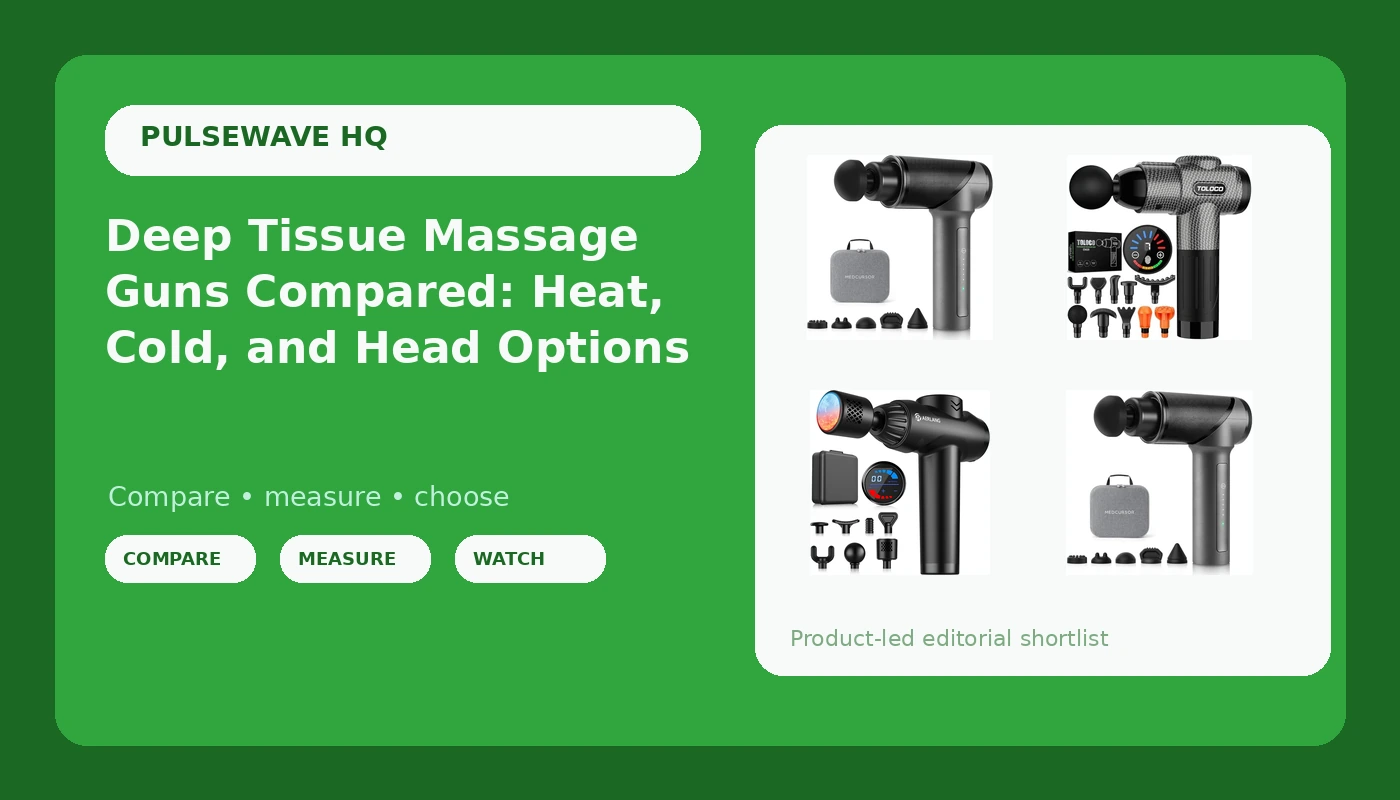
Decide on amplitude and stall force first, then on the features you will genuinely use. Of the four models here, the TOLOCO kit lists the most massage heads, the AERLANG is the only one that advertises heat and cold modes, and the two Medcursor guns are the same tool in two finishes, each with six heads. None of these listings publish amplitude or stall force in the product name, so check the current detail page for those numbers before you buy, and treat RPM as a secondary spec rather than the headline.
Four useful options
| Model | Best fit | What stands out |
|---|---|---|
| TOLOCO Massage Gun, Carbon | Anyone who wants a different head for every muscle group | Ten interchangeable massage heads and a brushless motor the brand describes as silent |
| AERLANG Massage Gun with Heat and Cold | Sessions where you want temperature as well as percussion | Heat and cold modes built into the same handheld tool |
| Medcursor Massage Gun (Gray) | A first massage gun, or a gift, in a neutral finish | Six massage heads and a high intensity brushless motor |
| Medcursor Massage Gun (Black) | The same tool as the gray version, in a darker finish | Six massage heads and a high intensity brushless motor |
Most head options: TOLOCO Massage Gun, Carbon
Ten heads sounds like padding until you think about how you actually use a gun. A large ball head covers quads and glutes. A flatter head spreads pressure across the back. A fork or wedge shape lets you work along a muscle without rolling onto bone, and a smaller head gets into the forearms and calves. A kit with ten shapes means less improvising with the wrong tool. The trade-off is storage, and the honest reality that most people settle on two or three favorites. The brushless motor is described as silent, and quieter motors generally mean you will reach for the gun more often at home.
Heat and cold: AERLANG Massage Gun with Heat and Cold
Heat and cold are the reason to look at this one. Percussion alone is a mechanical input; adding temperature gives you a second variable, and a warm muscle often feels more willing to move before activity, while a cooler setting can feel better once you are finished. The caveat is that combination tools usually make a trade-off somewhere, whether in weight, head selection, or how the temperature is delivered, so read the current listing details closely. If you know you only ever want percussion, you would be paying for a mode you will not use.
The gray version: Medcursor Massage Gun (Gray)
This is the uncomplicated option: six heads, a brushless motor, and a handle shape meant for one-handed use on your own back and legs. Six heads is enough to cover the shapes most people need, so you are not giving up much by skipping the larger kits unless you like having a specific head for every area. Because the two Medcursor listings here are the same tool in different colors, the decision between them comes down to finish and which listing is currently available, not to any difference in how they work.
The black version: Medcursor Massage Gun (Black)
Identical hardware to the gray version, in black. If you are buying a gift, the finish is often the deciding factor, and a darker body tends to show scuffs and hand oils less obviously than a light one. Otherwise, treat these as one product with two colorways: compare the two listings, see which one ships sooner or includes what you want, and pick on that basis rather than on any imagined performance gap between them.
Prices and availability may change. Product images, names, and retailer links must be matched by verified ASIN. Do not state a current price, rating, stock status, or measured result without current evidence.
Why amplitude and stall force matter more than RPM
Amplitude is stroke length in millimeters. It describes how far the head travels on each cycle, which is what determines whether the tap stays near the surface or reaches into the belly of a large muscle. Ten millimeters is a light, surface-level feel. Sixteen millimeters is deep tissue territory. Most cheap guns sit somewhere in the middle and do not say so.
Stall force is how much pressure the motor can absorb before the stroke stops moving. This is the spec that separates a massage gun from a buzzer. A gun with modest stall force feels fine when you glide it over a calf, then dies the moment you lean into a tight quad or a hamstring, which is exactly when you wanted it. RPM, by contrast, is strokes per minute, and it is the number brands print largest because it is the easiest to inflate. High RPM with shallow amplitude just means fast tapping that never gets anywhere.
When a listing does not publish amplitude and stall force, that absence is information. Look for the numbers in the specification table, in the manufacturer's own documentation, or in detailed reviews that mention how the gun behaves under load. If you cannot find them anywhere, assume the gun is built for light use and price your expectations accordingly.
What heat, cold, and extra heads actually add
Heat and cold are comfort features. Warming tissue before activity can make movement feel easier, and a cooler surface can feel soothing afterward. What temperature does not do is replace the mechanical work of percussion, and the evidence for temperature as a recovery intervention on its own is mixed. A tool that offers both simply saves you from owning two devices, which is a convenience argument rather than a performance one.
Head count is a fit argument, not a power argument. The shapes that matter most are a large ball for big muscle bellies, a flat head for broader surfaces, a fork or wedge for working along a muscle without hitting bone, and a small head for forearms, calves, and feet. Four shapes cover the vast majority of use. Ten shapes mean you rarely have to improvise, and six is a comfortable middle ground. More heads do not make a gun stronger.
If you want a repeatable way to choose between models, work through these steps in order:
- List the areas you will actually treat, and how much pressure you tend to apply. Heavy pressure on big muscles demands more stall force than a light pass over the shoulders.
- Hunt for amplitude and stall force on the current listing. If a brand hides them, treat that as a signal about who the gun is built for.
- Decide whether heat and cold belong in your routine. If you will not use temperature, do not pay for it.
- Count the head shapes you will use, not the number in the box. Ball, flat, fork, and small covers most needs.
- Check the noise description and the battery claim, then confirm the return window before you commit. A gun you avoid using because it is loud is a paperweight.
Using a percussion massager sensibly
- Work muscle bellies only. Never run the head over bone, joints, or the spine. That is anatomy, not a legal disclaimer.
- Keep each area short, roughly one to two minutes, then move on.
- Start at the lowest speed and lightest pressure, and add intensity only if it still feels comfortable.
- If the motor stalls under your hand, back off. A stall is a signal about the tool and your pressure, not a challenge to push through.
- Skip the area entirely over bruises, swelling, or anything a clinician is already treating, and ask a professional about pain that does not settle.
Which option should you choose?
Choose the TOLOCO Massage Gun, Carbon when you want the widest selection of head shapes and a motor the brand describes as silent. Choose the AERLANG Massage Gun with Heat and Cold when temperature matters to your routine and you would rather not own a separate heat or cold device. Choose the Medcursor Massage Gun (Gray) or the Medcursor Massage Gun (Black) when you want a simple six-head percussion tool and are choosing between two finishes of the same product.
One caveat applies to all four: none of these listings publish amplitude or stall force in the product name, so the numbers that matter most for deep tissue work have to be confirmed on the current detail page before you buy. If you cannot find them, plan for lighter use than a dedicated deep tissue session would require.
The bottom line
A massage gun helps your body recover so it can do the fixing, and it works best as a warmup and recovery tool rather than a treatment for an injury. Match the tool to the job: the TOLOCO kit wins on head variety, the AERLANG adds heat and cold, and the two Medcursor guns are one straightforward six-head design in two colors. Whichever you pick, verify amplitude and stall force on the live listing, keep the pressure moderate, and stay on muscle bellies. That combination matters far more than the RPM number on the box.