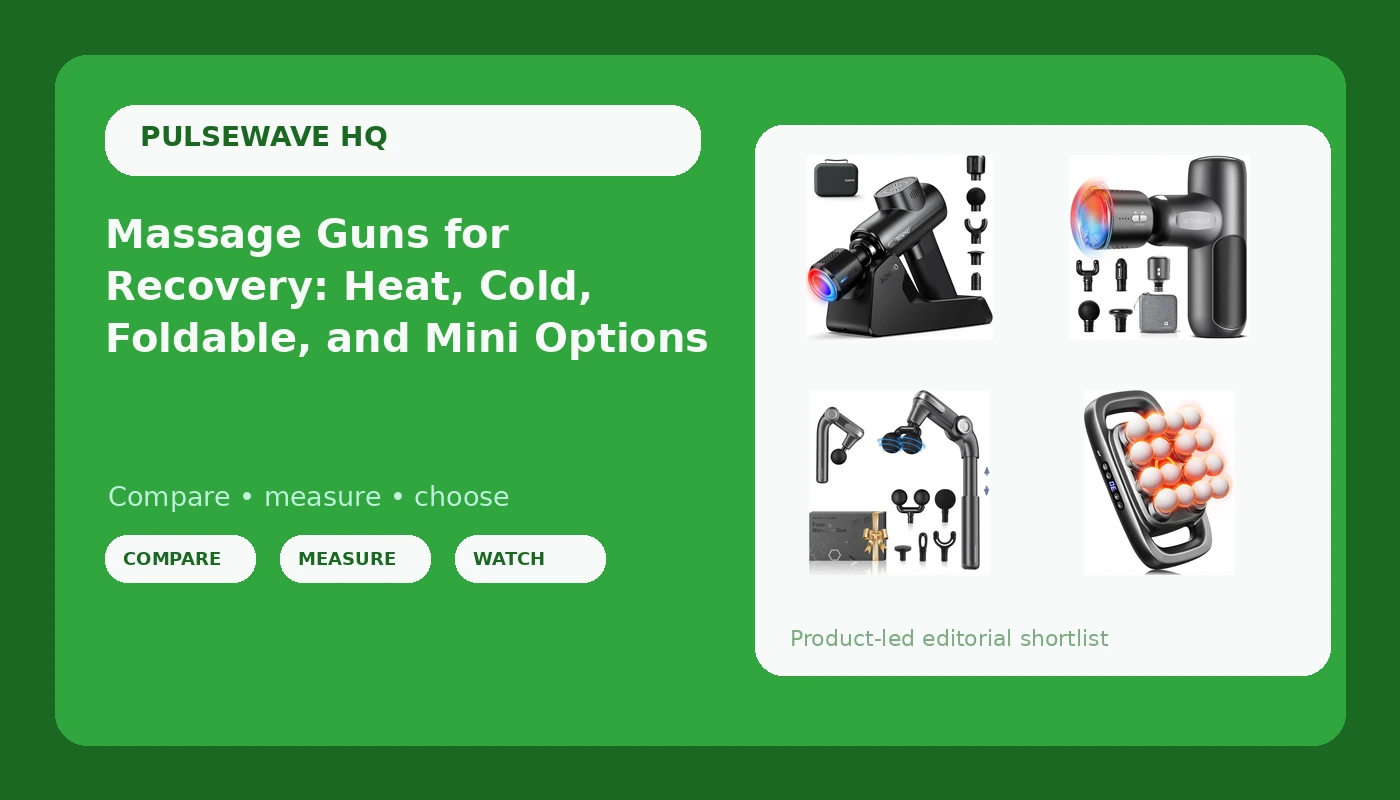
Massage guns for recovery have settled into a handful of recognizable shapes: a full-size unit that lives on a charging stand, a folding frame that travels, a kit with a head for every muscle group, and a mini that disappears into a gym bag. The problem is that the category sells itself on the wrong numbers. Boxes shout about strokes per minute while the two specs that decide whether a gun does anything useful, amplitude and stall force, sit in the fine print or nowhere at all. This is an explainer rather than a ranking: four current listings, what each shape is actually built for, and how to work out which one fits the way you train.
Related: How to Use a Massage Gun Without Overworking a Muscle →
Quick answer
Match the gun to the job before you match it to a budget. If you want heat and cold built into the same tool and a stand that keeps it charged and visible, look at the RENPHO Active Thermacool Deluxe. If you want something that folds flat for a gym bag or a carry-on, the KingPavonini foldable model is the shape to compare. If you want to experiment with different contact shapes, the 16-head set offers far more head variety than anything else here. If you want a small gun for arms, calves, and travel, the arboleaf Mini is the smallest option in this group. None of these are treatment devices. They are recovery and warmup tools.
Four useful options
| Model | Best fit | What stands out |
|---|---|---|
| RENPHO Active Thermacool Deluxe Massage Gun with Charging Stand, Heat, Cold | Heat and cold in one tool | Charging stand plus heat and cold functions |
| KingPavonini Foldable Massage Gun Deep Tissue, Grey, Model JA-G7 | Travel and tight storage | Folding body |
| 16-Head Massage Gun Set for Deep Tissue Massage, 3 Modes | Trying different contact shapes | 16 interchangeable heads and 3 modes |
| arboleaf Mini Massage Gun, Deep Tissue Percussion Massager Back Pain Relief | Small muscle groups and portability | Mini format |
The heat and cold option: RENPHO Active Thermacool Deluxe Massage Gun with Charging Stand, Heat, Cold
The trade-off here is weight and footprint. A full-size gun with a stand is the one you leave plugged in next to the couch or the foam roller, and that is genuinely useful, because the gun you can reach without thinking about it is the gun you actually use. Heat and cold are comfort features rather than performance specs: warmth can make a muscle feel readier to move, and cold can take the edge off a hot spot after a long session, but neither one changes the fact that percussion is a surface-level stimulus. The stand also means this is the least travel-friendly option of the four.
The foldable travel option: KingPavonini Foldable Massage Gun Deep Tissue, Grey, Model JA-G7
The folding hinge is the entire pitch, and it solves a real problem: most full-size guns are shaped like a handgun with a permanently extended barrel, which makes them awkward in a bag. A gun that folds stores in a fraction of the space and is far more likely to make the trip to a trailhead or a hotel room. The thing to check before buying any folding gun is whether the hinge introduces any wobble under load, because a frame that flexes when you lean into a quad wastes stroke length. That is a question about build quality you can only answer by handling the unit, not by reading the box.
The attachment-heavy option: 16-Head Massage Gun Set for Deep Tissue Massage, 3 Modes
Head shape does more than most people expect. A flat head spreads force across a broad area, a bullet head concentrates it into a small target, and a fork or wedge head works differently again around the edges of a muscle belly. Sixteen heads is more than anyone needs in a single session, but if you are still working out which contact style your body responds to, a kit lets you test the question cheaply. The counterargument is clutter: small attachments get lost, and a drawer full of heads you never use is not a feature. If you already know you like a round ball head and nothing else, this is not the pick for you.
The mini option: arboleaf Mini Massage Gun, Deep Tissue Percussion Massager Back Pain Relief
Small guns make a specific trade: they give up depth and stall force in exchange for portability, and that is usually the right trade for forearms, calves, and feet, where you do not need a deep stroke and you do need the tool to be within arm's reach. It is usually the wrong trade for a full back or a set of quads that just did thirty miles, because a light gun pressed into a big muscle group tends to stall rather than thump. One important note on the product name: percussion guns are recovery and relaxation tools. They do not treat back pain, injuries, or anything else, and a name on a listing does not change that.
Prices and availability may change. Product images, names, and retailer links are matched to verified listings. No current price, rating, stock status, or measured result is stated here without current evidence.
Amplitude, stall force, and the numbers that actually matter
Amplitude is stroke length, measured in millimeters: the distance the head travels on each cycle, which is roughly how deep the thump reaches into tissue. Around 10mm is a light, buzzy feel that mostly moves the surface. Around 14 to 16mm is deep tissue territory where the percussion actually gets into a large muscle belly. Amplitude is the single most useful number on a spec sheet, and it is frequently missing.
Stall force is how much pressure the motor can absorb before the stroke stops cycling. This is the spec that separates a massage gun from a vibrating toy. Every gun feels fine when you hold it in the air. The difference shows up the moment you press it into a hamstring: a weak motor stops reciprocating and just buzzes against the skin, which is useless and mildly annoying. A gun with real stall force keeps its stroke under load, which is exactly what you need on big, dense muscle groups.
Strokes per minute, the number brands print largest, means very little on its own. A high rate with a shallow amplitude is a surface vibration. A moderate rate with a deep amplitude is a real percussive tool. Two guns with identical RPM numbers can behave completely differently.
Two more specs matter in daily use. Noise decides whether you will actually use the gun while watching television or in a shared gym, and a gun that is too loud to run becomes a paperweight regardless of how strong it is. Battery behavior under real sessions matters more than a lab figure, because recovery work happens in ten to twenty minute blocks, often several times a week, and a gun that dies mid-week is a nuisance. Neither number is reliably printed on a box, so treat both as things to verify in reviews that describe sustained use rather than first impressions.
How to narrow the field
- Name the muscle groups you actually train. Big quads, glutes, and back muscles want amplitude and stall force. Forearms, calves, and feet do not.
- Decide where the gun lives. A stand on the floor next to the couch is a different product decision than something that has to fit in a gym bag.
- Check whether amplitude and stall force are published at all. If a listing leads with strokes per minute and never mentions stroke depth, that tells you something.
- Think about noise at the speed you will realistically use, not at the maximum setting you will touch once.
- Decide whether temperature or head variety solves a problem you actually have, or whether it is a feature you would pay for and never touch.
Using one without overdoing it
- Keep the head on muscle bellies only, never on bone, joints, or the spine. That is anatomy, not a legal disclaimer.
- Work in short passes, roughly thirty to sixty seconds per area, then move on rather than camping on one spot.
- Use light pressure at first. More pressure is not more recovery, and a gun that stalls is telling you to back off.
- Treat it as a warmup tool before activity and a recovery tool afterward, not as a substitute for sleep, food, and easy movement.
- If something hurts in a way that does not settle down, that is a conversation with a clinician, not a setting on a device.
Which option should you choose?
Choose the RENPHO Active Thermacool Deluxe Massage Gun with Charging Stand, Heat, Cold when you want one tool that covers heat, cold, and percussion, and you have a permanent spot for a stand. Choose the KingPavonini Foldable Massage Gun Deep Tissue, Grey, Model JA-G7 when storage and travel are the deciding constraints and you want a deep tissue format that folds down. Choose the 16-Head Massage Gun Set for Deep Tissue Massage, 3 Modes when you are still figuring out which contact shape works for you and want the variety to experiment. Choose the arboleaf Mini Massage Gun, Deep Tissue Percussion Massager Back Pain Relief when your priority is a small, portable gun for arms, calves, and travel days.
The honest caveat: amplitude, stall force, and noise are the specs that decide whether a gun works for you, and those numbers are not consistently published across this category. Where a listing does not state them, the responsible move is to check the manufacturer's own documentation and read sustained-use accounts before buying, rather than assuming that a higher price or a bigger number on the box means a better tool.
The bottom line
All four of these are recovery and warmup tools, and the right pick depends far more on your body and your routine than on any spec sheet headline. If you train big muscle groups and want the gun to live in one place, a full-size unit with a stand and temperature functions is the most convenient shape. If you are on the move, a folding frame or a mini makes more sense than raw power you will never use at home. Whichever you choose, buy for amplitude and stall force first, treat noise as a real feature rather than an afterthought, and keep the head on muscle bellies. A gun does not fix anything. It helps your body do the fixing.