I spend my weekdays in a sports rehab clinic in Denver, working with everyone from pro cyclists to weekend warriors who came back from a crash too fast. I spend my weekends on an enduro bike, which means every long Saturday ride turns into a Sunday spent negotiating with my own quads. That combination taught me something that took years to sink in: recovery is a skill, not a product. The tool just makes the skill easier to practice.
That is the lens I bring to this comparison of massage guns for muscle recovery. I have owned more than twenty guns, watched a cheap one stall out on a patient's hamstring mid-session, and watched an expensive one rattle a rider's hand numb at max speed. So when I line up four recovery tools, I am not ranking them by the numbers printed biggest on the box. I am ranking them by what they will actually do in your living room at 9 p.m. after a hard day.
Related: Percussive Therapy Basics: What A Massage Gun Can And Cannot Do
If you want one tool for post-ride legs, shoulders, and back, the NAPRE Foldable Massage Gun is the most versatile pick here, because the extension handle and five adjustable angles let you reach your own upper back without dislocating a shoulder. The FVZ is the lighter, simpler alternative with the same reach idea, the Sharper Image Powerboost Move is the one that disappears into a gym bag, and the TheraFlow Foot Roller is not a massage gun at all, it is a targeted tool for feet and arches. Buy accordingly.
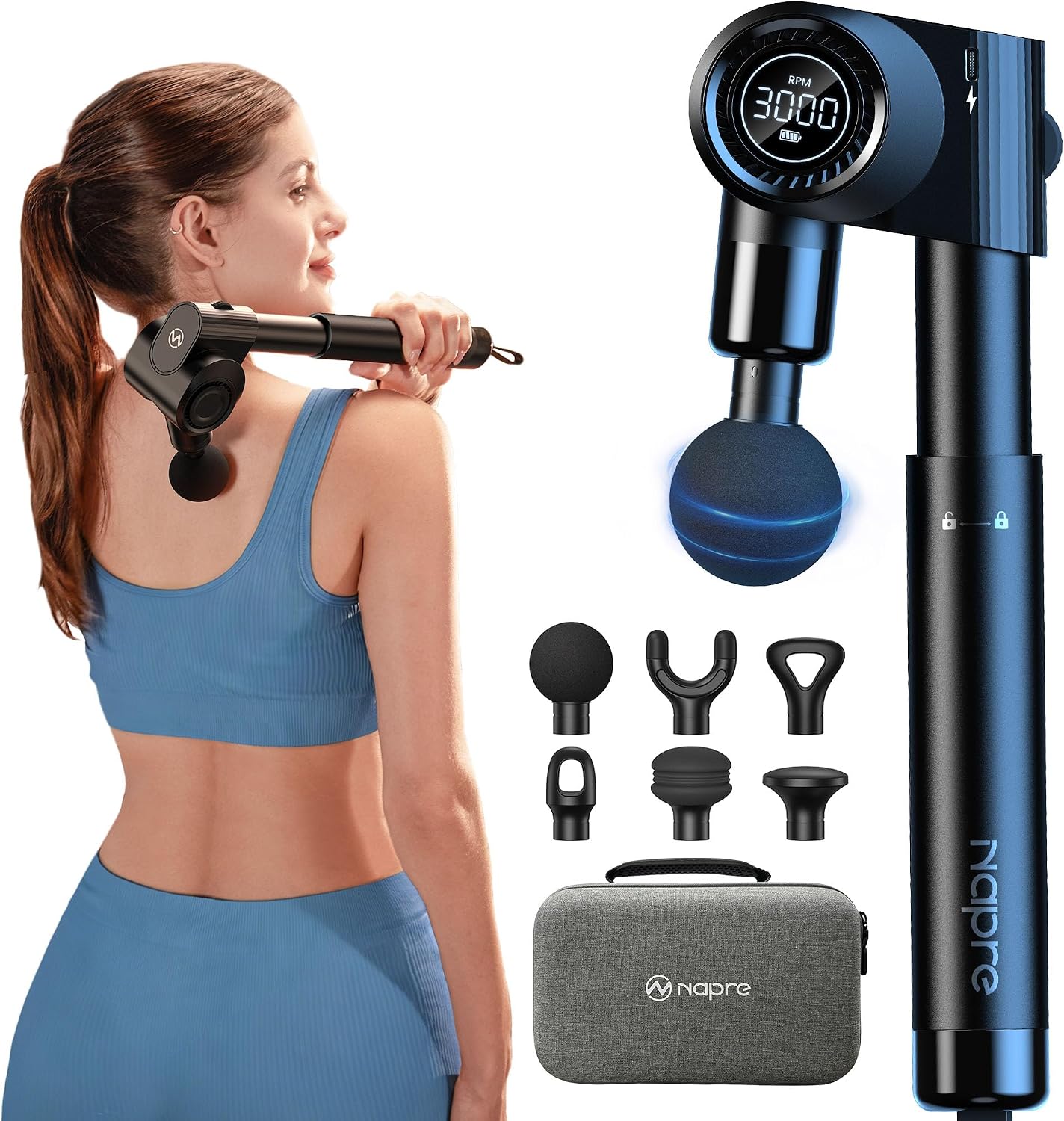
NAPRE Foldable Massage Gun with Extension Handle
Folds and adjusts through 5 angles, 32 speeds, 6 heads, and a case, so one tool covers back, neck, and legs
The most complex tool here, and the one with the most parts to lose
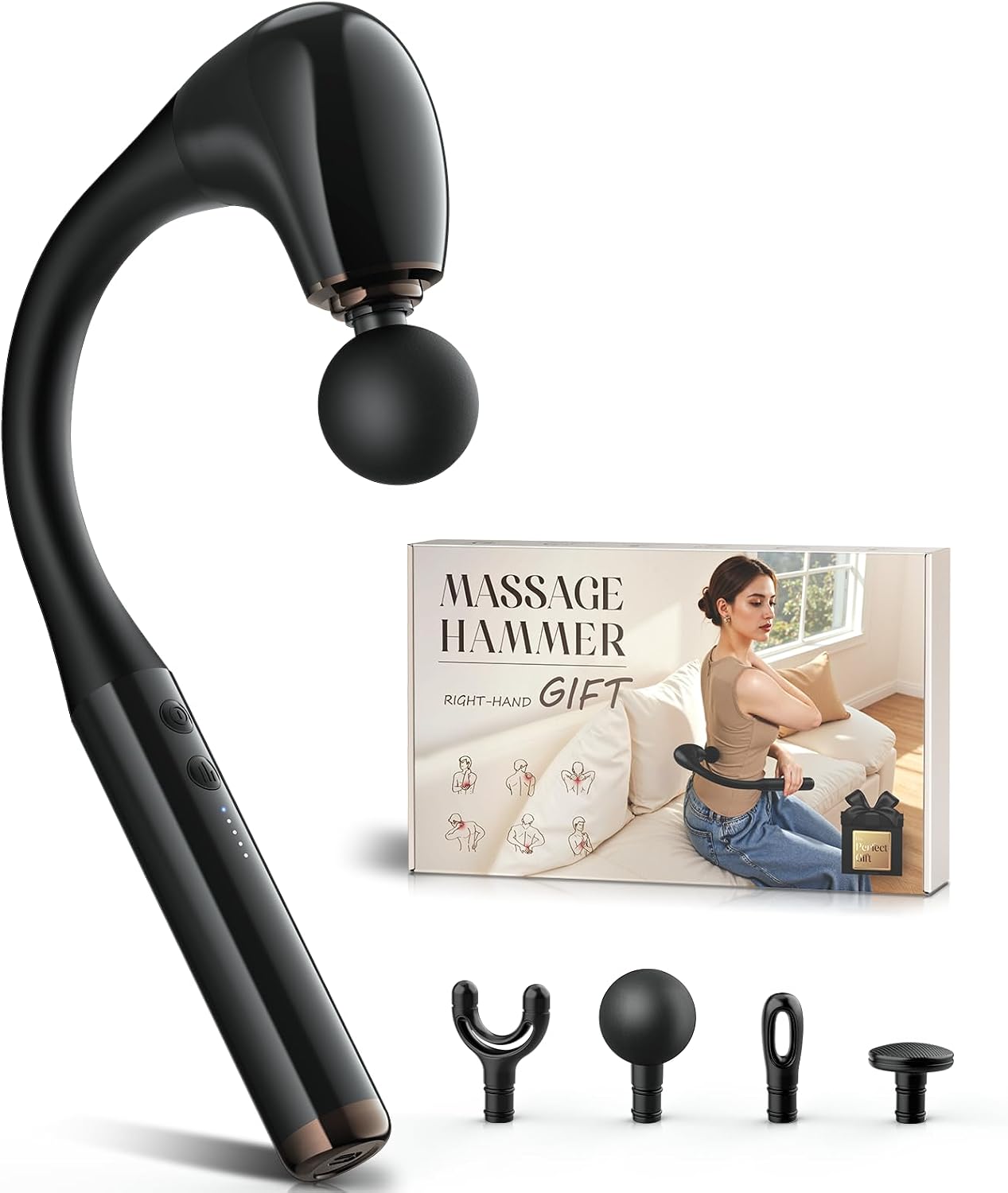
FVZ Massage Gun with Upgraded Extension Handle
Extension handle for back reach, listed 10MM amplitude, and a straightforward single-purpose design
Fewer heads and speeds than the NAPRE, so less to fine-tune with
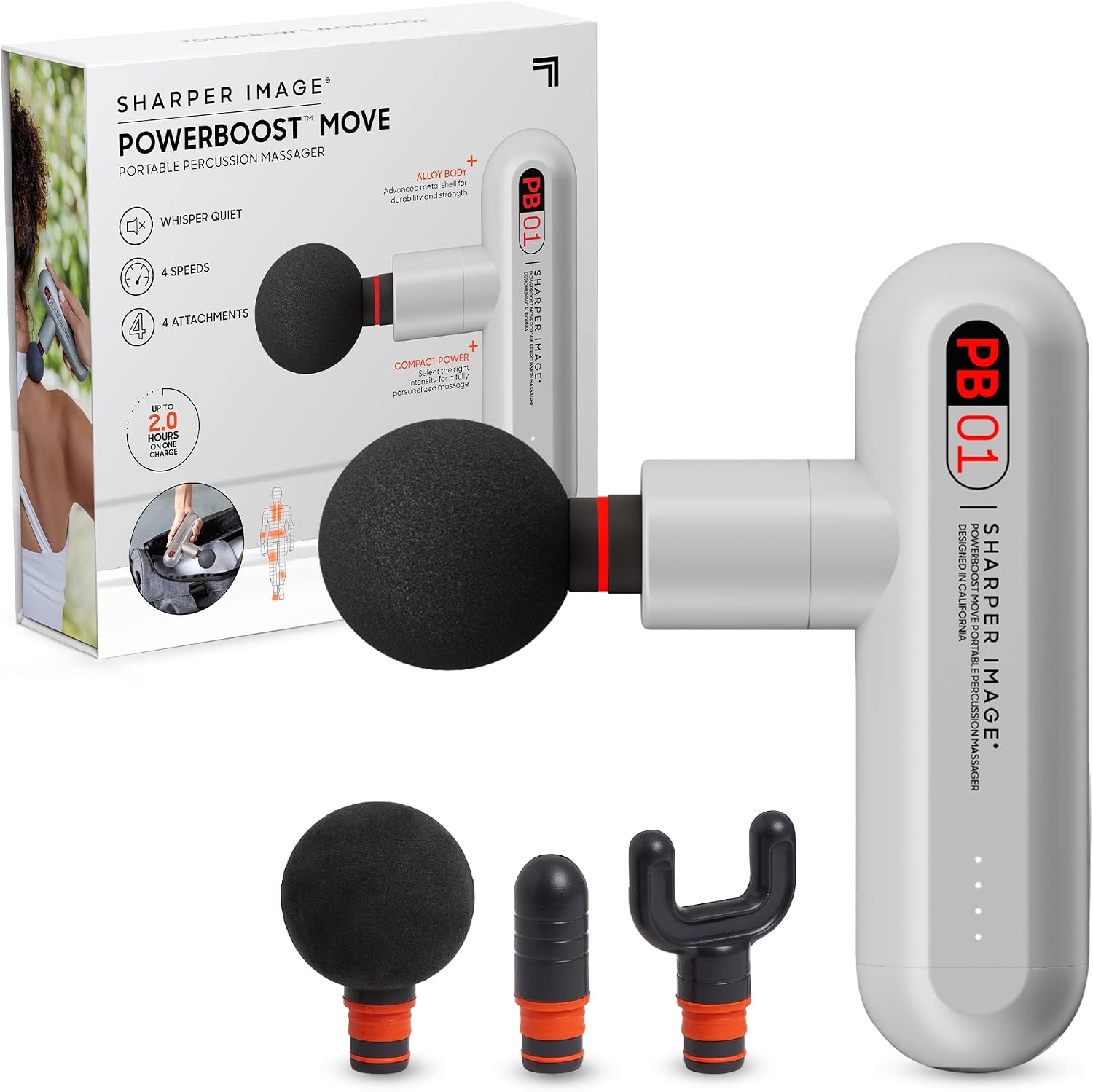
Sharper Image Powerboost Move Mini Percussion Massage Gun
Small, travel friendly, FSA eligible, and easy to hand to a beginner
Mini format means less reach and less headroom for big muscle groups
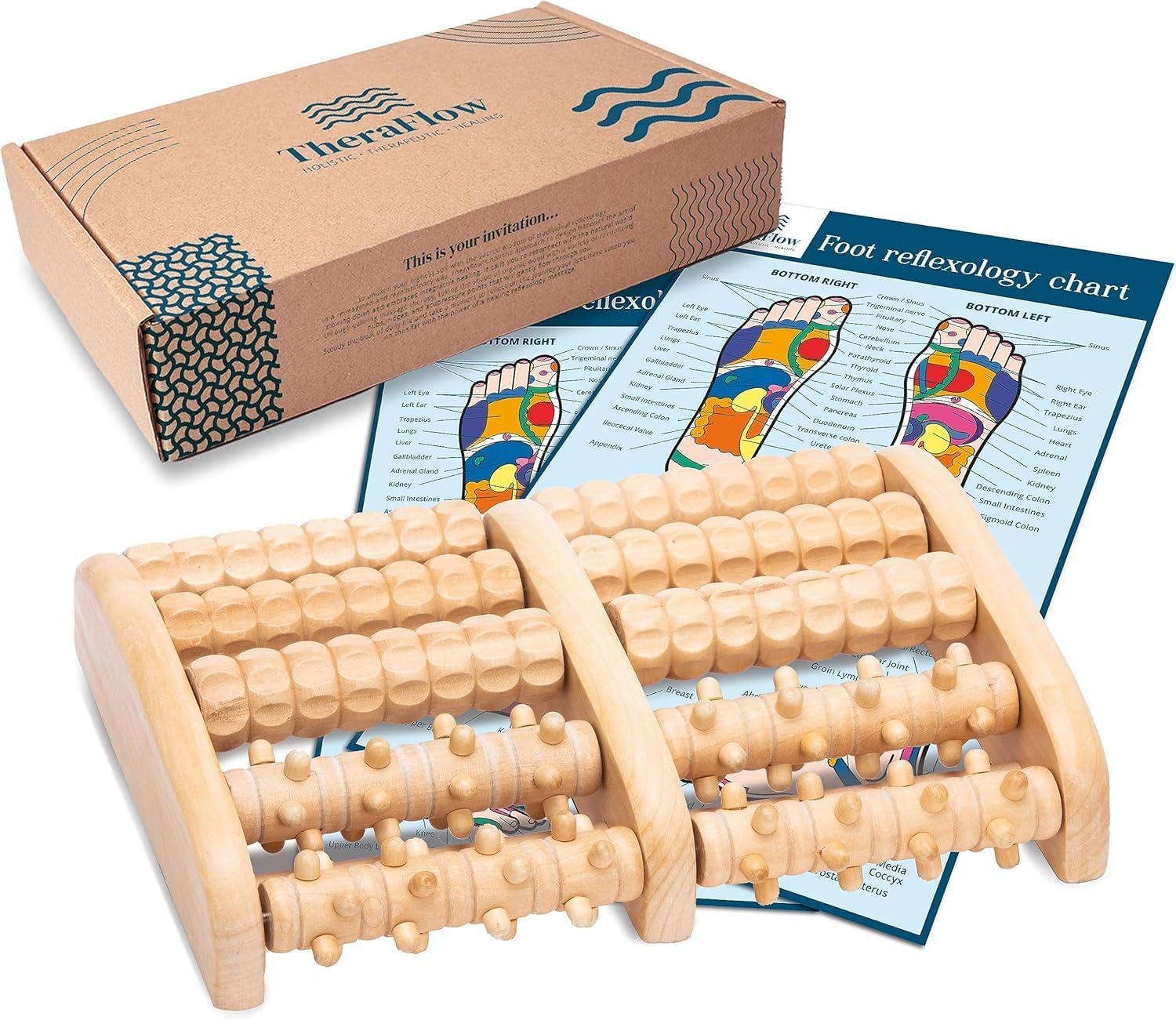
TheraFlow Foot Massager and Wooden Foot Roller
No battery, no charging, no motor to die, plus a reflexology chart in the box
Only works on feet, and it is manual, so you do the work
Prices and availability were captured from Amazon Creators API and may change.
How I judge a recovery tool
Four things decide whether a tool stays in my bag or ends up in the donation pile.
Stall force. This is how much pressure the motor can take before the stroke stops moving. It is the single spec that separates a massage gun from a buzzer. Press a weak gun into a tight quad and the head stops thumping and just vibrates against your skin. That is the moment I have seen derail a patient's session. If a listing does not talk about stall force at all, that tells you something.
Amplitude. Amplitude is stroke length in millimeters, the depth of the percussive thump. Light amplitude stays near the surface and feels pleasant. More amplitude reaches into the belly of a big muscle. RPM gets printed in huge letters on the box, and it means almost nothing without amplitude behind it. A gun can tap 3,000 times a minute at 6mm and never touch the tissue that is actually tight.
Noise at the speed you will really use. Most people buy a gun, run it at max for two sessions, then settle at speed two or three because max is uncomfortable and loud. So the only noise number worth caring about is the one at the middle speeds, at arm's length. If a gun is too loud to use while your partner watches television, it becomes an expensive paperweight.
Fit and reach. This is the unglamorous one. A gun you cannot hold comfortably on your own upper back is a gun you will not use on your upper back. That is why extension handles and folding designs exist, and why they matter more than most buyers expect.
One boundary before we go further: percussive therapy helps blood move through a muscle belly and helps you feel looser before and after effort. It does not treat injuries. Muscle bellies only, never bone, joints, or the spine. That is anatomy, not a disclaimer.
The NAPRE Foldable Massage Gun
The NAPRE is the most flexible tool in this group, and the reason is mechanical rather than electronic. It folds, it has an extension handle, and it locks into five adjustable angles. If you have ever tried to massage your own traps by reaching over your shoulder with a straight-bar gun, you understand why that matters. You can angle the head onto your upper back, hold the handle with a relaxed grip, and actually let the tool do the work instead of fighting your own shoulder.
On paper it is also the most configurable: 32 speeds, six heads, and a case. Thirty-two speeds is more than anyone needs, but the practical benefit is that you can find a genuinely gentle setting for a tender area and a firmer one for a big muscle group, without jumping between only four coarse steps.
Where it gives ground is complexity. Folding mechanisms, angle locks, and six interchangeable heads are all things that can loosen, get lost, or rattle over time. If you want a tool you can toss in a bag without thinking about it, this is not that tool. If you want one device that can cover neck, back, shoulders, waist, and legs, it is the most complete answer here.
The FVZ Massage Gun with Extension Handle
The FVZ takes the same core idea, an extension handle for reaching your own back, and strips it down. The listing calls out a 10MM amplitude, which puts it in the moderate depth range, the kind that feels good on shoulders, calves, and forearms and will not beat you up on a tender spot. For most recreational riders and lifters, that is a sensible place to land. Deeper is not automatically better when you are using the thing on yourself after a long day.
The design is deliberately simple. One handle, one clear job, and the head reaches where your hands cannot. In a clinic setting I like tools with fewer failure points, because fewer failure points means fewer surprises. There is less to fine-tune here than on the NAPRE, and less to break.
The honest trade-off is adjustability. If you want to dial in a specific angle for a specific spot, or swap between a broad head and a pointed one for different areas, the FVZ gives you less room to work. It is a good tool for a person who wants one setting that works and does not want to think about it again.
The Sharper Image Powerboost Move
This is the travel gun in the group, and it is worth being clear about what a mini format buys and costs. It buys portability. It fits in a gym bag or a backpack, it comes with four attachments and four speeds, and it is FSA eligible, which matters if you are buying through a benefits account. It is also the easiest gun here to hand to someone who has never used one, because the speed range is short and the tool is light.
What it costs is reach and headroom. A mini gun has a shorter body, so getting it onto your own mid-back is an awkward reach. It also has less mass behind the stroke, which is exactly what you feel when you lean into a big quad or glute. That is not a defect, it is physics. A mini gun is a warmup and travel tool. It is not the tool I would choose for a 30-mile ride's worth of quad tension.
For a weekend trip, a hotel room, or a desk drawer at the office, it is genuinely useful, and the low learning curve makes it a reasonable gift for someone who is massage-gun curious but not ready to commit to a full-size unit.
The TheraFlow Foot Roller
This one is not a massage gun, and I want to be direct about that instead of pretending otherwise. The TheraFlow is a wooden foot roller with deep tissue and reflexology nubs, and it ships with a reflexology chart. You put it on the floor, you roll your foot over it, and you control the pressure with your own body weight.
That manual control is the entire appeal. There is no motor, no battery, no charging brick, and no stall force to worry about, because you are the motor. Roll lightly and it is a gentle warmup for stiff arches. Lean in and the nubs dig into the plantar surface of the foot. For anyone who spends all day on their feet, or who puts in long days in stiff cycling shoes, it is a practical thing to keep under the desk. It is also the kind of low-risk gift that does not require the recipient to learn a technique or charge anything.
The limits are obvious. It only works on feet, and it only works while you are sitting or standing there doing it. If your tightness lives in your calves, hamstrings, or shoulders, this tool will not touch it. It is a complement to a gun, not a replacement.
Trade-offs worth naming
Full-size with a handle versus mini. The NAPRE and the FVZ both solve the reach problem, which is the problem most people underestimate. Your back is the hardest part of your own body to work on, and an extension handle or folding angle is the difference between using the tool and giving up on it. The Sharper Image mini wins on portability and loses on both reach and depth.
Adjustability versus simplicity. The NAPRE has the most settings and the most parts. The FVZ has fewer of both. Neither is wrong. More settings help if you are working on several different areas and want a gentler option for a sore spot. Fewer settings help if you know you will never open the manual.
Powered versus manual. Every gun here needs a charge, and every gun here can be loud enough that you skip a session because of it. The TheraFlow never needs either. It also cannot work on anything except your feet.
One more thing about noise. Whatever you choose, use it at the speed you can tolerate for a full two minutes per area. A gun that only feels good at max is a gun you will use three times and then leave in a drawer. That is the failure mode I see most often, and it has nothing to do with the specs.
Who should buy which
Buy the NAPRE Foldable Massage Gun if you want one tool that covers your whole body, especially your back, and you are willing to keep track of a case and a handful of heads. It is the pick for someone who wants to be self-sufficient with recovery at home.
Buy the FVZ Massage Gun with Extension Handle if you want the reach without the complexity, and you are happy with a moderate depth and a simple control scheme. It is a good fit for a rider or lifter who wants a repeatable routine, not a menu of options.
Buy the Sharper Image Powerboost Move if portability is the priority and you are mostly using it for shoulders, arms, and legs after a workout or a day at a desk. It is also the easiest one to give as a gift.
Buy the TheraFlow Foot Roller if your feet are the complaint, or if you want a no-battery tool that will still work in five years. Honestly, if you are on your feet all day, this is the cheapest upgrade to your evening routine in this whole group.
And if you are new to all of this, start with one tool, not four. Learn what two minutes on a calf actually feels like before you spend money on depth and reach you may not need. The gun does not do the recovery. It just makes the twenty minutes you were already going to spend a little more effective.